
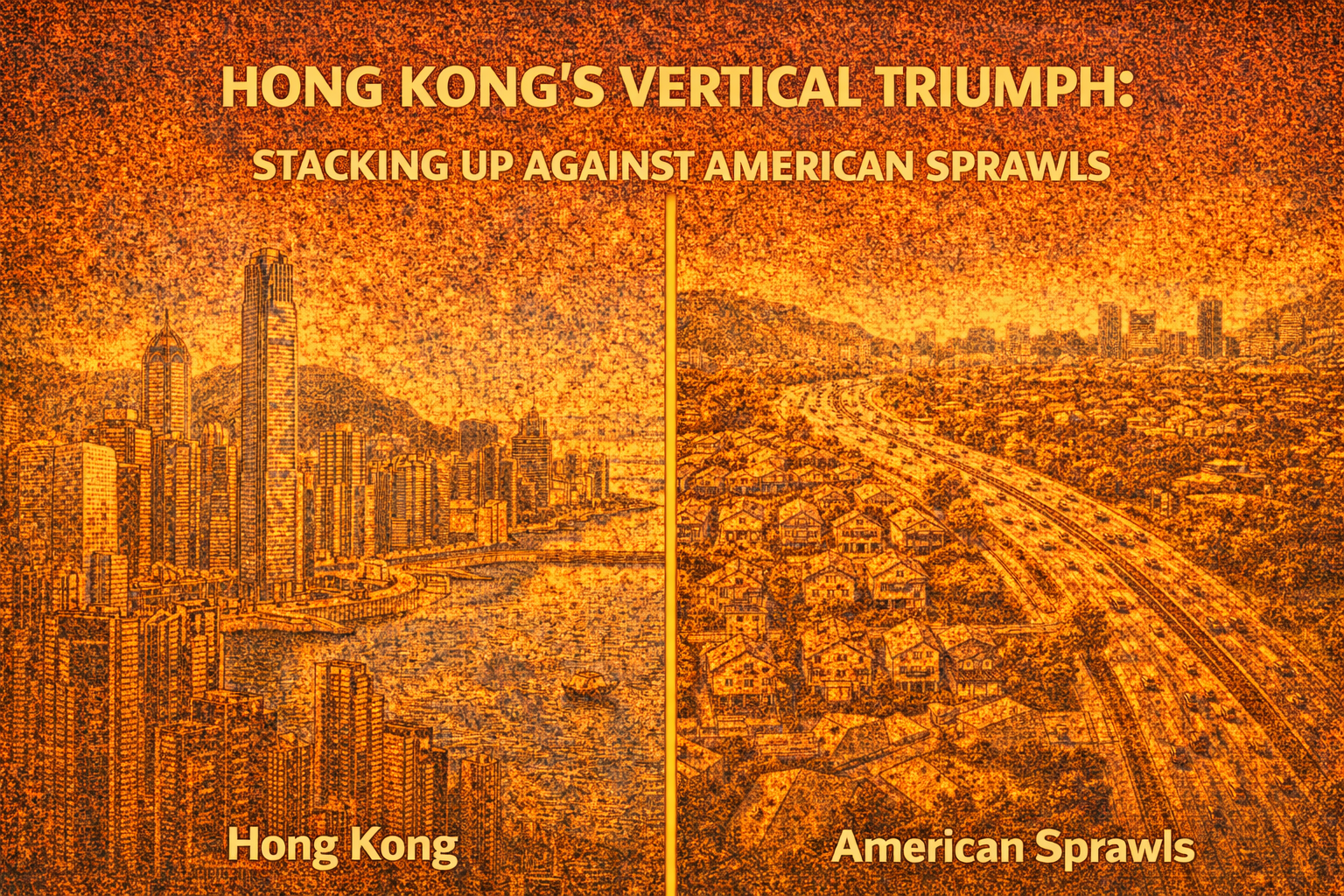

Hong Kong’s Vertical Triumph: Stacking Up Against American Sprawls
As I reflect on the contrasts between Hong Kong’s compact, transit-oriented urbanism and the sprawling, car-dependent layouts of American cities like San Francisco, Los Angeles, New York, Boston, Chicago, Atlanta, Miami, Dallas, New Orleans, and Washington D.C., it becomes clear that these dynamics offer fertile ground for Hollywood storytelling. Urban planning isn’t just backdrop; it can drive narratives on identity, inequality, ambition, and adaptation in a globalized world. Below, I outline how these elements could be woven into films, TV series, or limited series, proposing specific story ideas across genres. These suggestions emphasize the thematic depth of infrastructure as a character in itself, influencing plot, conflict, and character arcs without romanticizing or vilifying either model.
In action-thrillers, Hong Kong’s vertical density could juxtapose U.S. sprawl to heighten tension through mobility contrasts. Imagine a cyber-espionage film where a protagonist, a Hong Kong tech executive accustomed to seamless MTR commutes and high-rise surveillance, relocates to Los Angeles. The story unfolds as she uncovers a corporate conspiracy involving autonomous vehicle hacks that exploit L.A.’s freeway gridlock. Chases shift from HK’s crowded pedestrian tunnels—where crowds provide cover—to L.A.’s endless highways, symbolizing vulnerability in isolation. This highlights how HK’s integrated planning fosters communal resilience, while U.S. car reliance exposes individuals to targeted attacks. The upper class angle manifests in her status-symbol Ferrari, rarely driven in HK but weaponized in L.A., underscoring themes of adaptation and cultural dislocation.
For dramas exploring social mobility, a coming-of-age tale could contrast Boston’s historic, transit-patchy neighborhoods with HK’s efficient vertical hierarchies. A young architect from Boston’s working-class suburbs moves to Hong Kong for a skyscraper project, only to grapple with the city’s micro-apartments and elite enclaves like The Peak. The narrative probes how HK’s density compresses class interactions—elevator rides force encounters between tycoons and service workers—versus Boston’s zoned separations that entrench divides. Stories could culminate in a crisis, like a typhoon exposing infrastructure flaws, where the protagonist redesigns a hybrid model blending HK’s transit profitability with Boston’s green spaces. Upper-class reflections appear through HK elites who view cars as yacht-like luxuries, contrasting Boston’s affluent commuters in SUVs, revealing how planning shapes perceptions of success and isolation.
Sci-fi dystopias lend themselves to provocative extrapolations of these models. Envision a near-future series set in a climate-ravaged world, where Atlanta’s sprawling, flood-prone suburbs collapse, forcing refugees to a fortified Hong Kong-inspired megacity in the U.S. Southeast. The plot follows an upper-class family from Miami, used to gated estates and private jets, adapting to vertical communes with MTR-like hyperloops. Conflicts arise from equity issues: HK’s model, with its self-funding transit, becomes a blueprint for survival, but U.S. adaptations introduce surveillance overreach, echoing D.C.’s Metro funding woes. Stories could explore rebellions against density-induced overcrowding, with elites hoarding “status” autonomous pods—mirroring HK’s luxury cars—as symbols of fading individualism. This narrative straightforwardly critiques sustainability, showing how ignoring HK’s lessons accelerates environmental collapse.
Romantic comedies could lighten the theme with culture-clash humor. A film about a New York ad executive falling for a Hong Kong urban planner during a cross-cultural exchange program contrasts NYC’s chaotic subways with HK’s punctual MTR. Misadventures stem from her car-free lifestyle clashing with his reliance on Ubers in sprawling Chicago (a subplot detour), highlighting how infrastructure influences dating—HK’s walkable districts enable spontaneous encounters, while U.S. sprawl demands planned outings. The upper class is portrayed through HK’s elite using chauffeured services for discretion, versus NYC’s flashy limos, weaving in neutral observations on how density fosters intimacy but strains privacy. Resolution comes via a joint project reimagining New Orleans’ streetcars with HK efficiency post-hurricane, symbolizing blended futures.
In ensemble TV procedurals, like a crime series, Dallas’s highway-dominated expanse could foil HK’s compact grid for investigative contrasts. Detectives from both cities team up on a transnational smuggling ring, with episodes alternating settings. HK scenes leverage vertical integration—clues hidden in transit hubs funded by elite developments—while Dallas sequences involve long drives revealing suburban secrets. This manifests upper-class dynamics: HK tycoons in Mid-Levels high-rises use influence to manipulate planning approvals, paralleling Atlanta’s wealthy in exurban mansions lobbying for freeway expansions. Stories objectively depict how these systems enable or hinder justice, with a season arc on infrastructure sabotage tying into global inequality.
Finally, documentaries or docudramas could directly adapt these comparisons for educational impact. A limited series profiling real planners might dramatize hypothetical collaborations, like merging Chicago’s L with HK’s MTR for a resilient network. Narratives follow upper-class investors navigating cultural shifts—HK’s elite viewing transit as prestige investments, unlike D.C.’s lobbyist-driven models—while addressing flaws like HK’s housing crunch. Provocatively, this format challenges viewers: Could Hollywood’s own L.A.-centric stories evolve by filming in HK’s dense sets, reducing carbon footprints?
These incorporations position urban planning as a narrative engine, neutrally illustrating how it reflects societal values. Hollywood could tell stories that provoke without bias, urging audiences to question their built environments.