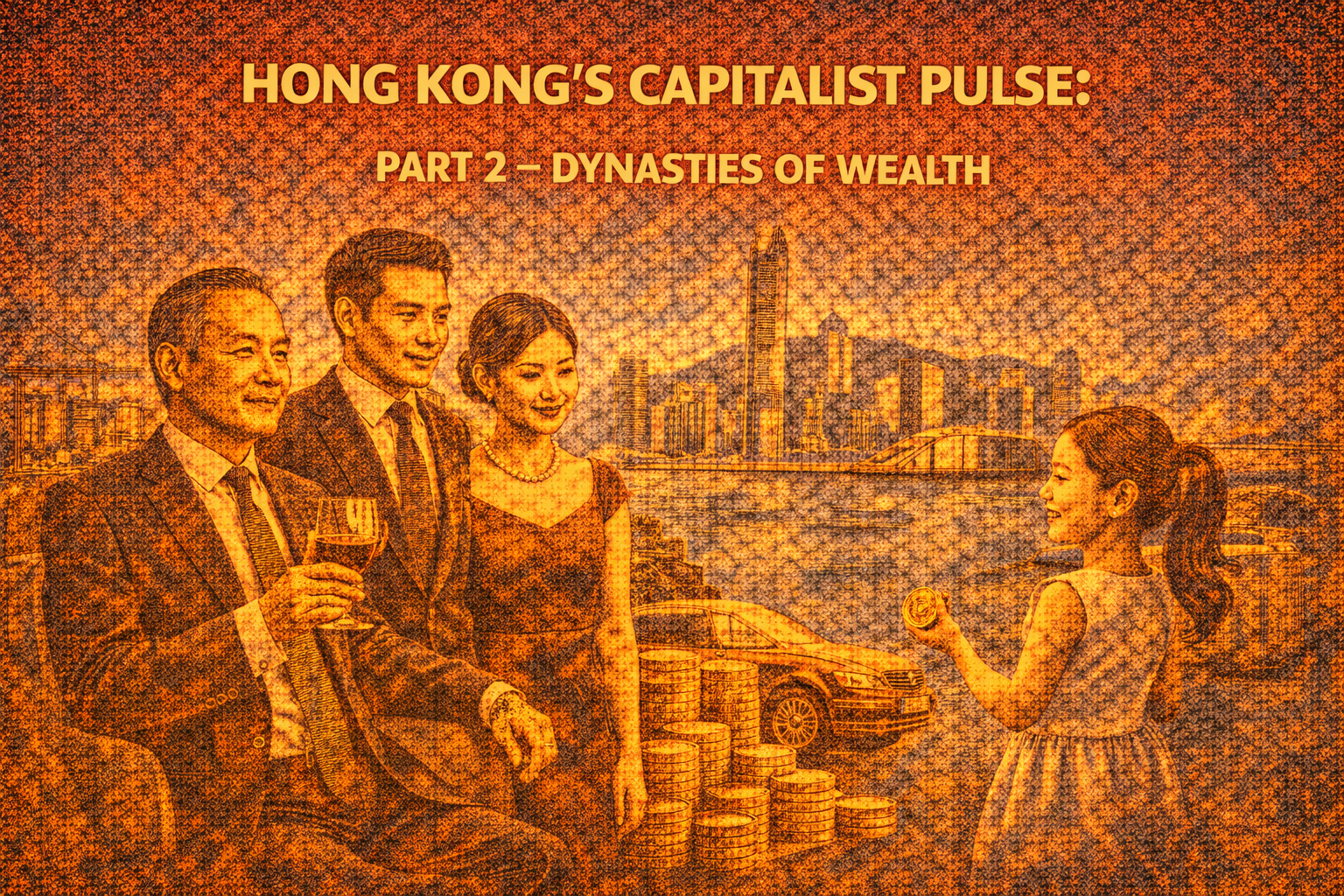
Hong Kong’s Capitalist Pulse: Part 2 – Dynasties of Wealth
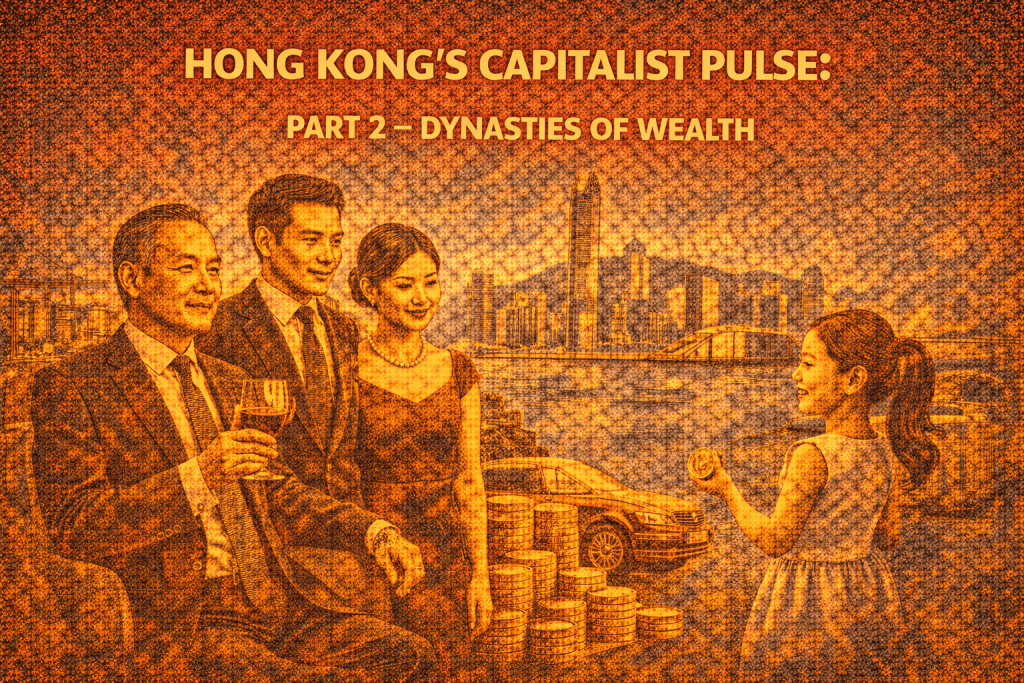
As I delve deeper into Hong Kong’s capitalist heartbeat in this series, I turn my attention to the family dynasties that have shaped its economic skyline. In Part 1, I explored the historical roots of HK’s free-market ethos. Now, in Part 2, I examine three pivotal families—the Kwoks, the Lis, and the Lees—whose empires exemplify concentrated wealth and influence. These dynasties aren’t just relics of old money; they are active architects of modern capitalism, blending tradition with aggressive expansion. Provocatively, their stories reveal how familial control can propel innovation while raising questions about equity in a city-state where billionaires often dictate the rules.
Let’s start with the Kwok family, stewards of Sun Hung Kai Properties, one of HK’s largest real estate conglomerates. Founded by Kwok Tak-seng in the mid-20th century, the company has grown into a behemoth with assets spanning commercial towers, residential developments, and infrastructure projects. The family’s wealth, now managed by descendants like Raymond Kwok, stems from astute land acquisitions during HK’s post-war boom. Their approach is straightforward: leverage government land auctions and urban density to maximize returns. This dynasty’s influence extends beyond property; they’ve invested in telecommunications and logistics, creating a diversified portfolio that mirrors HK’s role as a global trade hub. Objectively, their success underscores capitalism’s meritocratic facade—starting from modest roots, they’ve amassed fortunes through calculated risks. Yet, it also highlights dynastic continuity: family disputes, like the high-profile 2012 feud among brothers, show how personal ties can disrupt even the most robust empires.
Shifting to the Li family, led by Li Ka-shing and his heirs, we see a broader canvas of capitalist ambition. Li, often dubbed “Superman” in business circles for his deal-making prowess, built CK Hutchison Holdings into a multinational giant encompassing ports, retail, energy, and telecoms. His story begins in the 1950s with plastic flower manufacturing, evolving into strategic acquisitions like the purchase of Husky Energy in Canada. The family’s neutral, results-driven strategy involves global diversification—spanning over 50 countries—to hedge against HK’s geopolitical volatilities. This dynasty’s wealth isn’t confined to one sector; it’s a web of interconnected ventures that fuel economic growth. Provocatively, Li’s philanthropy, through foundations supporting education and health, adds a layer of social capital, yet it doesn’t obscure the reality that such families control vast resources in a city with stark income gaps. Their unbiased pursuit of profit has positioned HK as Asia’s financial gateway, but it also prompts reflection on whether true capitalism thrives under such concentrated power.
Finally, the Lee family, anchored by Henderson Land Development under Lee Shau-kee, represents resilience in property and beyond. Lee’s empire, valued in the tens of billions, focuses on high-end real estate, including iconic developments in Central and Kowloon. Starting from a small trading firm in the 1940s, the family expanded through partnerships and timely investments during HK’s industrialization. Their straightforward model emphasizes long-term holdings and urban renewal, contributing to the city’s vertical growth. The Lees have also ventured into gas utilities and hotels, demonstrating adaptability in a competitive market. Neutral analysis reveals their strength in navigating economic cycles, from the 1997 handover to recent global downturns. However, provocative scrutiny notes how family-led conglomerates like theirs can influence policy, as seen in land-use debates that favor developers. This dynasty’s legacy is one of quiet accumulation, where generational wealth ensures continuity amid HK’s fast-paced capitalism.
These families collectively embody HK’s upper-class ethos: a blend of Confucian familial loyalty, relentless opportunism, and global outreach. Their dynasties aren’t isolated; they interlink through board memberships and joint ventures, forming an elite network that drives the economy. In a neutral light, this concentration fosters efficiency and innovation, yet it challenges the ideal of open competition. As I prepare for Part 3 on HK’s banking sector, consider how these dynasties underpin financial systems—often as major clients or investors.
For Hollywood projects, incorporating these elements can add authentic depth, especially in films exploring wealth, power, and cultural nuance. Imagine a thriller like a HK-set “Succession” remake, where the Kwok family’s real estate feuds inspire sibling rivalries over skyscraper empires—culturally fitting HK’s upper class through depictions of mahjong nights in luxury villas, symbolizing strategic family bonds. Or a biopic on Li Ka-shing’s rise, scripted as an underdog-to-tycoon narrative, emphasizing Cantonese business dinners where deals seal over dim sum, reflecting the elite’s emphasis on guanxi (relationships) over overt confrontation. For the Lees, a drama about urban development could highlight boardroom scenes in opulent Central offices, incorporating Lunar New Year galas to show how tradition tempers capitalism’s edge. These fits provoke audiences by mirroring HK’s blend of East-West influences, where family honor fuels billion-dollar decisions, without romanticizing inequality.
Stay tuned for Part 3: HK & Banking, where I’ll unpack the financial engines powering this capitalist pulse.