Romance in the Harbor: A Chronicle of Hong Kong Love (Part 3)
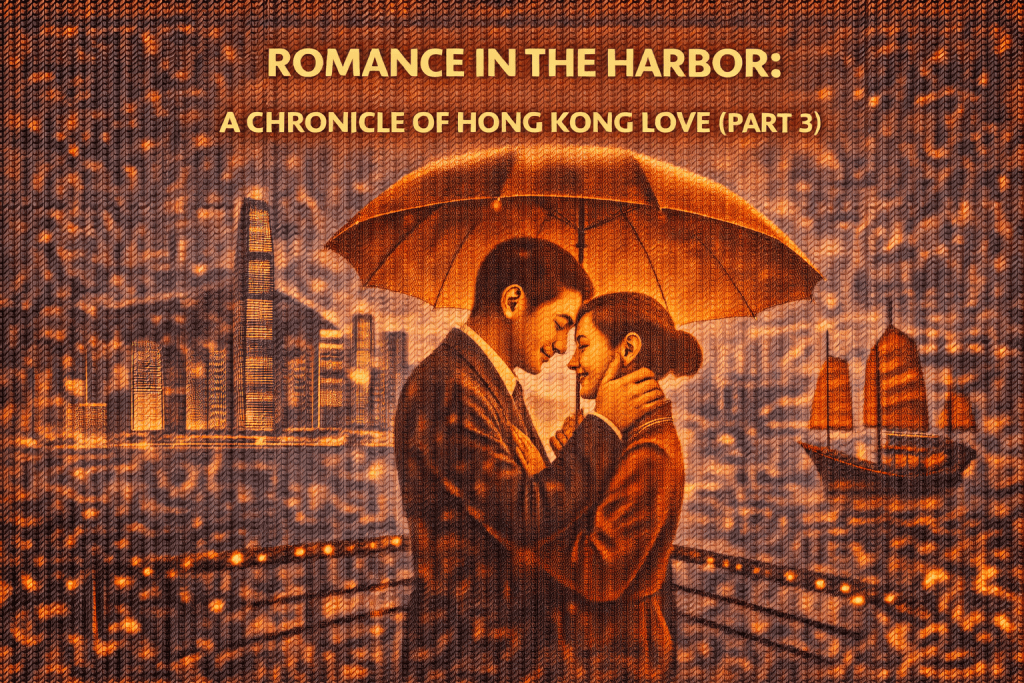
We have previously examined the indigenous roots of romance in Part 1 and the high-density adaptation of those roots in Part 2. Now, we must turn our gaze outward—or rather, upward. For over a century, a parallel romantic ecosystem existed in Hong Kong, imported entirely from the British Isles and superimposed onto the humid granite of the colony. This is Part 3 of our inquiry. Here, we analyze the historical Western celebrations of love in Hong Kong. This is a study of how Victorian, Edwardian, and eventually post-war British social codes attempted to survive in a subtropical climate, creating a distinct, segregated sphere of affection.
To understand the historical Western experience in Hong Kong, one must acknowledge the tyranny of the environment. For the British colonial administrator or merchant in the late 19th and early 20th centuries, romance was a logistical challenge. The climate was oppressive, and the clothing—wool suits and heavy dresses—was unsuited for it. Consequently, the “Season” for courtship was dictated not by the calendar of the heart, but by the thermometer. Social life peaked in the cooler months. The center of this world was physically elevated: The Peak. Here, amidst the fog and the cooler air, a replication of British society was enacted. Romance was formal. It took place at tennis parties, garden fetes, and balls held at the Governor’s House or the Hong Kong Club. It was a performance of civilization in what was viewed as a wild outpost.
A defining phenomenon of this era was the “Fishing Fleet.” This term referred to the annual arrival of ships from Britain carrying young, unmarried women. These women, often unable to find suitable matches in England or seeking adventure, came to the colonies to find husbands among the surplus of male civil servants and officers. Upon arrival, the social calendar accelerated. Tea dances at the Hong Kong Hotel (and later the Peninsula) became the primary battleground for courtship. The etiquette was rigid. Calling cards were exchanged; chaperones were present. A relationship proceeded through a series of authorized public appearances. To be seen walking together on Lugard Road—a path encircling the Peak with panoramic views—was a significant declaration of intent. It was a closed loop. The expatriate community was small, and privacy was nonexistent. A courtship was not merely a union of two people but a rearrangement of the community’s social fabric.
This rigid structure faced a rupture in 1941 with the Japanese occupation. The narrative of colonial romance shifted from formal balls to survival. The Repulse Bay Hotel, once a venue for moonlit dinners and jazz bands, became a defensive line. Following the surrender, the British civilians were interned at Stanley Camp. Here, romance was stripped of its class pretensions. It became a mechanism for psychological survival. Diaries from this period record weddings held inside the camp, with rings fashioned from scrap metal and wedding cakes made from ground rice and saved rations. This era stripped away the velvet ropes of the colonial club system and reduced love to its most elemental form: a partnership against uncertainty.
The cinematic potential of this era is substantial and largely untapped by Hollywood. While there are films about the Pacific theater of war, few focus on the specific social texture of the “Fishing Fleet.” A period drama could explore the intense pressure faced by these women, who had a limited window of time to secure a proposal before being socially compelled to return to Britain—a journey known as being part of the “Returned Empties.” The psychological stakes of this “market” set against the backdrop of lush, humidity-soaked colonialism offers a distinct flavor of tension. Furthermore, the transition from the opulence of the Peninsula Hotel tea dances to the starvation and resilience of Stanley Camp offers a profound narrative arc. A filmmaker could focus on the contrast: the visual lushness of the pre-war peak, with its white linens and ceiling fans, crashing abruptly into the grit of the occupation. It provides a setting where the class rigidity of Downton Abbey meets the survival stakes of a war epic.
As the city rebuilt post-war, the formality of the British “Season” began to wane, eventually blending with the cosmopolitan nature of the modern city. The “Fishing Fleet” ceased to sail, and the exclusivity of the Peak was eventually broken. However, the footprint of these traditions remains in the city’s hotels and private clubs. In the next entry, Part 4, we will examine how these Western traditions have evolved into the modern expatriate experience. We will look at the current “gweilo” dating scene, the nightlife of Lan Kwai Fong, and how the transient nature of modern global employment shapes the relationships of those who pass through the harbor today.