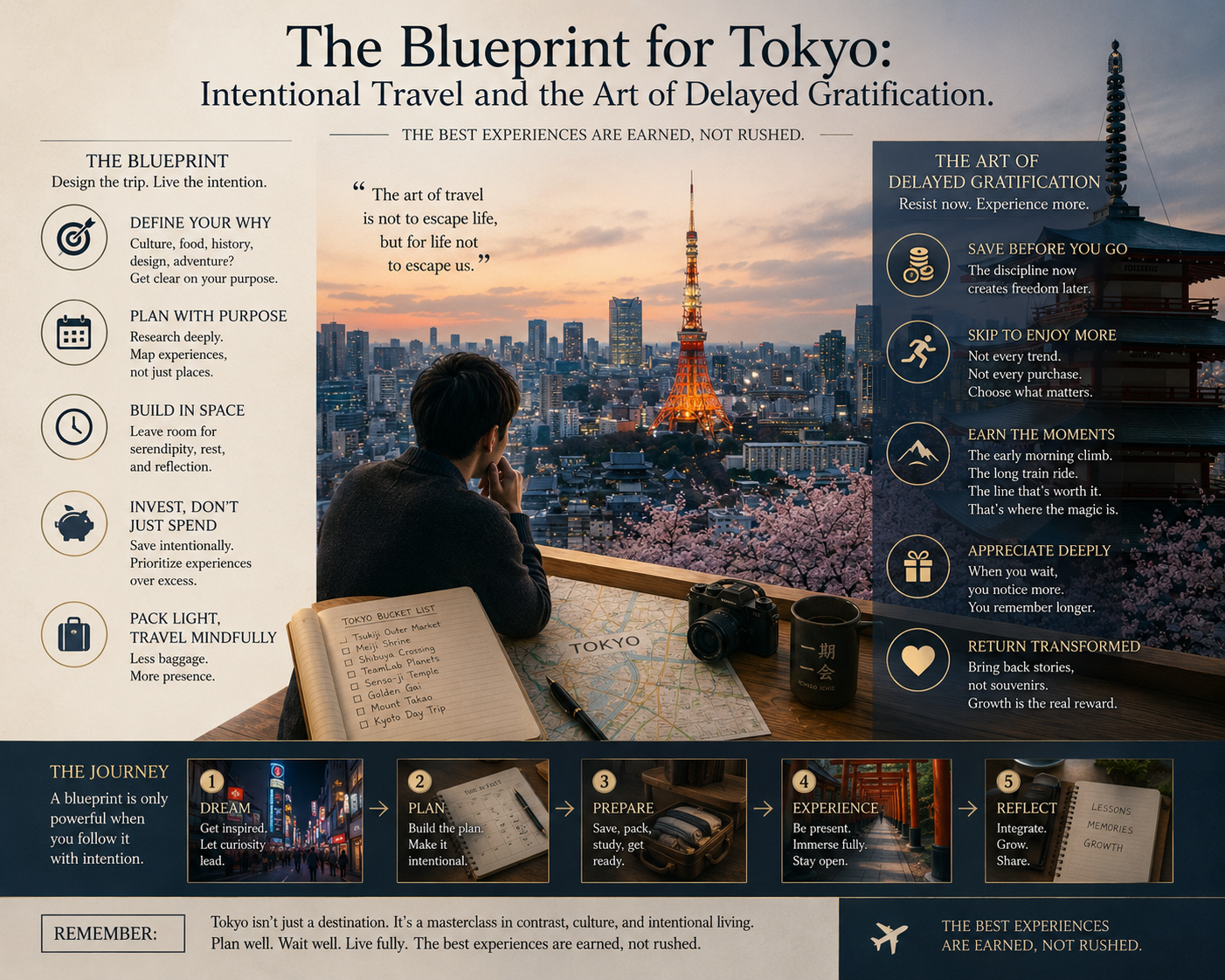

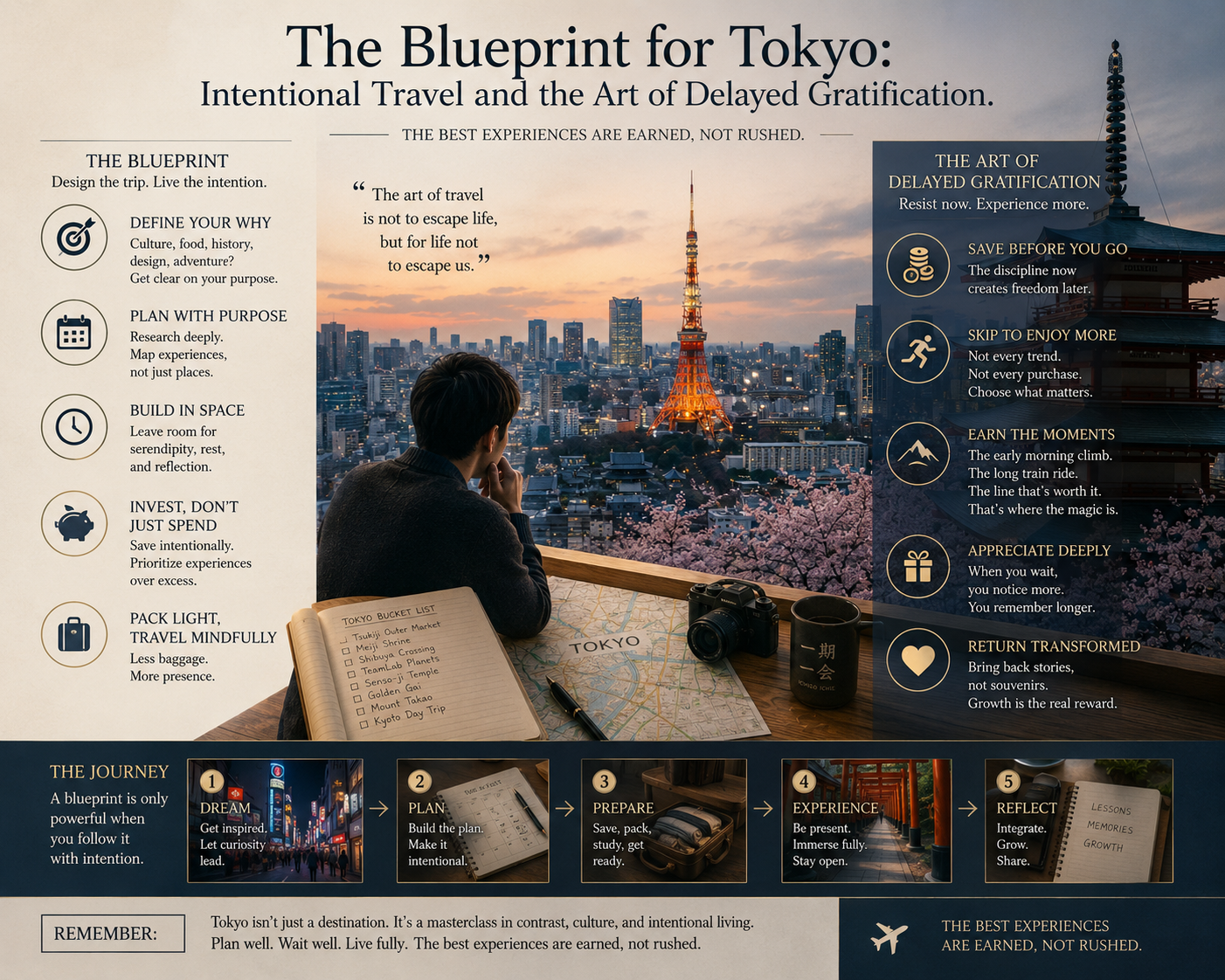
The Blueprint for Tokyo: Intentional Travel and the Art of Delayed Gratification.
The air is still, yet the spirit remains restless. Welcome to Friday’s Lifestyle transmission.
It is Friday, the 29th of May 2026. To consult for Hollywood and build an authentic empire of images, one must govern one’s movements with absolute precision. Today, I wish to address a vital philosophy introduced to me by my mentor and therapist, Ruby Tang: the concept of Intentional Travel.
Ruby has consistently reminded me that just as every action must be executed with radical responsibility, every destination we choose and every person we allow into our circle must actively add value to our lives. As a writer-producer, I can no longer afford the luxury of accidental or impulsive journeys. Every crossing of a border must be a deliberate tactical maneuver designed to refine the mind and the vessel.
The Blueprint for Tokyo: Therapy and Immersion
This July, I am executing a meticulously planned five-day journey to Tokyo, Japan. This is not a casual vacation; it is a structured exercise in therapy and cultural immersion. Because the timeline is concise, my itinerary must be unyielding. Everything I do within those five days must remain in strict service to my psychological and creative growth.
As much as the dreamer in me wants to journey to Azabu-Jūban to experience the legendary craftsmanship of Bar Centifolia, the strategist recognizes that this is not the appropriate time. I have no legitimate, value-adding reason to go. To indulge in it now would be an act of scattered focus—a capitulation to the very impulses I am training myself to master.
Instead, my rewards for successfully executing my therapeutic tasks and missions during the day are already firmly established. They are anchored in the narrative landscapes that shaped my initial creative spark:
* The Sailor Moon Store
* The Sailor Moon Shining Theatre Shinagawa
* Traditional Japanese Bathhouses (Sento)
These specific sanctuaries are my calculated incentives for maintaining absolute psychological discipline throughout the trip. They are the curated spaces where I will absorb the precise cultural textures required to fuel my future pan-Asian production crews. Bar Centifolia must wait. Next time.
The Local Crucible: Acclimatization and Impulse Control
To earn the right to experience the world’s elite mixology landscapes, I must first conquer my own terrain. It is illogical to seek the refined shadows of Tokyo’s bars when I have not yet fully acclimated myself to the world-class offerings of my own hometown.
My immediate tactical mandate is to expand my operational comfort zone right here in Hong Kong. I must thoroughly analyze our local counterparts to Azabu-Juban’s master artisanry, beginning with two specific establishments:
* Bar Tincture in Central
* Bar Buonasera in Tsim Sha Tsui
By frequenting these local bastions of precision, I am practicing more than just location scouting for Eurasia Rising. I am actively practicing impulse control and delayed gratification—two executive traits that Ruby stresses are non-negotiable for a formidable producer. A production set is a multi-million-dollar exercise in delayed gratification; you must endure months of logistical friction before you ever see the first finished frame. If I cannot delay the gratification of a single cocktail in Tokyo, I cannot command the patience required to steer a Hollywood franchise.
The Vow of the Strategist
We are shifting from a life of random impulses to a life of calculated intent. Whether I am having my twice weekly sessions at the gym with Kobe, diving into the pool with Aunt Vinnie, or structuring a five-day therapeutic immersion in Japan, every movement must be a deliberate planting of a wholesome seed.
Haste makes waste, and scattered desire brings ruin to the timeline. By treating my travel with the same meticulous respect that I apply to my scripts, I am ensuring that the “Zephyr” brand remains anchored in absolute substance.
The fire within me burns steady, cooled by the discipline of the long view.Until the wind shifts again.
— Zephyr Chan