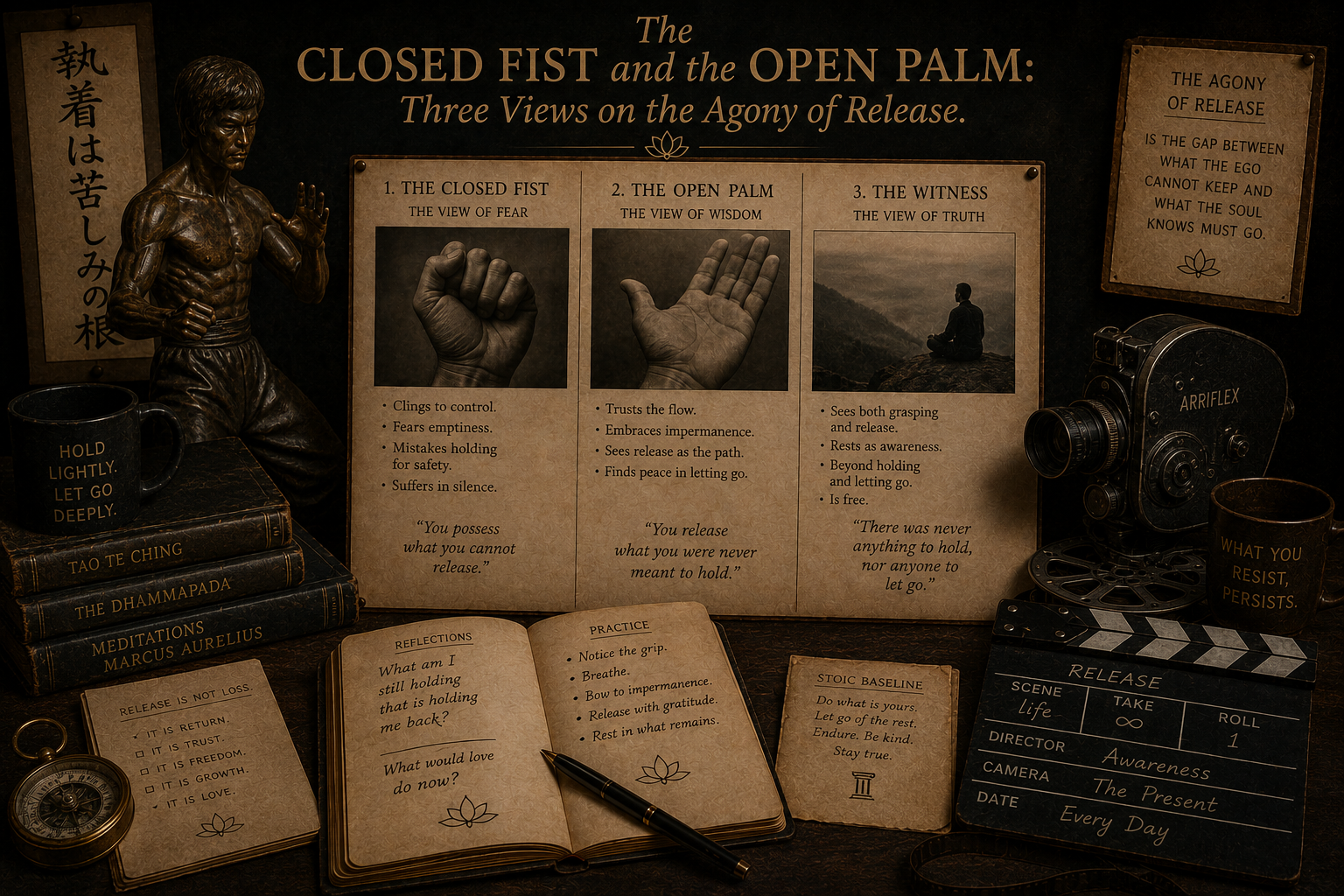
The Closed Fist and the Open Palm: Three Views on the Agony of Release.
The air is still, yet the spirit remains restless. Welcome to Zephyr’s spiritual transmission.
It is Monday, the 1st of June 2026. Having recently explored the discipline of intentional movement and the structural necessity of delayed gratification across foreign borders, I find myself drawn back to the most complex battlefield of the interior landscape. To consult for Hollywood on the deep undercurrents of the human condition, one must possess the scholarly detachment to diagnose suffering, but also the radical honesty to confront it within oneself. Today, I wish to address the foundational Buddhist concept of non-attachment (Upādāna) and the profound, agonizing friction that occurs when the intellect demands release, but the emotional vessel refuses to unclench.
The Logic of the Closed Fist
Let us be entirely straightforward: my current difficulty does not lie in a lack of philosophical comprehension. Through my years reading the sutras at Durham and within the Master of Buddhist Studies programme at HKU, the mechanics of impermanence (Anicca) have always read as completely logical. I know with absolute cognitive clarity when a person, an expectation, or an object has ceased to add value to my life. I know when a connection has turned harmful, acting as a source of stagnant energy that slows my executive stride.
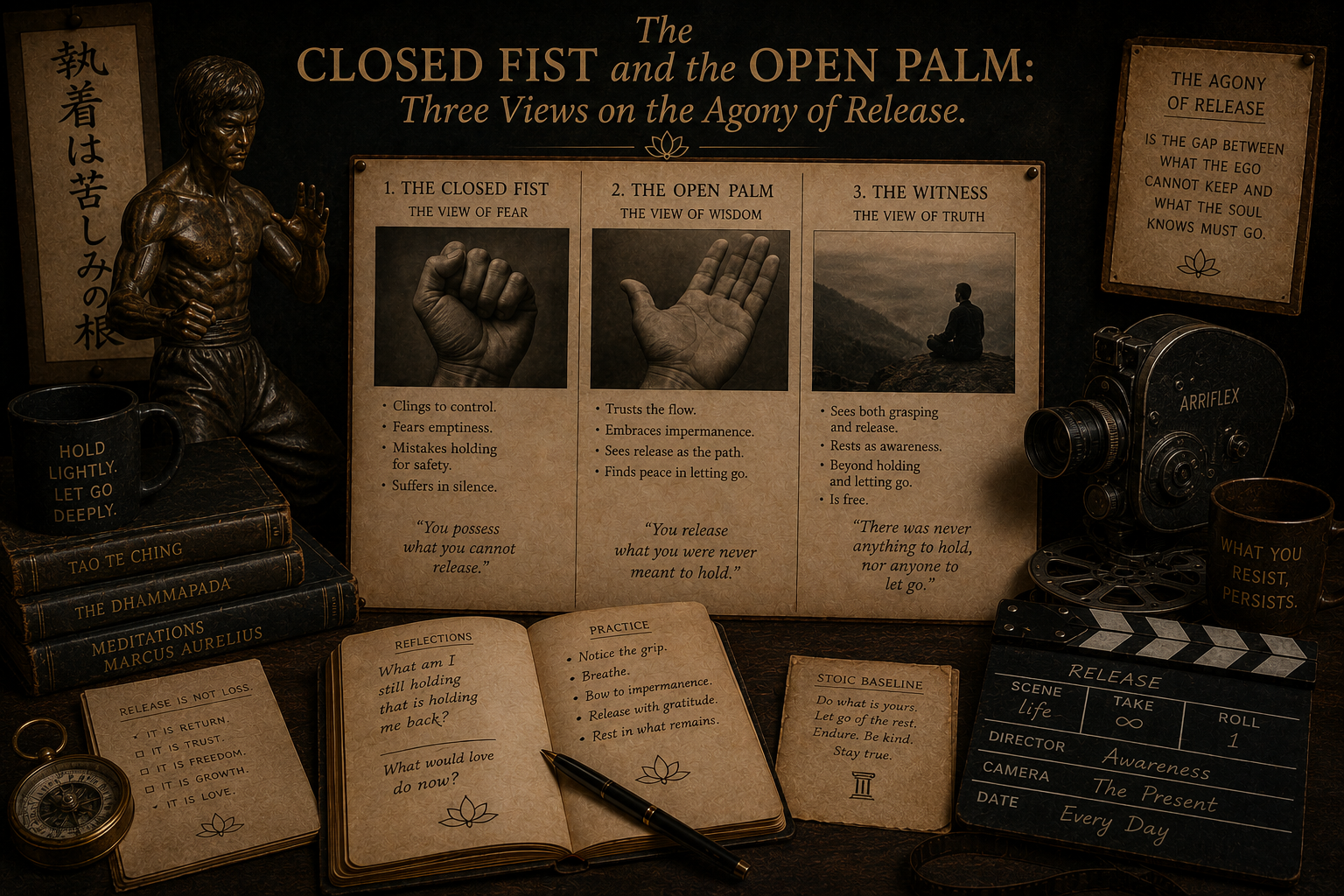
Yet, knowing is not the same as releasing. Emotional attachment is an anchor that defies intellectual metrics. To illustrate this internal paralysis, we must look to the classic metaphysical metaphor of the closed fist and the open palm.
When we cling to an unwholesome desire or an exhausting attachment, our hand is tightly clenched. We hold on so fiercely that our knuckles whiten and our energy is completely spent on the act of holding. But a fist that refuses to unclench is structurally incapable of receiving anything else. One must first intentionally open the palm, braving the immediate void of the empty hand, before one can ever hope to accept a new, wholesome seed. Haste makes waste, but a hand that cannot open is a dead instrument.
The Three Streams of Release
To fully parse why this emotional unclenching is so difficult for a writer-producer driven by intense focus, we must view the closed fist through the lenses of three distinct Chinese Buddhist traditions: Chan (禪), Pure Land (淨土), and Tiantai (天台).
1. The Chan Perspective: The Sudden Sword
In the Chan tradition, attachment is viewed as an illusion generated by a deluded ego trying to freeze a constantly shifting reality. The legendary masters taught that letting go is not a prolonged, agonizing negotiation; it is an immediate, sharp severance. It is the realization that the thing you are holding onto does not truly exist as a permanent entity. For me, the Chan perspective is a stark reminder of my professional training with Ruby Tang. It demands that I stop rationalizing my emotional lingering. I must use the “sword of wisdom” to cut the cord of attachment cleanly, recognizing that my insistence on holding on is merely my ego resisting the flow of reality.
2. The Pure Land Perspective: Surrender and Reorientation
Where Chan demands an internal sword, the Pure Land tradition offers the strategy of sacred displacement through Nianfo (recitation of Amitabha Buddha’s name). It acknowledges that human emotional attachment is immensely heavy—a weight so profound that we often cannot lift it by our own willpower alone (jiriki). The path to letting go here is not a cold suppression of desire, but a radical redirection of it. You surrender the unwholesome attachment to a higher, compassionate focus. For my own life, this means when my mind begins to spiral into old attachments, I must intentionally displace those thoughts. I must redirect that intense emotional energy away from the harmful object and invest it fully into the sacred work of my calling—using the “Zephyr” platform to preserve our heritage.
3. The Tiantai Perspective: The Three Truths of the Lens
The Tiantai school provides the ultimate analytical framework for a producer-writer through its doctrine of the Three Truths: the Empty (空), the Provisional (假), and the Middle (中).
* When I look at a toxic connection through the lens of Emptiness, I recognize that it has no inherent, independent substance.
* Yet, through the Provisional, I acknowledge that the emotional pain and the worldly narrative of that connection are temporarily real and must be respected.
* The mastery lies in the Middle—the ability to exist in Hong Kong’s hyper-capitalistic, high-friction entertainment industry, fully feeling the provisional weight of human relationships, while simultaneously anchoring the soul in the absolute peace of emptiness. It teaches me to observe my grief over letting go without being consumed by it.
The Producer’s Vow of the Open Palm
As I prepare for my upcoming production assistant duties with Kenneth on Master Ajax Ho’s podcast and refine the narrative layers of Eurasia Rising, I am treating this spiritual friction as essential executive training. A formidable producer cannot operate with a closed fist. If I am clinging to past comfort zones or harmful personal attachments out of sheer emotional inertia, my hands are too full to manage a multi-million-dollar project or negotiate a complex Hollywood distribution deal.
I must learn from the Tiantai masters to see the provisional drama of my life clearly, use the Chan sword to prune what is unwholesome, and utilize the Pure Land focus to direct my fire toward excellence. I am stepping back, taking a deep breath, and forcing my hand to open. It stings like salt water on a fresh laceration, but only through the open palm can the new empire enter.
The fire within me burns steady, cooled by the vast clarity of the open palm.
Until the wind shifts again.
— Zephyr Chan