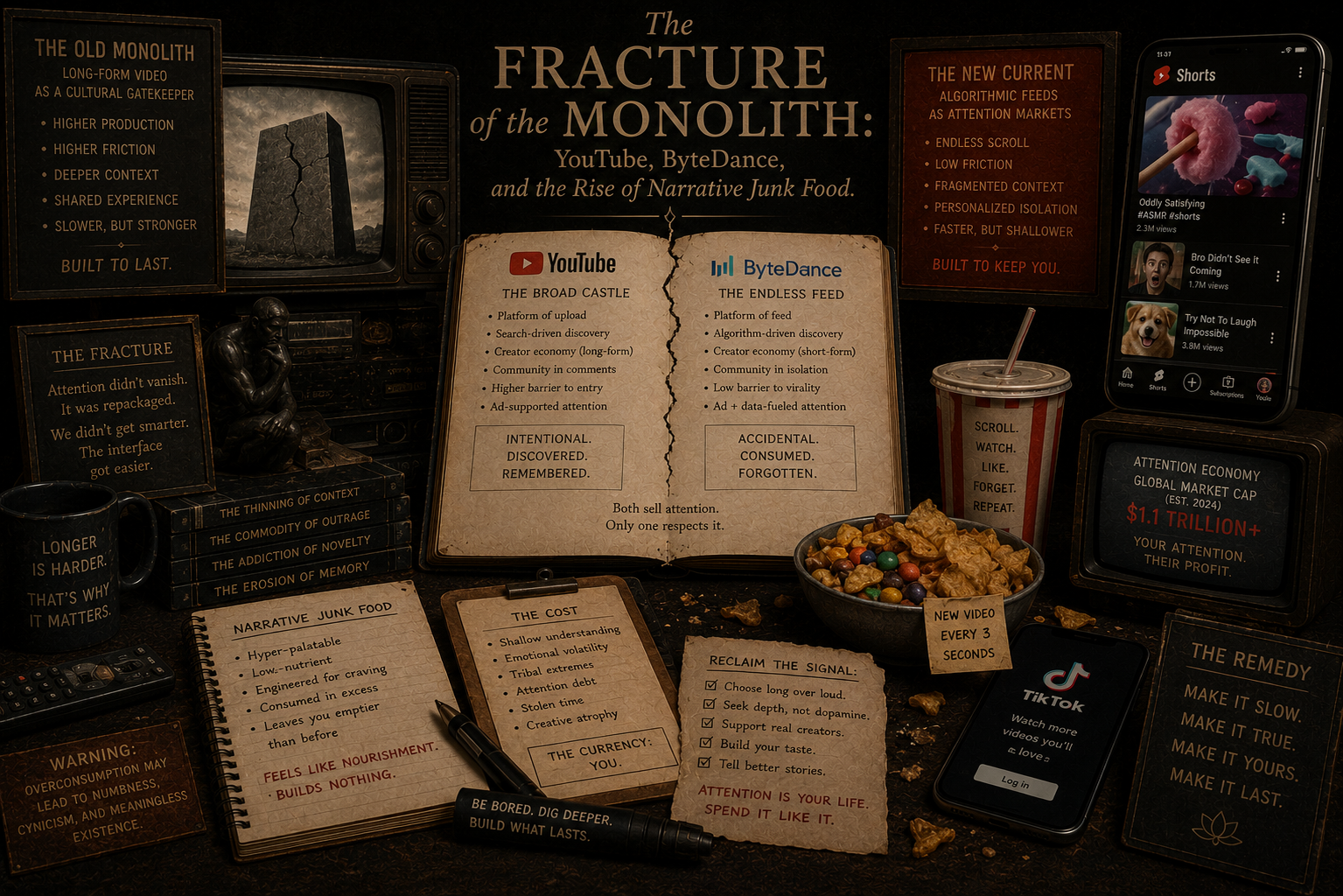
The Fracture of the Monolith: YouTube, ByteDance, and the Rise of Narrative Junk Food.
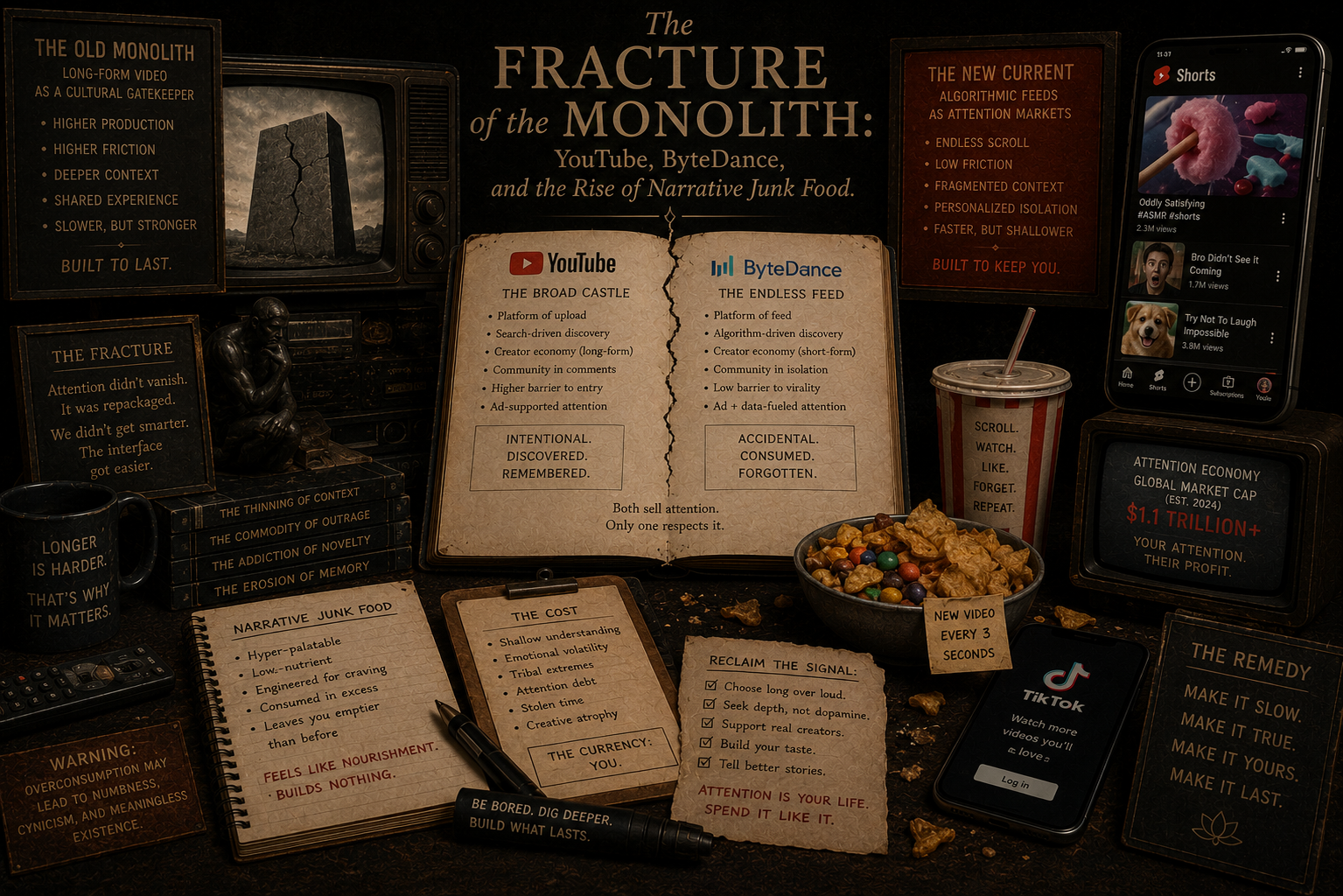
The air is still, yet the spirit remains restless. Welcome to Zephyr’s Wednesday transmission.
It is Wednesday, the 10th of June 2026. To consult for Hollywood and build an authentic empire of images, one must possess the analytical rigor to dissect the global market as it truly exists today. We are currently witnessing a massive, historic fragmentation of human attention. The traditional studio monoliths are fracturing, and the global entertainment landscape has dissolved into a complicated, messy stew. Today, I wish to offer my executive analysis on the monumental shift away from traditional films and television series toward three alternative titans: YouTube, TikTok/DouYin, and the explosive rise of microdramas.
The Timeline of the Shift
To understand the current market architecture, we must first map the historical chronology of these digital platforms:
* YouTube: Out of these three alternative forms, YouTube possesses the longest history. Founded on Valentine’s Day—the 14th of February—2005, the platform is now more than 21 years old. From its inception, it revolutionized media by allowing users to seamlessly embed uploaded videos into foundational social networks like MySpace and Facebook. Recognizing its massive disruptive potential, Google acquired YouTube just eighteen months after its public launch, in November 2006, for $1.65 billion USD in stock.
* DouYin and TikTok: Next came the short-video revolution, born not in the United States, but in the PRC by the Beijing-based technology company, ByteDance. DouYin, the original Chinese version, launched domestically in September 2016—almost exactly a decade after Google’s landmark acquisition of YouTube. Recognizing the global hunger for this vertical format, ByteDance deployed TikTok as its international counterpart just one year later, in 2017.
* Microdramas: The newest and most aggressive mutation of digital storytelling originated in China circa 2018, a mere year after TikTok’s debut. This format of ultra-short, highly addictive narrative was born on platforms like DouYin and Kuaishou (快手)—a rival short-video and livestreaming platform favored heavily by Tier-3 to Tier-5 cities and rural areas in mainland China. It was explicitly engineered to monetize compressed attention spans and the human love for serialized drama. Consisting of 50 to 100 episodes per series, the architecture relies on a “freemium” trap: the first 5 to 10 episodes are free, after which viewers must engage in micro-transactions to unlock the rest. These dopamine-driven series saw a massive, unprecedented spike during the COVID-19 lockdowns, permanently altering global consumption habits.
Search engines like Google indicate that this definitive global shift toward alternative entertainment began a decade ago with the birth of DouYin, a claim that the chronological ledger supports. What remains most evident today is the American audience’s blatant rejection of traditional Hollywood gatekeepers in favor of YouTube, TikTok, and increasingly, microdramas.
The Producer’s Verdict on ‘Narrative Junk Food’
What are my thoughts on this tectonic shift? As an independent executive, I completely understand the utility of all three platforms to market oneself, scale a brand, and distribute stories directly to the consumer. At the same time, I fully comprehend why traditional critics and legacy professionals within the global entertainment industry dismiss microdramas as “narrative junk food.” They are hyper-compressed, formulaic, and designed for immediate emotional gratification.
Yet, as an unorthodox producer-writer, I refuse to look at this landscape with academic snobbery. Storytelling is storytelling, regardless of the aspect ratio or the duration of the clip. The traditional studio executives in the U.S. are terrified because they no longer control the distribution pipelines.
Which form of media am I most strategically driven to exploit? The reality is nuanced:
* The YouTube Conundrum: I obviously require YouTube to market and promote my brand; let us be straightforward, hardly anyone reads a text-based blog in 2026. Yet, I must confess that I am still too shy to present myself on camera. While producers are public figures, I value the historical luxury of our role—we are less the public “face” of a project than the lead actors.
* The Regional Landscape: The same restriction applies to TikTok and DouYin. I must find a creative way to leverage both, a task complicated by the fact that TikTok is notoriously unavailable here in Hong Kong where I am based.
* The Dual Slate: As for microdramas, they present an incredibly lucrative, if commercially uneven, space. I intend to use this high-velocity format for my regional, wholly original corporate IP, Eurasia Rising, utilizing top-tier international and Hong Kong crews to elevate the production value far above standard “junk food” metrics. This commercial engine will run parallel to my grander cinematic ambition: producing the high-end, three-minute speculative pitch trailer for Jacqueline Carey to safely acquire the theatrical rights for my feature film spin-off, Kushiel’s Legacy: The Terminus. I am fully aware that I cannot embark on this cinematic journey in complete isolation; I require the backing and mentorship of industry seniors to help finance the project as well as teach me the real-world ropes of global physical production.
The Framework of Value
My strategy moving forward is to produce projects across all formats, refusing to limit my studio to a single lane. To navigate this messy digital stew without losing my creative soul, I only need to anchor my decisions in two words introduced to me by my mentor, Ruby Tang: Intention and Value.
Every piece of media the “Zephyr” brand releases must be executed with strict volition, and it must provide undeniable, authentic value—both to myself as the producer-writer guarding the cultural legacy, and to the global audience consuming the image. We are not here to chase empty algorithms; we are here to master the tools of the modern empire.
The fire within me burns steady, fully focused on the metrics of the future.
Until the wind shifts again.
— Zephyr Chan