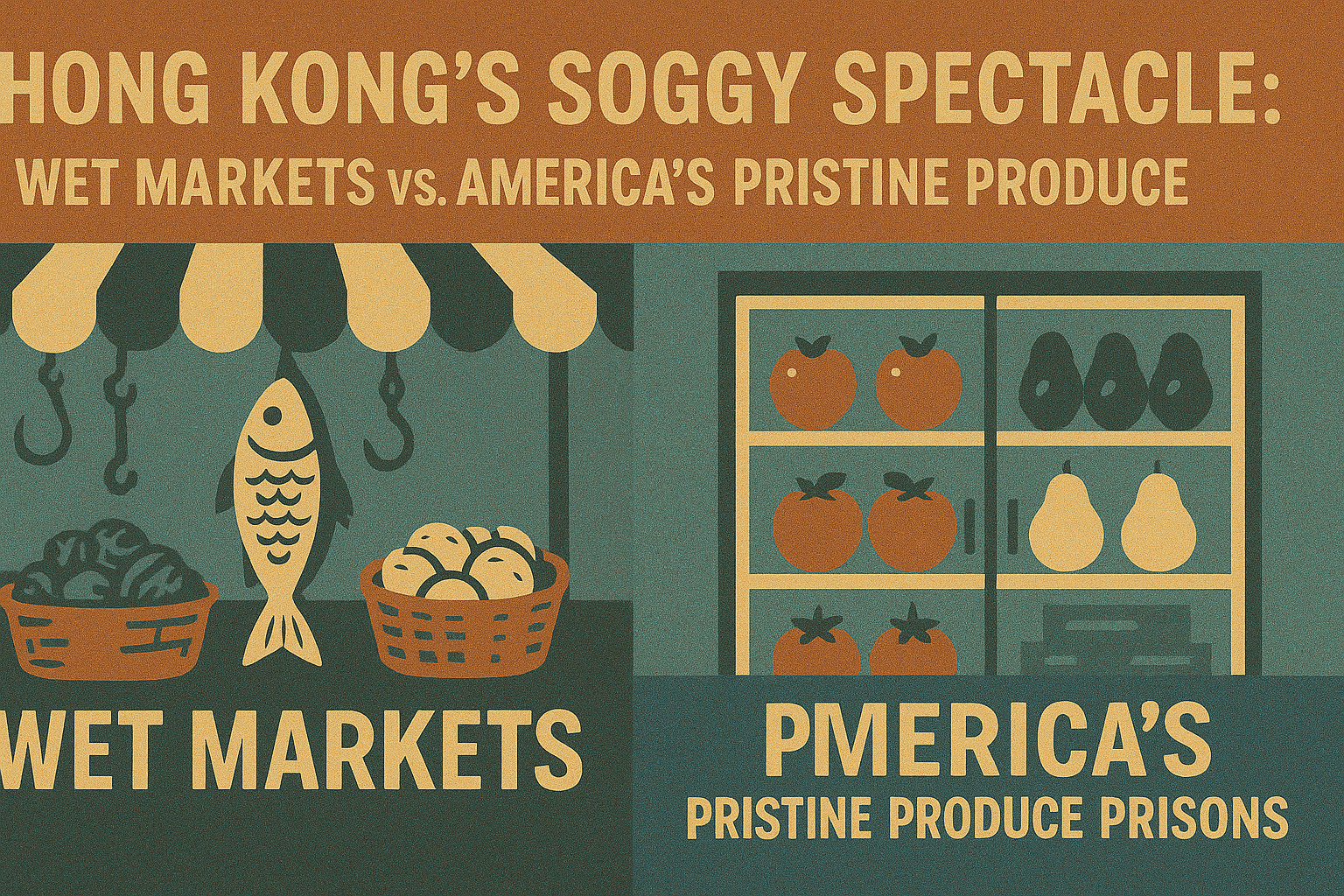

Hong Kong’s Soggy Spectacle: Wet Markets vs. America’s Pristine Produce Prisons
Picture this: You’re elbow-deep in a bustling Hong Kong wet market, dodging aunties haggling over wriggling eels while the floor squelches underfoot like a bad breakup. That’s the raw, unfiltered charm of Hong Kong’s gaai si—street markets that pulse with life, literally. These aren’t your grandma’s tidy grocery runs; they’re chaotic symphonies of fresh carnage. Vendors chop pork on the spot, fish flop in shallow tanks gasping for their last dramatic breath, and mountains of vibrant veggies glisten under fluorescent lights, sprayed with water to stay perky. It’s called a “wet” market for a reason—the floors are perpetually slick from ice melts, hose-downs, and the occasional escaped seafood skirmish. And let’s not forget the smells: a provocative cocktail of brine, blood, and basil that hits you like a love slap from the sea.
Hong Kong’s wet markets are the beating heart of neighborhood life, embedded in high-rises and spilling onto streets like an overenthusiastic party guest. Take the Mong Kok Wet Market or the iconic Wan Chai one—they operate from dawn till dusk, offering everything from seasonal dragon fruit to live chickens that meet their maker right before your eyes. It’s affordable, ultra-fresh, and fosters that community vibe where your butcher knows your stir-fry preferences better than your therapist. But beware, tourists: Navigating one requires ninja-level dodging skills to avoid getting splashed or stepping on a rogue prawn. Provocative? Absolutely—these markets thumb their nose at sanitized shopping, embracing the messiness of food origins in a city where space is scarcer than a polite queue.
Now, flip to supermarkets in Hong Kong, like Wellcome or ParknShop, which feel like a corporate hug after the wet market’s wild embrace. They’re air-conditioned oases stocked with neatly packaged imports, organic aisles, and self-checkout lanes that beep judgmentally at your impulse buys. Here, produce is pre-washed, meats are vacuum-sealed, and everything’s labeled with nutritional guilt trips. They’re convenient for the harried office worker grabbing ramen at midnight, but they lack the soul-stirring drama of the wet markets. In a city of 7.5 million packed into skyscrapers, these modern marvels dominate grocery retail alongside convenience stores, yet wet markets hold their ground for that unbeatable freshness factor.
Cross the Pacific to the US, and the supermarket scene is like Hong Kong’s on steroids—vast Walmart warehouses or Kroger kingdoms where you could get lost for days amid endless aisles of processed bliss. Think fluorescent-lit football fields crammed with everything from kale chips to king-size candy bars. They’re efficient, 24/7 behemoths designed for the American dream of bulk-buying toilet paper during apocalypses. But provocative truth bomb: They’re also sterile soul-suckers, where fruits are waxed to unnatural shine and meats come pre-portioned like sad little apologies for once-living creatures. No haggling, no splashes—just Muzak and masked smiles. Hong Kong’s supermarkets feel intimate by comparison; in the US, they’re impersonal empires that prioritize convenience over connection, turning shopping into a solo sport.
Ah, but wet markets in America? Do they even exist, or is that just a myth peddled by conspiracy theorists munching on organic kale? Spoiler: They do, but they’re not the virus-breeding boogeymen some headlines scream about post-COVID. The US has dozens of live-animal markets, often tucked into ethnic enclaves like Chinatowns or immigrant neighborhoods, where you can buy fresh-killed poultry or seafood on-site. Think of them as “wet markets lite”—regulated to heck by the USDA, with animals butchered under strict hygiene rules that make Hong Kong’s freewheeling stalls look like a rebel yell. No wild critters here; it’s mostly domesticated fare, and wildlife trading is a no-go to avoid zoonotic drama.
More commonly, America’s answer to wet markets is the farmers’ market—a sanitized, feel-good facsimile that’s more picnic than pandemonium. These pop up like optimistic weeds across the country, selling heirloom tomatoes and artisanal cheeses from smiling vendors in plaid. But here’s the humorous hypocrisy: While Hong Kong’s wet markets embrace the “wet” with gleeful abandon, US farmers’ markets are often dry as a bone—produce misted politely, no live slaughter in sight, and floors you could eat off (though why would you?). They’re safer, sure, but where’s the thrill of watching your dinner’s last wiggle?
And oh, the variations! Farmers’ markets morph wildly from city to city, state to state, like chameleons on caffeine. In sunny California, San Francisco’s Ferry Plaza is a year-round gourmet gala with organic everything and bay views, drawing foodies like moths to a flame. Head to Seattle’s Pike Place, and it’s a tourist trap extraordinaire—flying fish, buskers, and enough coffee to fuel a revolution. But venture to the Midwest, say Chicago’s Green City Market, and it’s seasonal survival mode—braving blizzards for root veggies and hot cider. Southern states like Georgia amp up the peaches and pecans, while New York’s Union Square buzzes with urban edge, protesters mingling with pickle purveyors. State-wise, Hawaii’s tropical bounty contrasts Montana’s hardy ranch goods, reflecting local climates, cultures, and economies. It’s a patchwork quilt of Americana—some markets are upscale affairs with live music and craft beers, others humble roadside stands where the biggest excitement is a rogue cow.
Provocatively speaking, Hong Kong’s wet markets mock America’s obsession with sterility: Why shrink-wrap freshness when you can have it flapping? US versions, whether true wet markets or farmers’ fests, prioritize safety over spectacle, varying by locale to mirror regional quirks—from LA’s celebrity-spotted stalls to Boston’s lobster-laden ones. Yet, in a world of pandemics, maybe Hong Kong could borrow a dash of US regulation, and America a sprinkle of that raw vitality. After all, life’s too short for bland broccoli—dive into the wet, or stay dry and dull.