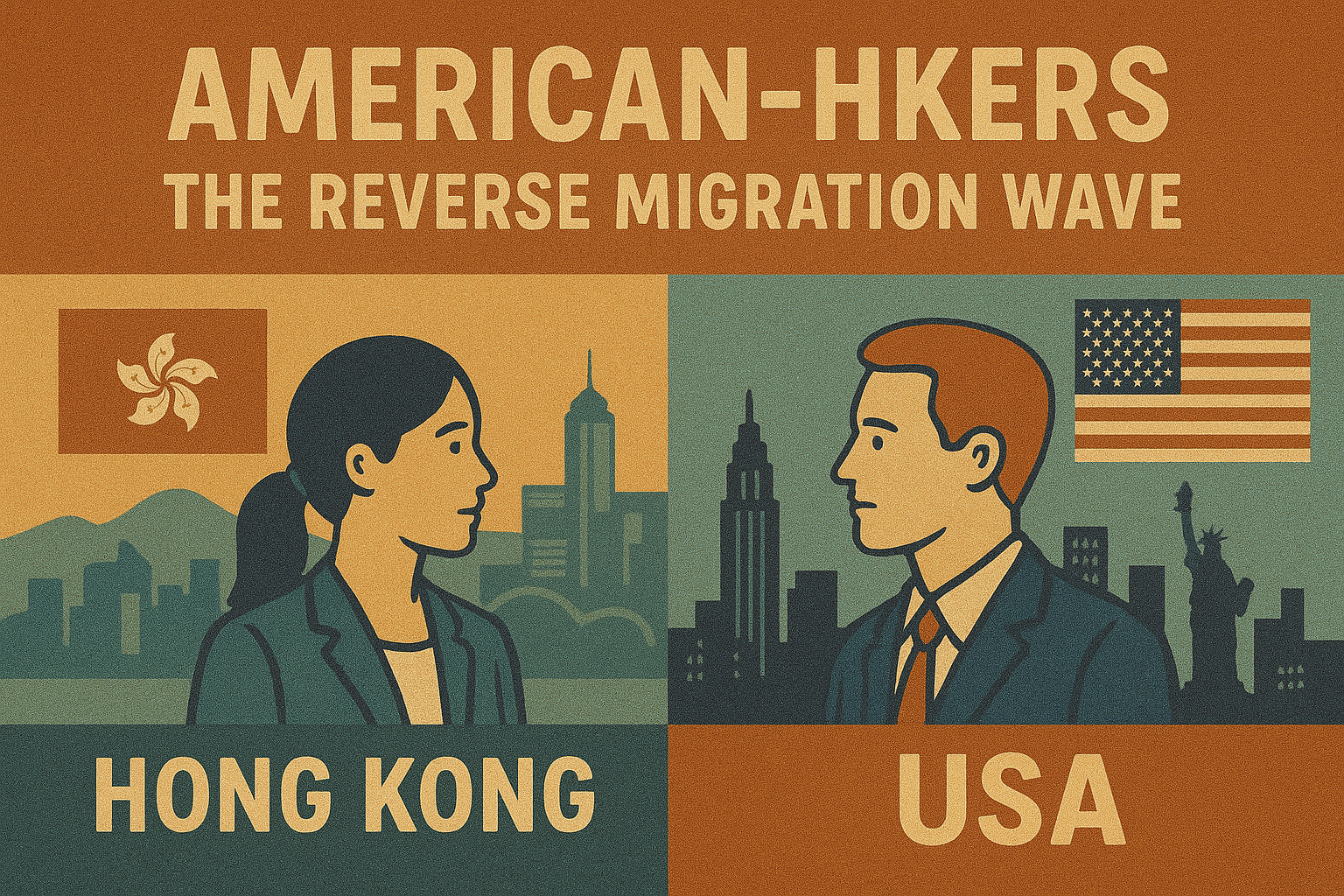

American-HKers: The Reverse Migration Wave
In the bustling streets of Hong Kong, amid the neon lights and skyscrapers, a lesser-known immigrant story unfolds. While much attention focuses on Hong Kongers flocking to the United States for freedom and opportunity, there’s a counterflow: Americans who’ve made the Special Administrative Region their home. Dubbed “American-HKers,” this group represents a fascinating mirror to the U.S.’s Hong Kong-American population. Drawing from demographic data and cultural insights, this post explores their dynamics, draws comparisons, and imagines Hollywood spins and practical applications for cultural consultants specializing in HK culture.
Who Are the American-HKers?
Hong Kong’s expat scene is vibrant, with Americans forming a key part. As of January 2023, the U.S. Consulate estimates around 70,000 Americans reside in Hong Kong, a dip from 85,000 in 2018 due to factors like the COVID-19 pandemic and political shifts. This makes them a small but influential slice of Hong Kong’s 7.5 million population. Many are professionals in finance, tech, education, or media, drawn by Hong Kong’s status as a global financial hub. Low taxes, efficient public transport, and a blend of East-West lifestyles are major pulls.
Demographically, American-HKers skew toward younger professionals and families. They’re often expatriates on temporary assignments, though some settle long-term. Integration isn’t seamless; cultural clashes abound. Hong Kong’s collectivist society, scoring low on individualism in cultural models, emphasizes group harmony and hierarchy over personal expression. Americans, accustomed to direct communication and autonomy, might find the indirect “face-saving” etiquette challenging. Workplaces are more hierarchical, with longer hours and less discretion at lower levels compared to U.S. norms. Socially, while Hong Kongers are polite, forming deep friendships can take time, and expats often stick to international circles. Yet, many embrace local customs, from dim sum brunches to hiking the Dragon’s Back trail, fostering a hybrid identity.
Comparing to U.S. Hong Kong-Americans
Flip the script to the U.S., where Hong Kong immigrants—often called HK-Americans—form a subset of the broader Chinese-American community. As of 2021, about 248,024 U.S. residents were born in Hong Kong, comprising roughly 10% of the 2.4 million Chinese immigrants. This group has grown amid waves tied to the 1997 handover, economic booms, and recent protests. Concentrated in places like San Francisco’s Bay Area and New York, they include students, professionals, and families seeking stability.
As immigrants, HK-Americans often pursue permanent settlement, contrasting American-HKers’ more transient stays. Both groups are educated and middle-to-upper class, but motivations differ: Americans in HK chase career adventures in a dynamic Asia hub, while HKers in the U.S. flee political uncertainty or seek better education and freedoms. Integration for HK-Americans involves navigating U.S. diversity, where they enrich Chinatowns with Cantonese flavors and entrepreneurial spirit. They’ve transformed Chinese-American communities, introducing middle-class norms and hybrid cuisines like soy-sauce Western dishes. Challenges include racism, identity struggles—balancing Hong Kong pride with American assimilation—and generational gaps.
In contrast, American-HKers enjoy “expat privilege” in a city that values Western expertise, but they grapple with isolation in a homogenous society (91.6% Han Chinese). HK-Americans integrate into a multicultural U.S., contributing to tech, finance, and culture, yet face stereotypes. Both embody transpacific ties: Americans bring individualism to HK’s collectivism, while HKers infuse U.S. innovation with resilience. Cultural differences highlight hierarchies in HK versus U.S. egalitarianism, and social groupings—race-based in America vs. less so in HK. Ultimately, American-HKers represent “brain gain” for Hong Kong amid its emigration woes, mirroring how HK talent bolsters the U.S.
Hollywood Projects from These Insights
These dual narratives scream cinematic potential. Imagine a rom-com like Crazy Rich Asians but reversed: “Expat Entanglements,” where a brash American banker in Hong Kong navigates family hierarchies and falls for a local activist, highlighting cultural mishaps like bungled Lunar New Year customs. Or a thriller series, “Neon Shadows,” drawing from post-2019 tensions, following an American-HKer caught in espionage between U.S. interests and Beijing’s grip, echoing real diplomatic strains.
For the flip side, a drama like “Handover Hearts” could chronicle a HK family’s U.S. immigration during the 1997 transition, exploring identity loss and rebirth—think Minari meets Hong Kong protests. Anthologies could juxtapose stories: an American adapting to HK’s fast-paced life versus a HKer facing U.S. suburbs. These projects would humanize migration, boost representation, and tap into U.S.-China relations buzz, potentially starring talents like Awkwafina or expat actors for authenticity.
Applications for HK Cultural Consultants
More immediately, this knowledge empowers cultural consultants specializing in Hong Kong. As bridges between worlds, consultants can advise American businesses expanding to HK on etiquette—like exchanging business cards with two hands or avoiding clock gifts (symbolizing death). For media, they ensure accurate portrayals in Hollywood scripts, preventing stereotypes like portraying all HKers as mainland-aligned. In education, consultants facilitate exchange programs, helping American students grasp HK’s Lingnan Cantonese roots and British colonial legacy.
Tourism firms could use insights to tailor experiences for American visitors, blending expat hotspots with local gems. In diplomacy or NGOs, understanding dual identities aids in fostering U.S.-HK ties, like refugee policies. Personally, consultants might coach American-HKers on integration, from learning Cantonese slang to navigating social harmony, turning cultural friction into synergy.
In essence, American-HKers and HK-Americans illustrate migration’s two-way street, enriching both societies. As global ties evolve, their stories offer endless inspiration—from silver screens to boardrooms—reminding us that home is where cultures collide and thrive.