
Comparing Work Cultures in Hong Kong and the United States: Blue- and White-Collar Dynamics and U.S. Political Variations
Comparing Work Cultures in Hong Kong and the United States: Blue- and White-Collar Dynamics and U.S. Political Variations
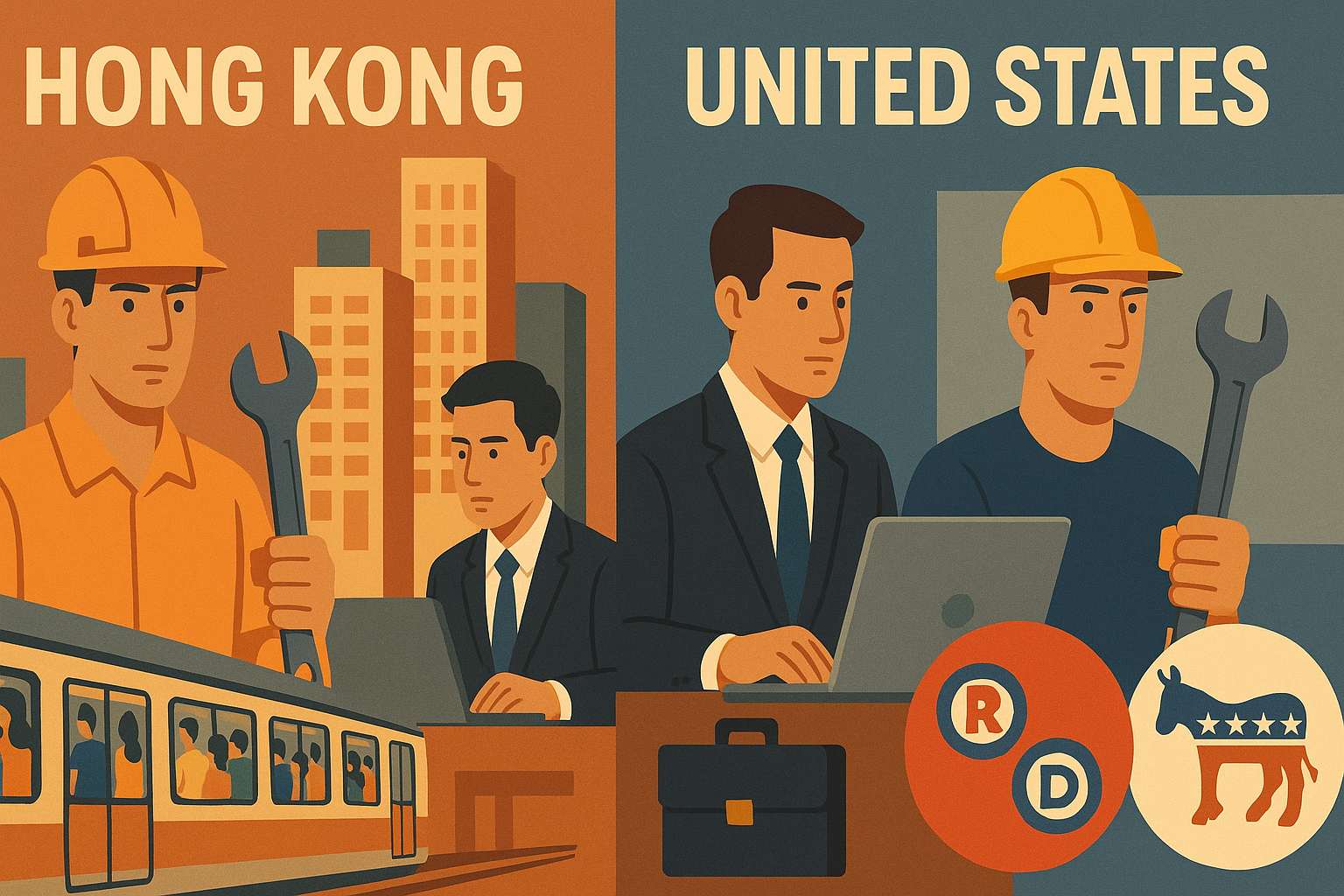
Work cultures reflect economic structures, historical influences, and societal values. Hong Kong (HK), a global financial hub with a dense urban economy, emphasizes efficiency and hierarchy, while the United States (US), a larger and more diverse market, prioritizes individualism and flexibility. This analysis compares blue- and white-collar experiences in both regions, drawing on labor statistics and cultural studies, and examines partisan differences in U.S. work ethics based on survey data.
Working Hours and Structural Frameworks
A key distinction lies in regulated and actual working hours. HK lacks a statutory maximum for most sectors, contributing to some of the world’s longest average annual hours. Data indicate HK workers log approximately 2,185 hours annually, with weekly averages around 43. In contrast, the US Fair Labor Standards Act mandates overtime pay beyond 40 hours weekly, resulting in lower averages of about 1,791 hours annually per OECD estimates. HK’s culture often normalizes extended hours without premium pay, while U.S. norms, though variable by industry, increasingly incorporate remote work and paid time off post-COVID.worldpopulationreview.com
White-Collar Work Cultures
White-collar sectors highlight competitive pressures differently. In HK’s finance industry, hierarchical structures dominate, with investment banking roles routinely exceeding 80–100 hours weekly. Employees prioritize group harmony and face-saving, reflecting collectivist scores on cultural dimensions. Job security concerns have risen amid 2024’s declining vacancies, leading to reduced mobility among professionals.quora.com
U.S. white-collar environments, particularly in tech and finance, allow greater autonomy at junior levels, fostering innovation but also burnout in high-stakes firms. Work-life balance indices rank U.S. cities higher than HK, with emphasis on personal discretion and hybrid models. However, satisfaction varies; white-collar workers report higher attachment than blue-collar counterparts.reddit.com
Blue-Collar Work Cultures
Blue-collar experiences reveal disparities in protections and conditions. HK’s construction and service sectors face harsh realities, including heat-related risks and an aging workforce projected to shrink amid labor shortages. Workers receive fewer public holidays than white-collar peers, and imported mainland labor intensifies competition, often at lower wages. Unionization remains limited, with community-based advocacy filling gaps.pmc.ncbi.nlm.nih.gov
In the US, blue-collar roles in manufacturing and trades benefit from stronger union presence in certain regions, offering better safety regulations and benefits. Yet, job satisfaction is lower, with workers feeling less respected and more detached. Recent trends show white-collar professionals considering trades for stability and higher earnings potential, blurring traditional divides.factorialhr.com
Partisan Differences in U.S. Work Ethics
Within the US, political affiliation influences perceptions of work ethic. Surveys reveal Republicans are more likely to attribute economic success to individual effort and hard work, viewing poverty as tied to lack of effort. Democrats, conversely, emphasize circumstantial factors like education access, discrimination, and systemic barriers. This aligns with broader ideological divides: Republicans favor personal responsibility and limited government intervention, while Democrats support policies enhancing work-life balance, such as union protections and social safety nets. These attitudes persist across collars, though blue-collar voters historically lean Republican, associating the party with traditional work values.pewresearch.orgcato.org
Conclusion
HK’s work culture prioritizes endurance and collective goals in a high-pressure environment, yielding productivity but at the cost of balance, particularly for blue-collar workers. The US offers more flexibility and protections, though inequalities remain. Partisan lenses in the US further nuance work ethics, with Republicans stressing individual merit and Democrats structural equity. As global labor markets evolve—HK importing talent and the US adapting to remote trends—these differences underscore the interplay of policy, culture, and ideology in shaping worker experiences.