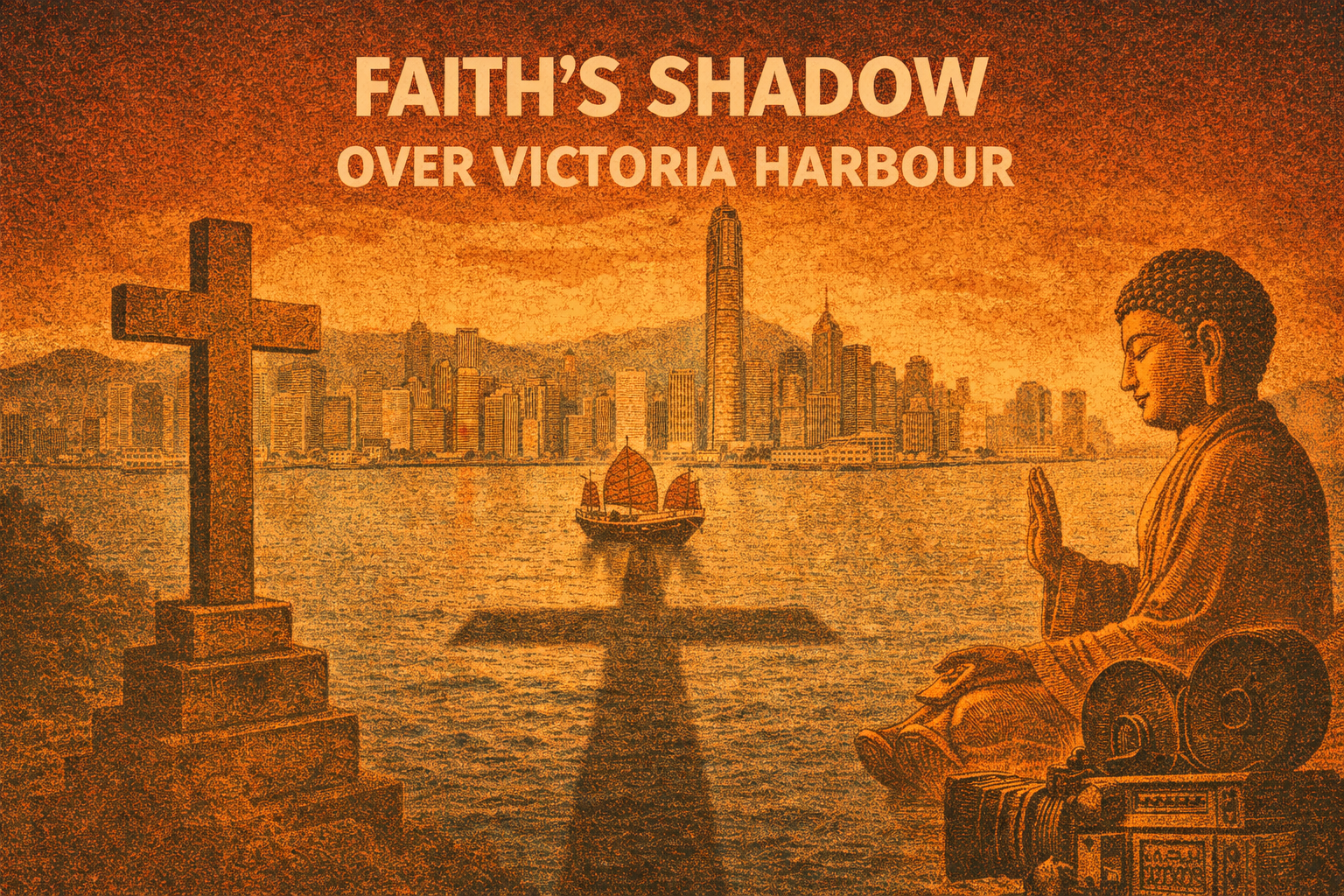
Faith’s Shadow Over Victoria Harbour
As I sit here in my Echoes of Empire office overlooking Victoria Harbour on this Christmas Eve, Wednesday, 24 December 2025, at 8:00 PM HKT, the city lights twinkle like distant stars amid the festive hum. Hong Kong, or 香港 (Hoeng1 gong2, Fragrant Harbour), pulses with a blend of carols and firecrackers, a reminder of its layered spiritual fabric. As a fledgling Hollywood cultural consultant specializing in Hong Kong culture, I often draw from this city’s resilient narratives to advise on scripts that capture its essence. Today, reflecting on the Protestant and broader Christian community’s evolution since Hong Kong became a British Crown Colony in 1842, I see a trajectory marked by expansion, adaptation, and now, subtle constriction—five years after the National Security Law’s enactment in 2020. This analysis, grounded in historical records and recent developments, reveals untapped stories ripe for cinematic exploration.
The seeds of Christianity in Hong Kong were planted alongside colonial ambitions. Following the Treaty of Nanking in 1842, which ceded the island to Britain, Protestant missionaries arrived swiftly. In 1843, Reverend Vincent John Stanton was appointed as the first Colonial Chaplain, establishing the Anglican presence that would grow into the Hong Kong Sheng Kung Hui. This era saw an influx of denominations, including Baptists, Methodists, and Presbyterians, who convened in an 1843 conference to strategize outreach to China via the new treaty ports. The British administration fostered this growth, viewing Christianity as a civilizing force aligned with imperial goals. Churches proliferated, providing not just worship but education and social services—hallmarks of Protestant influence. By the late 19th century, missions like the London Missionary Society had embedded themselves, translating Bibles and establishing schools that shaped generations.
Under colonial rule, Christianity’s role was multifaceted. It intertwined with trade and governance, as Western churches benefited from extraterritorial privileges. Yet, this was no monolithic imposition; local Chinese converts adapted the faith, blending it with Confucian values in what became a hybrid 基督教 (Gaai1 duk1 gaau3, Christianity). Post-World War II, Hong Kong emerged as a hub for Chinese Protestant Bible publishing after 1948, when mainland restrictions forced operations southward. The Hong Kong Bible House distributed millions of copies globally, cementing the city’s status as a spiritual lifeline for diaspora communities. By the 1980s, over 70 Protestant denominations operated here, influencing everything from philanthropy to politics. Figures like Bishop Ronald Hall championed social justice, aiding refugees and advocating for workers’ rights amid rapid urbanization.
The 1997 handover to China marked a pivot. Initially, the “one country, two systems” framework preserved religious freedoms, with churches continuing as vibrant centers. However, tensions simmered as Beijing’s influence grew. The 2019 protests saw Christian leaders, including pastors from evangelical groups, vocal in calls for democracy, drawing on biblical themes of justice and liberty. Then came the National Security Law on 30 June 2020, criminalizing secession, subversion, terrorism, and foreign collusion. Five years on, its impact on the Christian community is evident in self-censorship and exodus. Sermons once critiquing inequality now tread carefully to avoid subversion charges. Some clergy have aligned closer to pro-Beijing stances, while others face scrutiny for international ties—viewed as potential “collusion.” The 2024 Safeguarding National Security Ordinance expanded offenses, including anti-espionage measures that could target religious organizations with overseas links. Reports indicate jailing of activists with Christian affiliations and a chill on faith-based gatherings, though outright bans remain absent. Believers persist, but the law’s shadow looms, prompting emigration and quieter observances.
This history, from colonial cradle to contemporary caution, offers fertile ground for Hollywood narratives. As a consultant, I envision stories that humanize these shifts without sensationalism. Picture a biopic on a 19th-century missionary like Stanton, navigating opium trade ethics and cultural clashes—a tale of moral ambiguity echoing “The Mission” but set against Victoria Peak’s fog-shrouded trails. Or a drama inspired by post-1949 Bible smugglers, where underground printers in Kowloon evade mainland crackdowns, blending espionage thriller with spiritual quest, akin to “Argo” with Cantonese hymns. Fast-forward to the NSL era: a character-driven film about a pastor’s family torn between faith and loyalty, where a daughter’s protest involvement tests patriarchal bonds—provoking questions of subversion versus sermon. These could draw from real inspirations, like escapes to Hong Kong in films such as “China Cry,” adapting persecution tales for modern audiences. Imagine a ghost story weaving Protestant folklore with colonial haunts, where a haunted church in Central reveals buried imperial sins, merging horror with historical reckoning. Such scripts could spotlight unsung heroes, like women in missionary schools challenging gender norms, or interfaith dialogues amid handover anxieties.
In advising studios, I emphasize authenticity: use Traditional Chinese subtitles, Cantonese dialogue for grit, and visuals capturing neon-lit chapels against skyscrapers. These stories aren’t just entertainment; they preserve Hong Kong’s voice amid global shifts. On this 聖誕前夕 (Sing3 daan3 cin4 zik6, Christmas Eve), as choirs sing in churches across the territory, the Christian community’s endurance inspires resilience. Yet, five years post-NSL, its future hangs in balance— a provocative reminder that faith, like empires, adapts or fades.