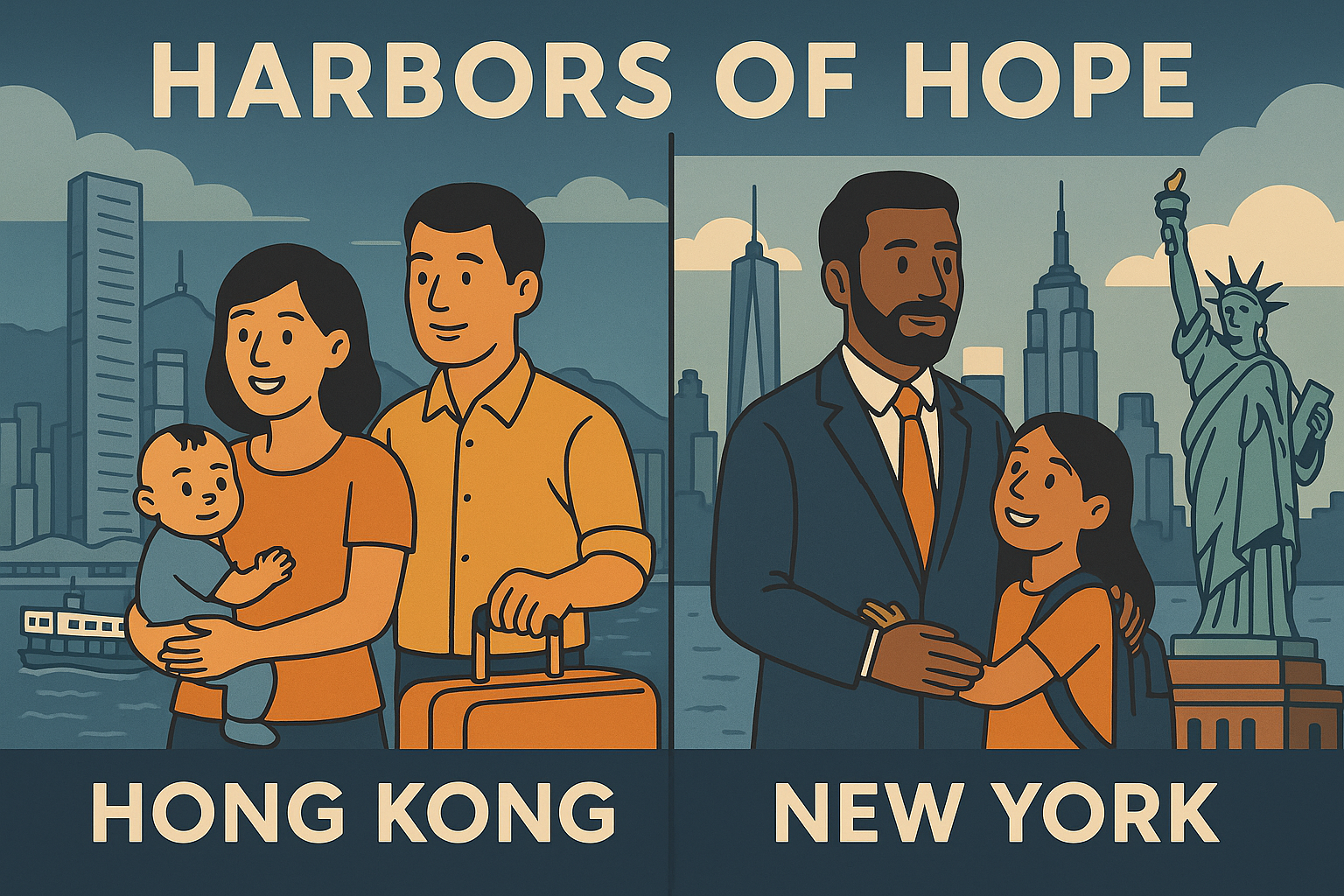

Harbors of Hope: Hong Kong and New York as Immigrant Cities
Hong Kong and New York City stand as global symbols of opportunity and resilience, shaped profoundly by waves of immigrants and refugees. Both have served as gateways for those seeking safety and prosperity amid turmoil. This analysis draws from historical patterns, highlighting how Hong Kong’s British colonial status provided a buffer from mainland China’s upheavals, attracting refugees, while New York evolved as a melting pot for diverse global migrations. By examining their histories, policies, and societal impacts, we can compare their roles without endorsing or critiquing underlying political contexts.
Hong Kong’s identity as a city of immigrants is rooted in its colonial era. Established as a British Crown Colony in 1842, it offered relative stability compared to the mainland’s instability. The mid-20th century marked a pivotal influx. Following the 1949 Communist victory in China, hundreds of thousands fled the civil war’s aftermath. By 1956, Hong Kong’s population had swelled to 2.5 million, with one-third classified as refugees. Many crossed borders illicitly, including swimmers braving shark-infested waters to reach the colony. Subsequent crises amplified this: Mao Zedong’s Great Leap Forward (1958-1962) and Cultural Revolution (1966-1976) drove further escapes, with estimates of tens of thousands arriving annually during peaks. These migrants, often from Guangdong province, brought skills in manufacturing and trade, fueling Hong Kong’s economic boom into a financial hub.
Beyond Chinese refugees, Hong Kong hosted others. During World War II, it sheltered individuals fleeing Japanese occupation in nearby regions. In the 1930s and 1940s, it provided temporary refuge to Jewish Europeans escaping Nazi persecution, though policies later shifted toward expulsion. Post-1975, nearly 200,000 Vietnamese boat people arrived, escaping communist rule; Hong Kong managed camps under international agreements until repatriation in the 1990s. Immigration policies evolved from open borders to stricter controls by the 1970s, including the “touch-base” system allowing those reaching urban areas to stay. This history underscores Hong Kong’s role as a neutral haven, its colonial governance insulating it from mainland policies while absorbing displaced populations that diversified its culture and economy.
New York City, conversely, has a longer, more varied immigration narrative tied to America’s expansive ethos. From its Dutch origins in the 1600s as New Amsterdam, it attracted settlers from Europe, including Protestants fleeing religious strife. The 19th century saw massive waves: Irish immigrants arrived en masse during the 1840s potato famine, followed by Germans and Scandinavians. Between 1880 and 1920, over 1.5 million entered via Ellis Island, operational from 1892, including Italians, Eastern European Jews escaping pogroms, and Poles. These groups transformed neighborhoods like Little Italy and the Lower East Side into ethnic enclaves.
The 20th century broadened sources. Post-World War I quotas limited Europeans, but the Great Migration (1910-1970) drew over a million African Americans from the South, seeking industrial jobs and escaping Jim Crow laws—often viewed as internal refugees. After 1965’s Immigration and Nationality Act, inflows shifted to Latin America, Asia, and the Caribbean. Puerto Ricans, Dominicans, and Chinese formed vibrant communities, with Chinatown expanding via Hong Kong and Taiwanese migrants. Refugees included Cubans in the 1960s, Soviets in the 1970s-1980s, and more recently, those from war-torn regions like Afghanistan and Ukraine. New York’s policies, influenced by federal laws, emphasized assimilation through public education and labor markets, contributing to its status as a cultural mosaic where immigrants comprise about 37% of the population today.
Comparing the two reveals parallels and distinctions. Both cities owe their dynamism to immigrants: Hong Kong’s refugees powered its shift from entrepôt to manufacturing powerhouse, much as New York’s fueled industrialization and finance. Economically, they attracted the ambitious—Hong Kong with low taxes and free markets under British rule, New York with the American Dream. Culturally, both foster hybrid identities; Cantonese dialects blend with English in Hong Kong, while New York’s multilingual streets echo global tongues. As safe havens, Hong Kong shielded from communist policies, akin to how New York offered refuge from European autocracies and wars.
Differences stem from scale and sources. Hong Kong’s inflows were predominantly Chinese (over 90% in mid-century waves), creating a more homogeneous immigrant base tied to regional geopolitics, whereas New York’s were globally diverse, reflecting broader transatlantic and transpacific shifts. Policies diverged: Hong Kong’s colonial administration imposed ad-hoc measures, like detaining Vietnamese in closed camps, contrasting New York’s federal framework with paths to citizenship. Integration varied too—Hong Kong’s “squatter” settlements housed refugees in makeshift conditions before urban redevelopment, while New York’s tenements evolved into integrated boroughs, though challenges like discrimination persisted in both.
In modern contexts, both face evolving migration pressures. Hong Kong’s 1997 handover to China altered dynamics, with recent emigration outflows amid political changes, while New York grapples with federal debates on borders and asylum. Yet, their legacies endure: immigrants built skylines, cuisines, and innovations, from Hong Kong’s dim sum empires to New York’s bagel shops.
Ultimately, Hong Kong and New York exemplify how cities can absorb displacement, turning it into strength. Their stories highlight migration’s role in urban evolution, offering objective insights into global human movement without romanticizing hardships.