
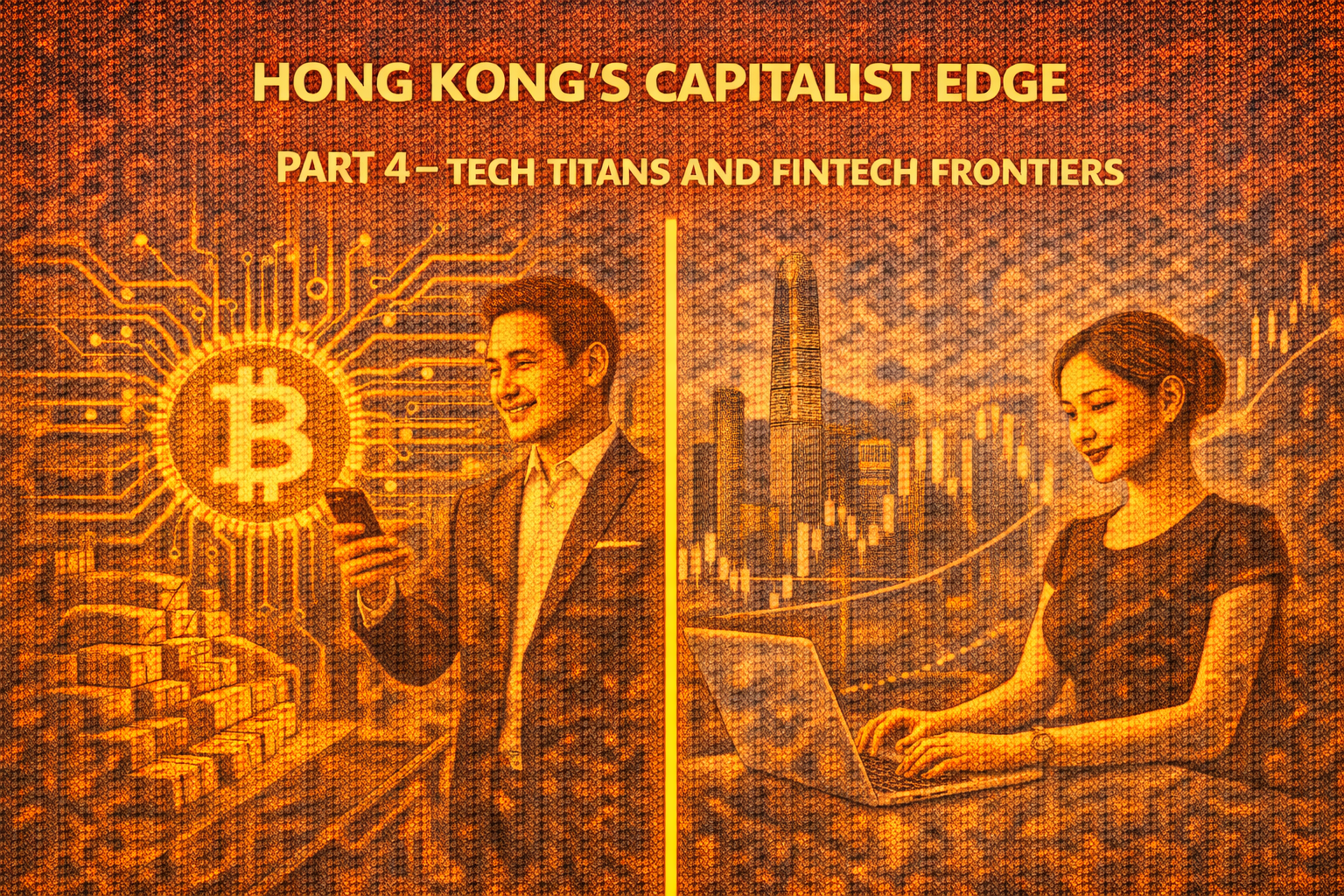

Hong Kong’s Capitalist Edge
Part 4: Tech Titans and Fintech Frontiers
As I continue this exploration of Hong Kong’s intricate dance with capitalism, we’ve journeyed through its historical roots, economic engines, and cultural undercurrents in the previous installments. Now, in this penultimate chapter, I turn my lens to the city’s burgeoning tech sector, with a particular emphasis on financial technology—fintech. Hong Kong’s tech landscape exemplifies capitalism’s relentless drive for innovation, where market forces propel rapid advancements amid global competition. This is not merely about gadgets or apps; it’s about how tech reshapes capital flows, disrupts traditional industries, and reinforces Hong Kong’s position as a financial hub. I’ll examine this objectively, highlighting key dynamics without endorsing or critiquing the system itself.
Hong Kong’s tech ecosystem thrives on its strategic geography and laissez-faire economic policies, fostering an environment where startups and giants alike pursue profit through ingenuity. The city’s tech scene has evolved from a manufacturing base in the mid-20th century to a hub for software, AI, and blockchain today. Capitalism here manifests in the form of venture capital influxes, with firms like Sequoia Capital China and Horizons Ventures injecting billions into local ventures. This capital flow encourages risk-taking, where entrepreneurs leverage Hong Kong’s proximity to mainland China for talent and markets, while benefiting from its independent legal system that protects intellectual property. The result? A vibrant marketplace where ideas compete freely, and success is measured by scalability and returns.
Fintech stands out as the crown jewel of this sector, blending finance with technology to streamline transactions, lending, and investments. Hong Kong’s fintech boom is driven by its status as an international financial center, handling trillions in daily trades. Companies like WeLab and TNG Wallet exemplify this, offering digital banking and mobile payments that challenge traditional banks. These innovations capitalize on regulatory sandboxes provided by the Hong Kong Monetary Authority, allowing tested experiments in a controlled environment before full market deployment. Capitalism’s invisible hand is evident: competition from fintech disrupts incumbents, forcing efficiency and lower costs for consumers. For instance, peer-to-peer lending platforms have democratized access to capital, enabling small businesses to bypass cumbersome bank loans. Yet, this also introduces risks like data privacy concerns and market volatility, which the system absorbs through adaptive regulations rather than outright bans.
Provocatively, one might question whether this fintech surge truly empowers the masses or merely consolidates wealth among a tech-savvy elite. Objectively, data shows fintech has expanded financial inclusion—over 70% of Hong Kong adults now use digital wallets—but it also widens gaps, as those without tech literacy fall behind. In capitalist terms, this is efficiency at work: resources flow to the most productive uses, rewarding innovators who navigate regulatory hurdles and consumer demands. Hong Kong’s fintech landscape further integrates with global trends, such as cryptocurrency exchanges like Crypto.com, which exploit the city’s tax advantages and connectivity to attract international talent. This cross-border dynamism underscores capitalism’s borderless nature, where Hong Kong serves as a gateway between East and West.
Shifting gears, let’s consider how these elements could inform Hollywood projects. Incorporating Hong Kong’s tech and fintech themes into films or series can add layers of authenticity, especially when portraying the upper class. Culturally, Hong Kong’s elite often embody a blend of Eastern discipline and Western ambition, residing in luxury high-rises like those in Mid-Levels or The Peak, where fintech moguls host exclusive networking events amid skyline views.
A screenplay could feature a protagonist—a fintech entrepreneur—navigating high-stakes deals in boardrooms overlooking Victoria Harbour, emphasizing the cultural fit through subtle details: tailored suits from Savile Row paired with jade cufflinks, symbolizing a fusion of global capitalism and traditional status symbols. Provocatively, such narratives could explore moral ambiguities, like a character using AI-driven algorithms for predatory lending, without bias—simply presenting the capitalist incentives at play. This fits the upper class’s ethos of discretion and legacy-building, where family offices invest in startups not just for profit, but to secure generational wealth. Hollywood could draw from real archetypes, like tycoons who jet between Silicon Valley and Hong Kong, to create compelling anti-heroes or visionaries, making the story resonate with audiences familiar with tech-driven dramas.
In essence, Hong Kong’s tech and fintech sectors illustrate capitalism’s capacity for transformation, turning abstract ideas into tangible economic power. The city’s low barriers to entry and emphasis on meritocracy—however imperfect—fuel this engine, positioning it as a model for urban innovation. Yet, as with any system, it raises straightforward questions about equity and sustainability in an era of rapid digital change.
Stay tuned for the final installment, where I’ll delve into Hong Kong’s consulting world, examining how advisory firms navigate capitalist complexities. What insights might they offer on the city’s future?