Hong Kong’s Sacred Synergy: Faiths in Flux
As I sit here in Hong Kong on December 27, 2025 (HKT), reflecting on yesterday’s Boxing Day, I find myself pondering the city’s understated spiritual depth. On December 26, I made my way to the Buddha Hall at 天后 (Tin Hau, Empress of Heaven) to join the opening segment of the 梁皇寶懺 (Loeng Wong Bou Caam, Emperor Liang’s Jeweled Repentance) ceremony—a ritual of compassionate atonement rooted in Buddhist tradition, where participants seek to cleanse karma through chants and prostrations. The air was thick with incense, the rhythmic drumming echoing ancient pleas for redemption. Afterward, I rejoined my parents for an overnight stay at the Hong Kong Jockey Club’s Beas River Country Club (BRCC), a serene retreat blending equestrian heritage with modern leisure, its chalets offering a quiet contrast to the temple’s fervor. This personal juxtaposition— from sacred repentance to familial repose—mirrors Hong Kong’s broader religious landscape: a pragmatic fusion where diverse faiths coexist without fanfare, occasionally intersecting in ways that challenge simplistic views of a “secular” metropolis.
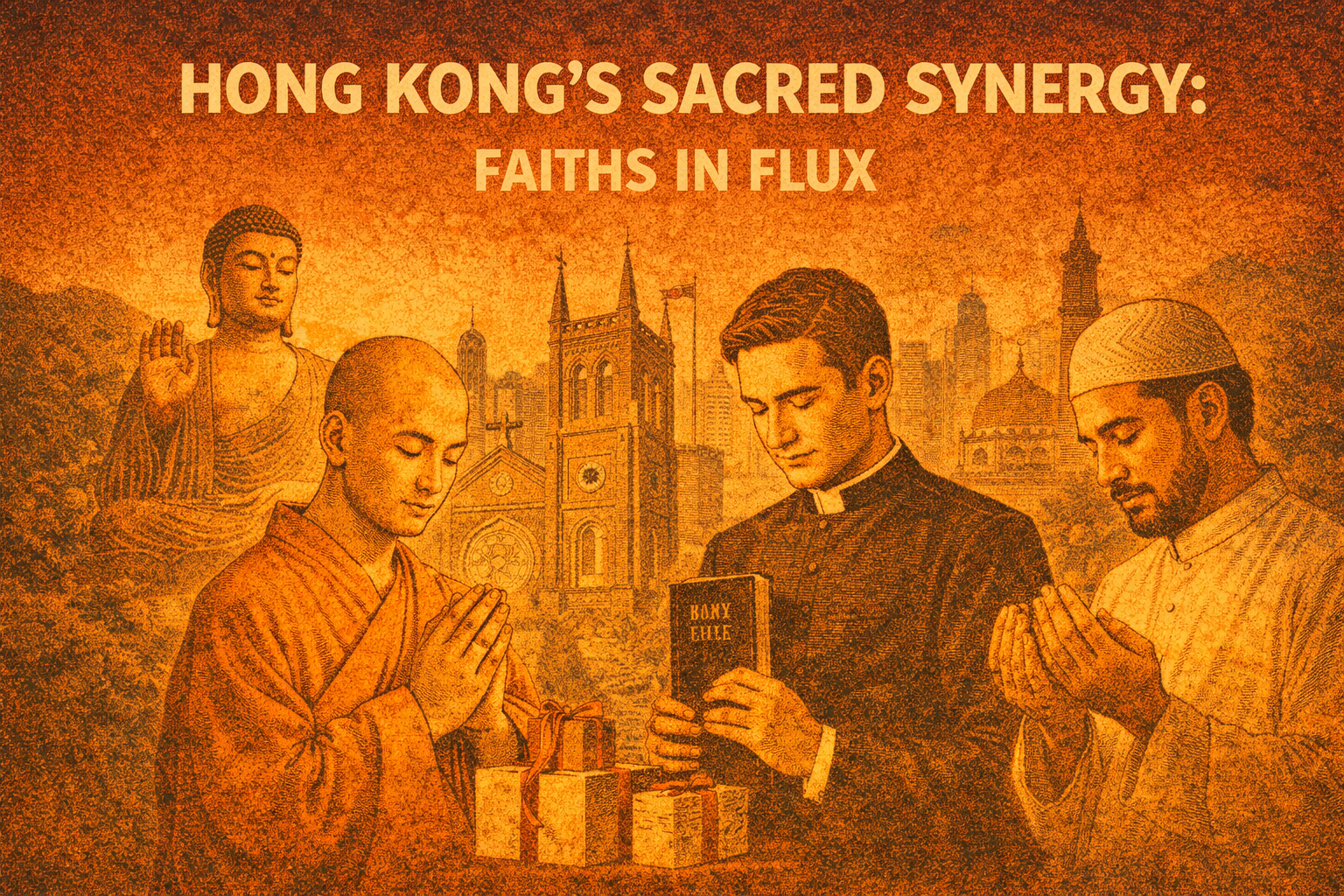
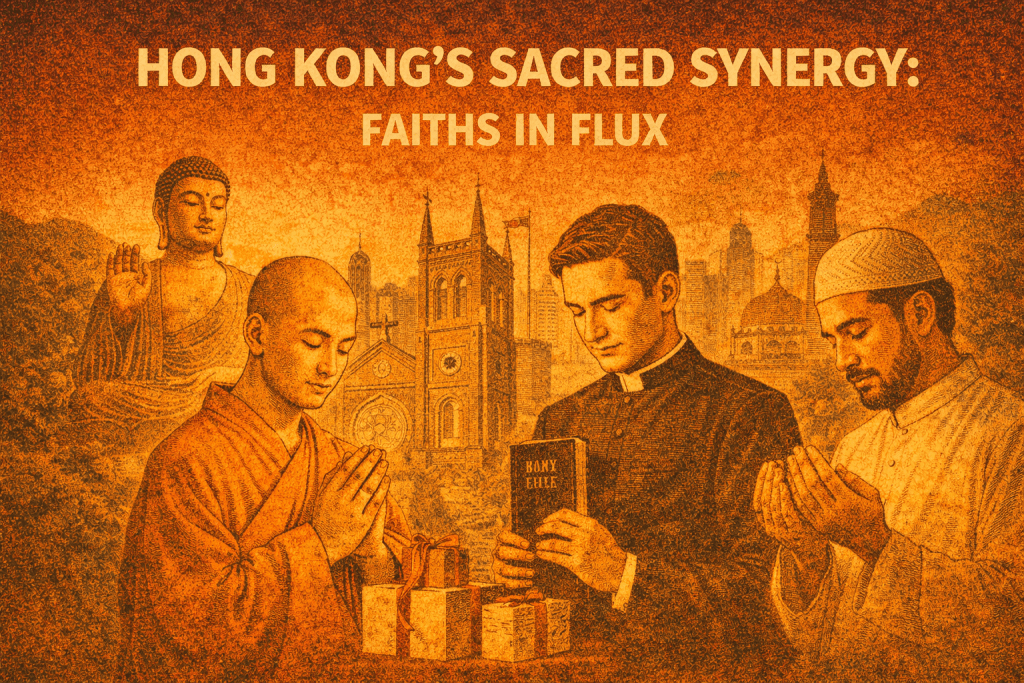
Hong Kong’s population of about 7.5 million harbors a mosaic of beliefs, with no single religion dominating. Roughly 14% identify as Buddhist, drawing from Theravada, Mahayana, and Vajrayana traditions, with communities centered around monasteries like Po Lin on Lantau Island, home to the iconic Tian Tan Buddha, and Tsz Shan Monastery in Tai Po, which emphasizes Dharma preservation. Protestant Christians, numbering around 1,040,000, form a significant group, with denominations including Baptists, Methodists, and Anglicans; their presence dates to the 1840s, fostering education and welfare through churches like the Hong Kong Baptist Church. Roman Catholics, about 400,000 strong, maintain a parallel structure, with the Diocese of Hong Kong overseeing parishes and schools, blending European roots with local adaptations. The Jewish community, comprising around 5,000 mostly expatriates, revolves around synagogues like Ohel Leah in Mid-Levels and Kehilat Zion in Kowloon, supporting Orthodox, Progressive, and Chabad practices in a diaspora setting. Muslims, estimated at 300,000, include Hui Chinese, South Asians, and Indonesians; key hubs are the Kowloon Masjid and Islamic Centre, which facilitate halal services and community outreach. Daoist adherents, often overlapping with folk practices, exceed one million, venerating deities at sites like Wong Tai Sin Temple and Ching Chung Koon, where rituals emphasize harmony with nature. Chinese folk religion, practiced by many ethnic Chinese, integrates Confucian ethics, ancestral veneration, and shamanistic elements, manifesting in festivals and household altars without formal affiliation.
What intrigues me most is not the isolation of these groups but their subtle interweavings—provocative in a city stereotyped as materialistic. Interfaith activities, though not ubiquitous, reveal pragmatic collaborations. The Asia Pacific Interfaith Network for Migrants (AP INFORM), founded in 2010, unites Christian, Muslim, Buddhist, and Hindu communities to advocate for migrant rights, hosting dialogues on shared social issues. Events like the 2025 World Religion Day gathering at EY Wavespace in Central brought together faith leaders for discussions on “faith and true wealth,” fostering neutral exchanges amid economic disparities. The upcoming International Conference on Interfaith Dialogue and World Religions in Kowloon City, slated for 2026, promises academic panels on pluralism. Workshops at Africa Center Hong Kong explore religious diversity through tours of mosques, temples, and churches, while the “Coming Together to Build a Better World” Interfaith Concert at Chinese University of Hong Kong in November 2025 will feature multicultural performances. These initiatives, often grassroots, underscore how Hong Kong’s faiths navigate coexistence without enforced harmony, occasionally clashing over urban space but more frequently aligning on welfare.
As a fledgling Hollywood cultural consultant specializing in Hong Kong culture, I see untapped narrative potential in this religious tapestry. Stories could provoke audiences by subverting expectations: imagine a thriller where a Buddhist monk and a Muslim imam collaborate to unravel a corporate conspiracy, drawing on interfaith networks like AP INFORM to highlight migrant exploitation in a global city. Or a romantic drama inspired by the Jewish community’s expatriate life, where a Progressive synagogue wedding intersects with Daoist family rituals, exploring identity in diaspora. A historical epic might trace Protestant missionaries’ arrival in the 1840s, blending with Chinese folk ancestor worship to depict colonial tensions and hybrid faiths. Even my own Boxing Day experience could inspire a coming-of-age tale: a young protagonist torn between the solemn 梁皇寶懺 (Loeng Wong Bou Caam, Emperor Liang’s Jeweled Repentance) at 天后 (Tin Hau, Empress of Heaven) and a family retreat at BRCC, symbolizing the pull between spiritual duty and secular comfort. These narratives, grounded in Hong Kong’s neutral pluralism, could challenge Hollywood’s often monolithic portrayals of Asian spirituality, offering straightforward yet provocative insights into resilience amid flux.
In a world quick to polarize, Hong Kong’s faiths remind us that diversity thrives not through spectacle but quiet adaptation. As I build my career, I’ll advocate for such stories—ones that capture this synergy without bias, inviting viewers to question their own assumptions.