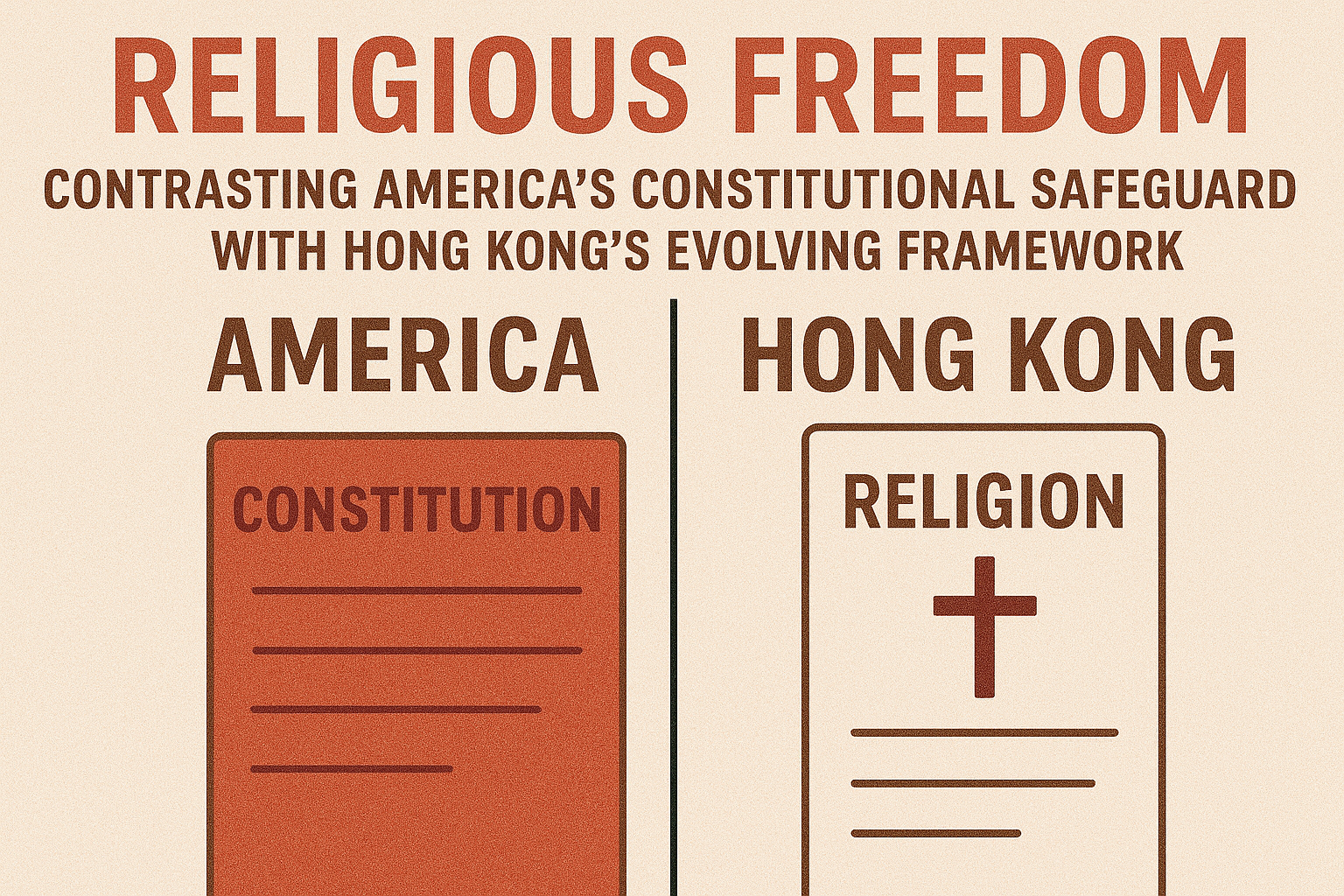

Religious Freedom: Contrasting America’s Constitutional Safeguard with Hong Kong’s Evolving Framework
Religious freedom stands as a cornerstone of human rights, allowing individuals to practice, change, or abstain from religion without fear of persecution. In the United States, this principle is deeply embedded in the nation’s founding documents, particularly the First Amendment to the Constitution, which prohibits the establishment of a state religion and protects the free exercise of faith. This has fostered a diverse religious landscape where Hinduism, Islam, Buddhism, Judaism, Wicca, Christianity, and countless other beliefs coexist. The user mentioned the Second Amendment in relation to these protections, but it primarily concerns the right to bear arms; religious freedoms are chiefly safeguarded by the First Amendment’s clauses on religion, speech, assembly, and petition. In contrast, Hong Kong, as a Special Administrative Region (SAR) of China under the “one country, two systems” principle, also enshrines religious freedom in its Basic Law. However, recent political developments have introduced complexities. This post objectively compares the two systems, drawing on legal frameworks, government practices, and societal dynamics to highlight similarities and differences.
In the United States, religious freedom is robustly protected through constitutional and legal mechanisms. The First Amendment states: “Congress shall make no law respecting an establishment of religion, or prohibiting the free exercise thereof.” This dual protection—the Establishment Clause and the Free Exercise Clause—ensures government neutrality toward religion while allowing individuals to practice freely. Landmark Supreme Court cases, such as Employment Division v. Smith (1990) and Burwell v. Hobby Lobby (2014), have refined these rights, balancing them against compelling state interests like public health or anti-discrimination laws. As a result, Americans can openly practice diverse faiths: mosques, temples, synagogues, and pagan circles operate without state interference. Religious organizations enjoy tax-exempt status, and faith-based schools receive public funding under certain conditions, provided they meet secular standards. Societally, while tensions exist—such as debates over religious symbols in public spaces or accommodations for beliefs—the U.S. ranks highly in global indices for religious liberty. For instance, Pew Research Center reports that the U.S. has low government restrictions on religion compared to many nations, though social hostilities can occur. This framework supports a pluralistic society where over 70% of adults identify with a religion, including growing non-Christian populations like Muslims (1.1%) and Hindus (0.7%). Government practices reinforce this: federal laws like the Religious Freedom Restoration Act (1993) require strict scrutiny for burdens on religious exercise. Even during crises, such as the COVID-19 pandemic, courts often struck down restrictions deemed overly burdensome on worship. Overall, the U.S. system emphasizes individual rights, judicial oversight, and minimal state involvement in religious affairs, creating an environment where faiths thrive amid diversity.
Hong Kong’s approach to religious freedom, while formally protective, operates within a distinct political context influenced by its ties to mainland China. The Basic Law, enacted in 1997 upon handover from British rule, guarantees “freedom of conscience” and “freedom of religious belief,” allowing residents to preach, conduct, and participate in religious activities publicly. This mirrors international standards, incorporating elements of the International Covenant on Civil and Political Rights. Religious groups are not required to register but can do so for benefits like tax exemptions. Diverse faiths are practiced: Buddhism and Taoism are prominent, alongside Christianity (about 20% of the population), Islam, Hinduism, and others. The government oversees some temples through the Chinese Temples Committee and provides subsidies for religious schools, which constitute a significant portion of the education system. Interfaith activities are common, with leaders from Buddhist, Catholic, Confucian, Muslim, Christian, and Taoist groups participating in events promoting harmony. Societal attitudes are generally tolerant; a 2023 survey rated religious freedom at 7.34 out of 10. However, recent developments have raised concerns. The 2020 National Security Law (NSL) and the 2024 Safeguarding National Security Ordinance have expanded government powers, leading to arrests for sedition that may intersect with religious expression, such as commemorating the 1989 Tiananmen Square events. Religious schools must now incorporate national security education, and churches have reported self-censorship, avoiding politically sensitive sermons. Falun Gong practitioners, banned in mainland China, can operate in Hong Kong but face harassment from pro-Beijing groups. Beijing’s “Sinicization” policy, which aligns religions with socialist values, has influenced local churches, with some displaying national flags and emphasizing patriotism. Freedom House downgraded Hong Kong’s religious freedom score to 3 out of 4 in 2025, citing increased Chinese Communist Party control and declines in church attendance due to emigration and political pressures. Despite these issues, overt persecution is rare, and religious leaders continue interfaith dialogues, including visits between Hong Kong and mainland bishops.
Comparing the two, both the U.S. and Hong Kong affirm religious freedom in their foundational laws, promoting tolerance and diversity. The U.S. benefits from an independent judiciary and separation of powers, enabling consistent enforcement against encroachments. Hong Kong’s system, while autonomous on paper, faces pressures from mainland China’s authoritarian approach, where religions must align with state ideology. This has led to subtle restrictions in Hong Kong, such as self-censorship and event cancellations, contrasting with the U.S.’s more unfettered environment. Public perception in Hong Kong remains positive, but international observers note a downward trend amid broader civil liberty erosions. Ultimately, while America’s model emphasizes individual liberty, Hong Kong’s reflects a balance between autonomy and national integration, with ongoing evolutions shaping its future. As global dynamics shift, monitoring these frameworks remains essential for understanding religious pluralism worldwide.