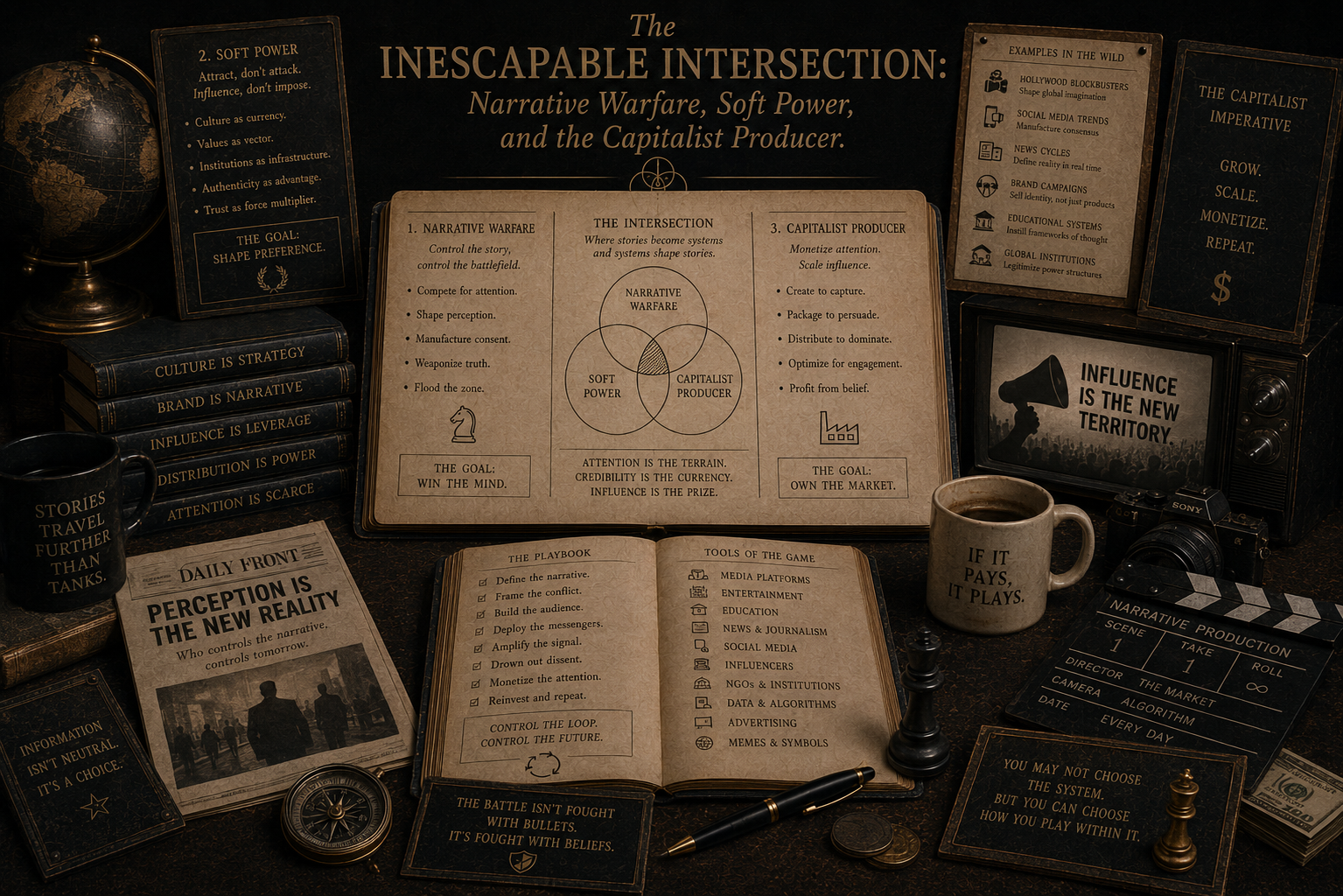

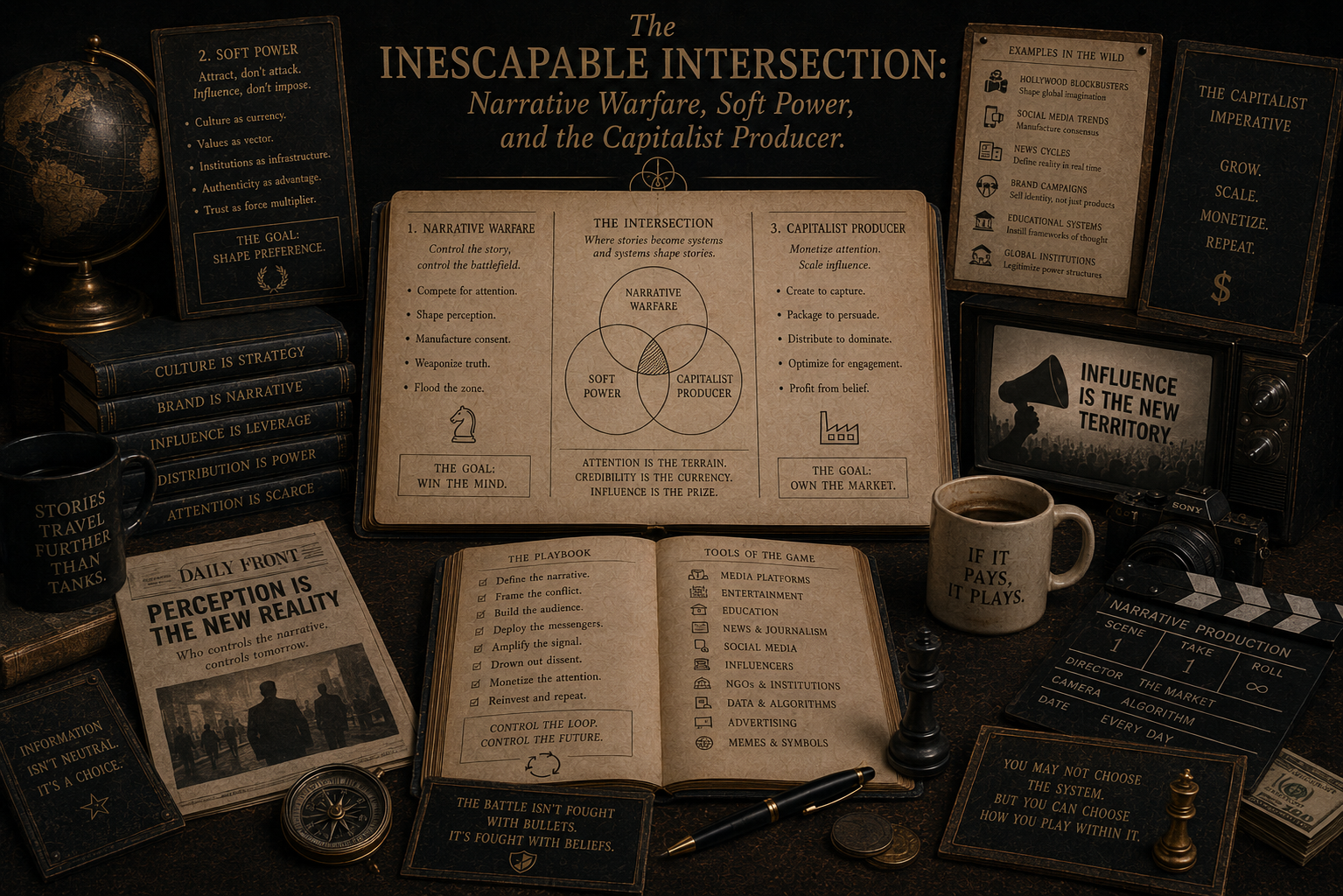
The Inescapable Intersection: Narrative Warfare, Soft Power, and the Capitalist Producer.
The air is still, yet the spirit remains restless. Welcome to Wednesday’s Personal Opinion-Editorial.
It is Wednesday, the 17th of June 2026. While I deeply wish it were not the case, we must confront an uncomfortable global reality: entertainment and politics are entirely, inescapably intertwined. In the international arena, an independent executive cannot afford to be naive about how narrative is weaponized. As a producer, my philosophy is firmly rooted in a market-driven, capitalist perspective. My goal is to tell stories that sell, remaining entirely authentic to whatever culture I am representing and fiercely faithful to the source material I am adapting. In my current slate, this means defending the raw, unvarnished authenticity of Hong Kong culture for Eurasia Rising, and protecting the integrity of Jacqueline Carey’s complex world for Kushiel’s Legacy: The Terminus. However, this capitalist commitment to authenticity places me in direct opposition to a much larger, state-driven apparatus.
The Propaganda Paradigm and the Weaponization of Soft Power
Where I see commerce and cultural fidelity, the Chinese Communist Party (CCP) sees state subordination. Ever since Chairman Mao, the Party has viewed entertainment strictly as a mechanism for ideological engineering. Mao was, at his core, a master propagandist who recognized that narrative is a weapon just as potent—if not more so—than conventional kinetic warfare.
From a strategic standpoint, the logic is clear: why rely on overt military force when you can infiltrate an adversary with your own agents, sow domestic discord, and systematically weaponize soft power? Scholars, industry insiders, and journalists like Chris Fenton, Aynne Kokas, Erich Schwartzel, and investigators at The Epoch Times such as Joshua Phillips and Tiffany Meier have all meticulously analyzed Hollywood’s historical relationship with Beijing. Their collective conclusion is definitive: no amount of financial incentives or market access will ever entice the PRC to liberalize. Instead, history proves that the CCP routinely exploits the West’s goodwill and good faith for its own asymmetric benefit. One need only look at how the Party has progressively expanded its influence over Hollywood’s creative choices since 1997.
The Redlines of Modern Storytelling
This geopolitical chokehold severely limits the stories that can be told. For instance, if Lewis Tan’s series adaptation of the David Ignatius spy thriller, Quantum Spy, is successfully and faithfully produced, I confidently predict it will face an absolute ban in Hong Kong, Macau, and mainland China. The script places the CCP’s Ministry of State Security (MSS) as the central antagonist losing a high-stakes quantum computing arms race—a premise entirely unacceptable to state censors.
I fervently hope Quantum Spy becomes a massive global success despite being locked out of the Chinese market. Frankly, I am exhausted by the industry’s cowardice—the refusal to portray Chinese antagonists or tackle narratives exposing the CCP’s weaponization of entertainment and its deployment of United Front Work Department agents. Current global headlines reveal exactly how deep certain foreign governments are in the Party’s pockets. The world is swimming in brilliant, high-stakes story inspiration, if only producers possessed the courage to defy Beijing.
Consider the untapped potential of genre fiction, like time travel. Why haven’t we seen a mixed-race protagonist time-traveling across global history? It is a creative shame that the BBC’s Doctor Who historically focused so heavily on Western and British history at the expense of rich East Asian epochs. If Chinese history could be told authentically—entirely unburdened by the paranoid scissors of CCP censors—the narrative possibilities would be limitless.
The Reality on the Ground
As an executive, I am pragmatic enough to accept a hard truth: unless the current hybrid authoritarian-totalitarian regime across the border is replaced by a free system, my projects cannot be authentically produced or co-produced within mainland China, Macau, or even my home city. In fact, due to the intense political zeal of the current Chief Executive, Hong Kong’s entertainment redlines and censorship frameworks have become noticeably stricter and more unpredictable than those across the border.
Because I cannot control macro-politics, I must focus entirely on controlling my internal operational parameters:
• Economic Literacy: For now, I am concentrating heavily on mastering financial and economic literacy. I am learning to audit my exact numbers so I can budget properly, both professionally and personally. This skill is my ultimate shield for the future.
• The Strategic Step: Career-wise, I am forcing myself to execute one precise step at a time. I am consciously dismantling my horrible habit of putting the cart before the horse and trying to reach the sky in a single bound—or as we say in Cantonese, “jat1 bou6 dang1 tin1” (一步登天). Hastiness is a vice; systematic preparation is a virtue.
A Fervent Wish for 2026
We build this infrastructure so that when opportunity knocks, we are ready to answer. It remains my absolute, fervent goal to personally meet and collaborate with Lewis Singwah Tan this year. To my readers who believe in independent, uncompromising storytelling: please subscribe, share, and amplify this humble blog far and wide to help make this connection a reality.
The fire within me burns steady, refusing to compromise the narrative.
Until the wind shifts again.
— Zephyr Chan