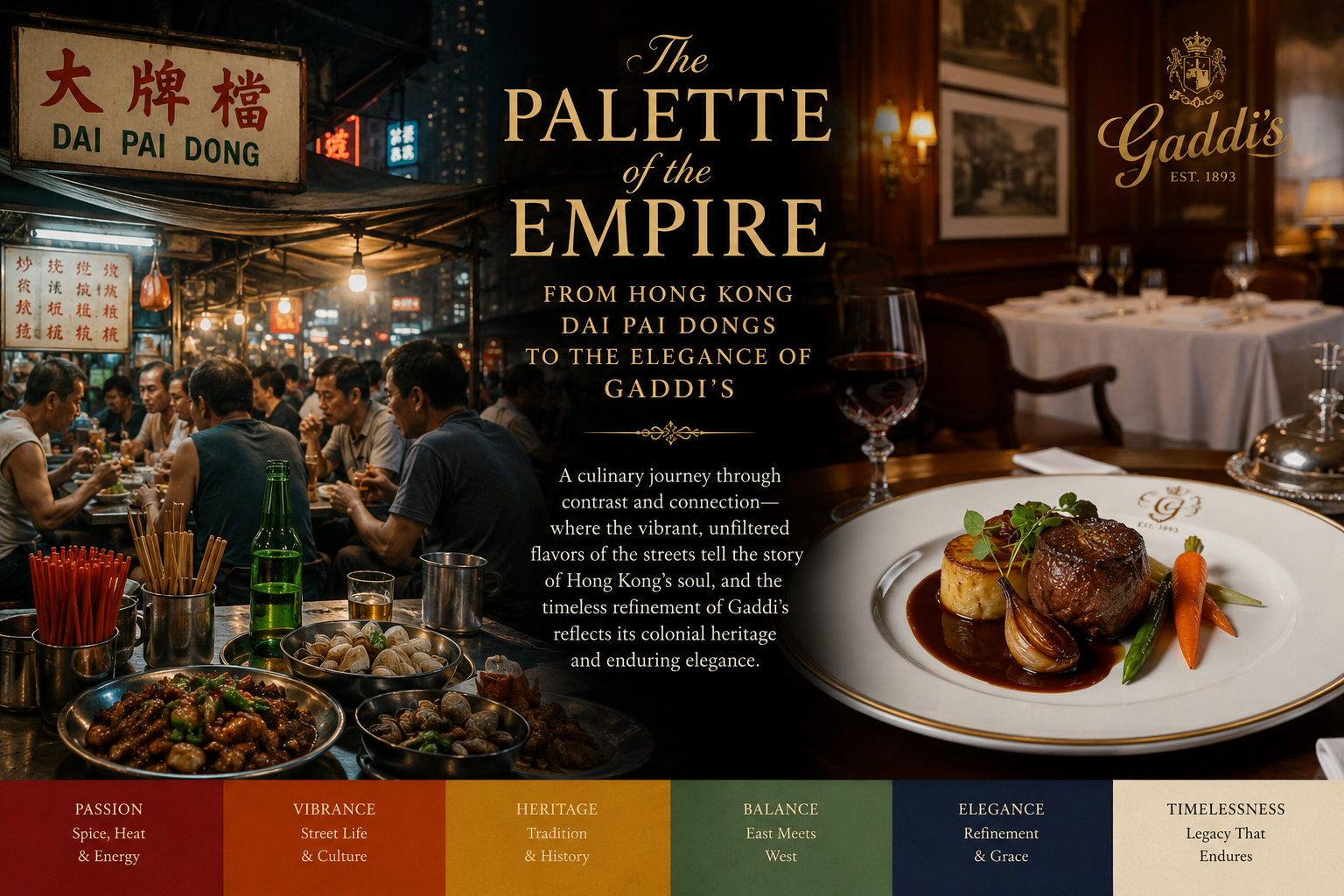

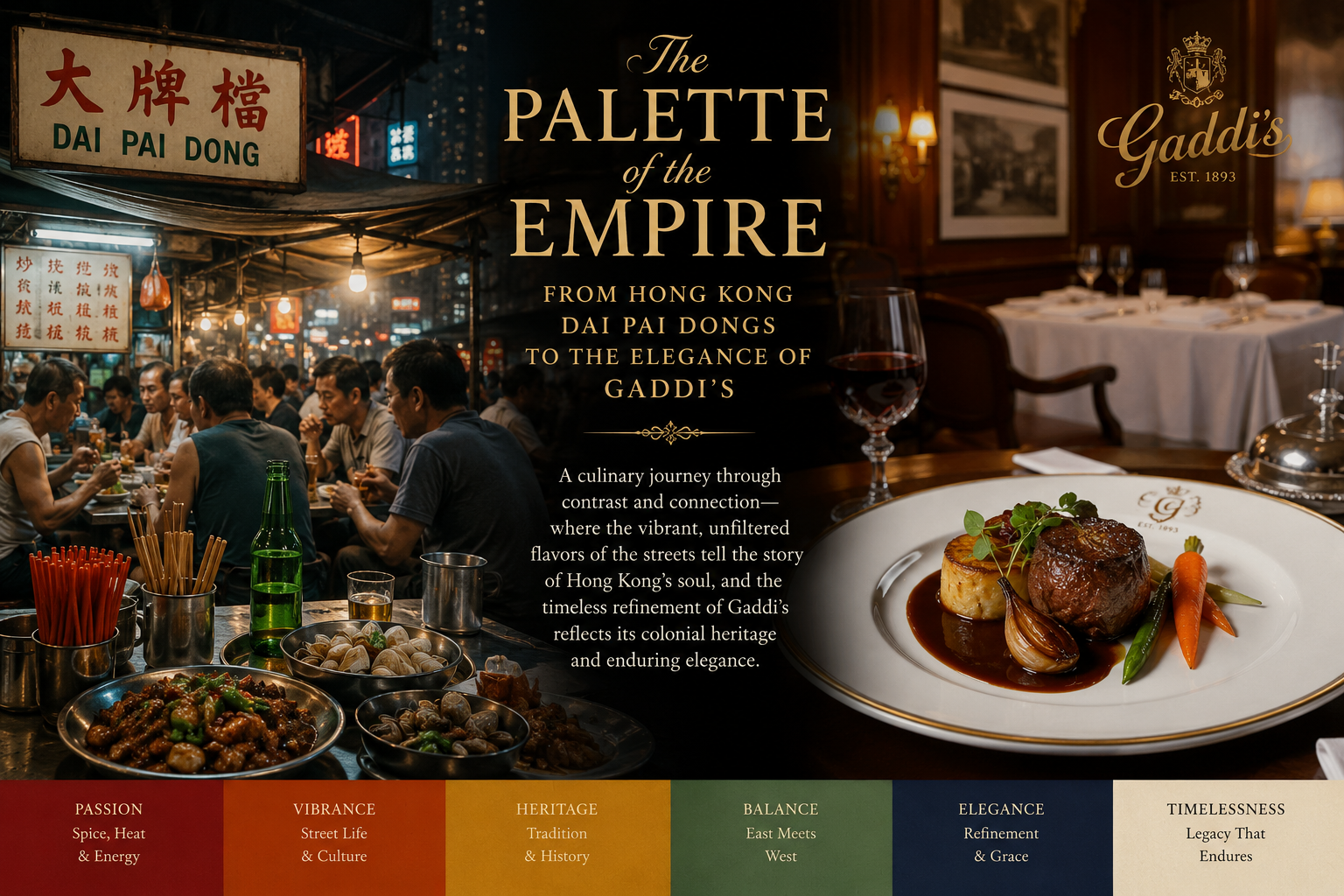
The Palette of the Empire: From Midnight Dai Pai Dongs to the Chandeliers of Gaddi’s.
The air is still, yet the spirit remains restless. Welcome to Friday’s Lifestyle transmission.
It is Friday, the 22nd of May 2026. To consult for Hollywood on the cinematic identity of the Far East, one must treat the entire city as a living, breathing canvas. In Hong Kong, nowhere is the intersection of class, velocity, and history more tangibly expressed than across our culinary landscape. From the high-octane energy of the streets to the disciplined etiquette of our finest dining institutions, every eating establishment is a specific narrative space.
As a producer, becoming intimately well-acquainted with each and every style of dining available is a tactical asset. Every establishment has its distinct time to shine. Whether serving as a makeshift operations base for a technical crew, a battlefield for international capital, or a potential location for a future production, the palate of the city dictates the texture of the screen.
I. The Democratic Engine: From Dai Pai Dong to Tea House
In a city driven by hyper-capitalism, the truest vitality is often found in the high-velocity, functional spaces of the everyman.
* The Dai Pai Dong (大排檔) and Hong Kong-style Diner (茶餐廳 & 冰室): These spaces are the epitome of Hong Kong’s relentless speed. They feature high decibels, rapid table turnover, and an aggressive fusion of Chinese and Western comfort foods. When I need to sit down with my technical crew—such as the camera, lighting, or logistics leads—to hash out immediate production frictions, we have our conversations here. Amidst the steam and shouting, communication becomes direct, unpretentious, and efficient.
* The Tea House (茶樓) and Tavern (酒樓): These institutions anchor a different kind of social cohesion. The ritual of morning dim sum, the clatter of porcelain carts, and the steady stream of jasmine tea serve as the backdrop for multi-generational family dynamics and old-school commercial dealings. For a writer-producer sculpting the traditional elite families in Eurasia Rising, these spaces provide the definitive psychological blueprint for localized heritage.
II. The Fine Dining Sanctuary: Old Money and Capital Negotiations
When the front shifts toward securing investors, courting global co-producers, or hosting high-level Hollywood executives, the producer must leverage the “Quiet Majesty” and strict etiquette of the city’s elite bastions:
* Gaddi’s (The Peninsula Hotel) and Petrus (Island Shangri-La): Gaddi’s remains a monument to old-world French haute cuisine and colonial prestige, while Petrus offers a sweeping, panoramic gaze over the Victoria Harbour skyline. These formal establishments are saved for monumental celebrations—such as a finalized financing package or a completed casting attachment. Amidst the silver service and fine crystal, the producer projects absolute command over the project’s viability.
* Amigo (Happy Valley): A fortress of old-world European romance, featuring heavy timber beams, medieval accents, and a legendary standard of service. It is a space designed for longevity, making it the perfect setting to treat industry elders whose respect and tenure must be acknowledged.
* The Verandah (Repulse Bay): Haunted by the literary ghosts of Eileen Chang, this space utilizes colonial archways and slow-turning ceiling fans to evoke a nostalgic, aristocratic melancholy. It reads beautifully as a setting for old money contemplation.
* Bistronomique (Kennedy Town): Situated directly on the waterfront, this establishment represents the contemporary, fluid, and refined taste of the modern Western District. It captures the energy of the new generation of globalized Asian executives.
III. The Scout’s Eye
Whenever I dine at these establishments—whether enjoying a structured weekend luncheon with my parents or a brief espresso with a colleague—my “Producer’s Eye” is perpetually scanning the perimeter. I am not simply eating; I am scouting.
When developing a cutthroat entertainment industry drama like Eurasia Rising, these spaces cease to be mere businesses and transform into sets. I find myself mapping out the spatial choreography: imagining our corporate protagonists conducting ruthless legacy warfare underneath the chandeliers of Gaddi’s, contrasted sharply against the production assistants downing beers at a midnight dai pai dong to vent about the frictions of the studio. This visual and socioeconomic contrast is the truest narrative of Hong Kong—warts and all.
We must master every layer of our home’s social fabric. Only then, when we present our stories to the global market, can we deliver an empire of images that transcends the ordinary.
The fire within me burns steady, tempered by the flavors and shadows of the city.
Until the wind shifts again.
— Zephyr Chan