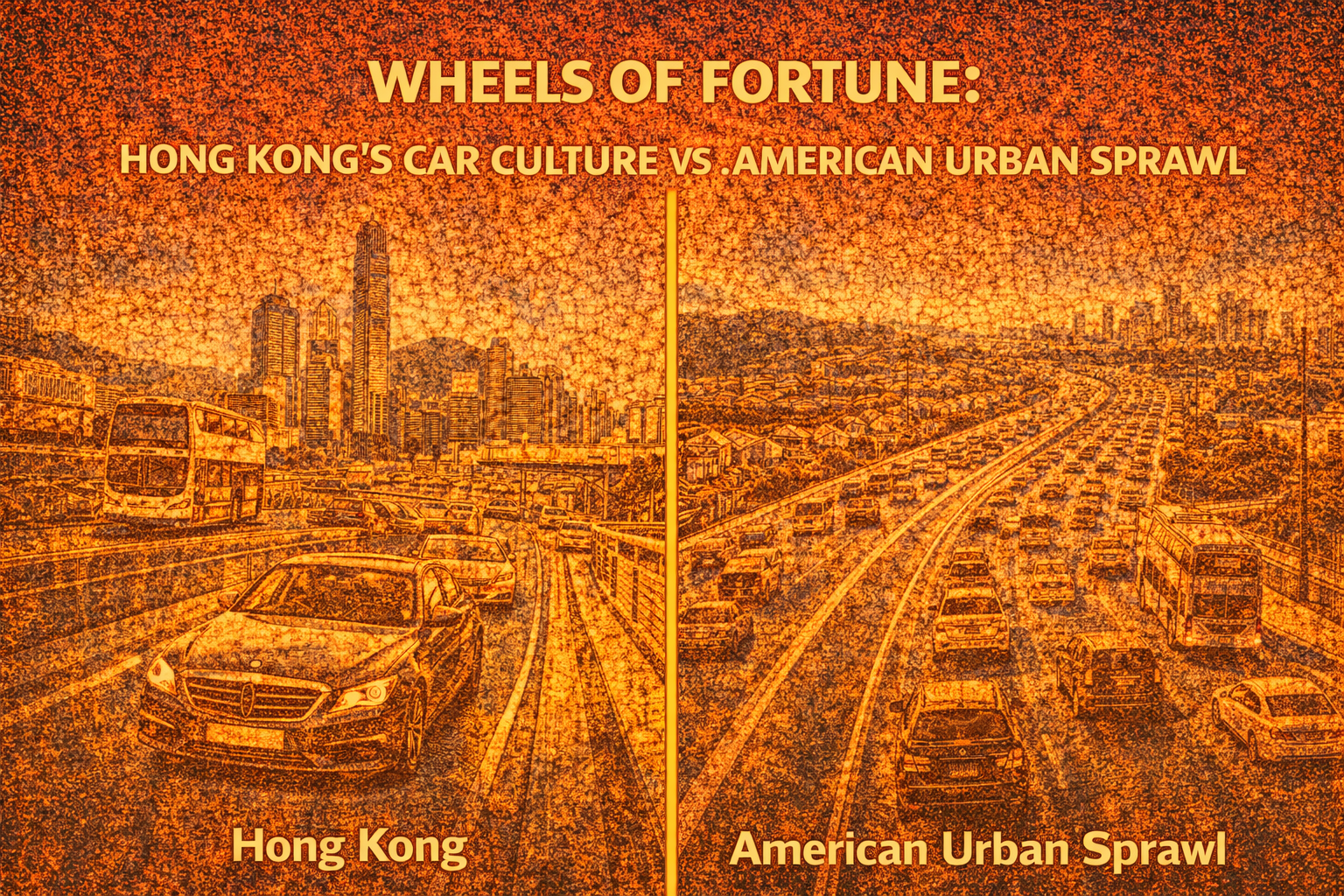

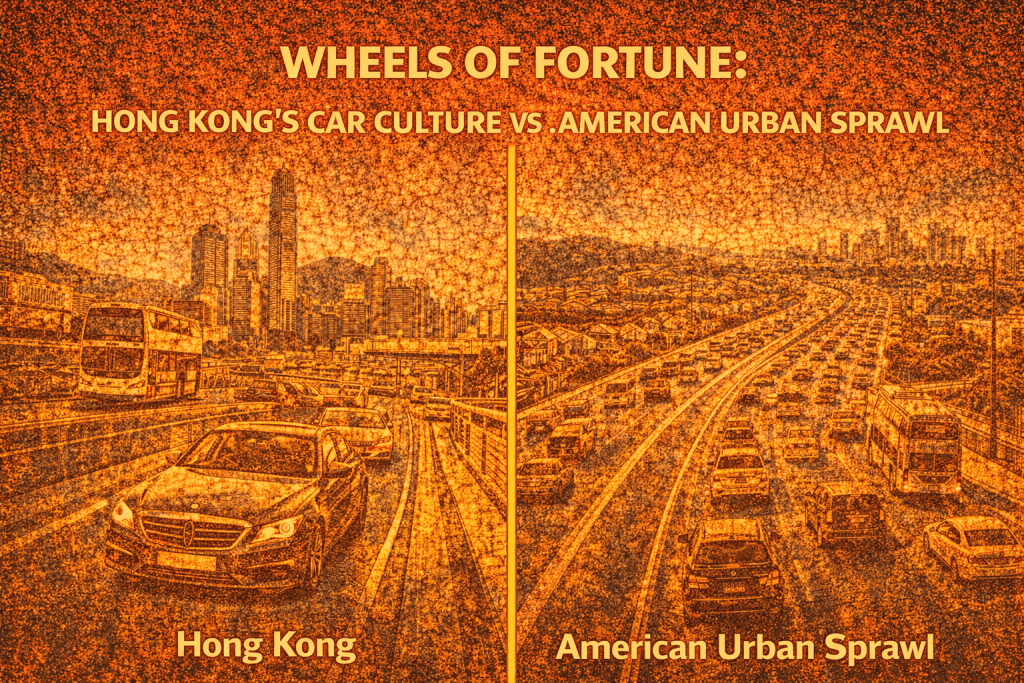
Wheels of Fortune: Hong Kong’s Car Culture vs. American Urban Sprawl
As someone who’s navigated the bustling streets of Hong Kong and observed the automotive pulse of various American cities, I’ve often pondered how vehicles shape our urban landscapes. In this blog post, I’ll dive into Hong Kong’s infrastructure and urban planning, emphasizing the roles of cars—whether electric, unleaded petrol, or diesel—and draw comparisons with key U.S. metropolises. Drawing from my own experiences, including my family’s setup with a chauffeur and three cars (an unleaded petrol SUV for daily commutes, an unleaded petrol sedan for use when the SUV is at the mechanic shop, and an unleaded petrol sportscar for those rare adrenaline rushes), I’ll explore how this fits into the upper-class lifestyle here. Along the way, I’ll suggest ways Hollywood could integrate these insights into films, provoking thought on global mobility without bias or exaggeration.
Hong Kong’s infrastructure is a marvel of density and efficiency, where towering skyscrapers and narrow roads dictate a car culture that’s more about status and convenience than sheer necessity. With over 7 million people crammed into about 1,100 square kilometers, urban planning prioritizes vertical expansion and public transport like the MTR subway and ferries. Cars, however, remain pivotal for the elite. Electric vehicles (EVs) are gaining traction, bolstered by government incentives like tax waivers that make models from Tesla or local brands appealing for their low emissions in a city choking on pollution. Unleaded petrol cars dominate the mid-range, offering reliability for the hilly terrain and quick escapes to the New Territories. Diesel options, though less common due to stricter emission standards, persist in commercial fleets and some SUVs for their torque in congested traffic.
In my family’s case, our unleaded petrol SUV handles the daily commutes, while the unleaded petrol sedan serves as a backup when the SUV is at the mechanic shop, and the unleaded petrol sportscar adds a touch of excitement. This setup isn’t just practical; it’s cultural. For Hong Kong’s upper class, cars symbolize success in a society where space is premium—owning multiple vehicles, often with a chauffeur, underscores financial prowess and frees time for business dealings. It’s a blend of Western aspiration and Eastern pragmatism, where a chauffeur isn’t mere extravagance but a nod to hierarchical family structures, allowing elders or executives to focus on calls during commutes. Provocatively, this raises questions: In a city where public transport is world-class, why do the wealthy cling to personal wheels? It’s about control in a chaotic urban ecosystem, a subtle flex amid the tycoon-driven economy.
Now, let’s compare this to American cities, starting with the West Coast. San Francisco’s hilly layout mirrors Hong Kong’s topography, but its urban planning favors tech-driven EVs, with charging stations proliferating amid the fog. Unlike Hong Kong’s compact chaos, SF’s sprawl encourages hybrids over pure diesels, reflecting California’s green mandates. Los Angeles, the epitome of car dependency, contrasts sharply: Its vast highways and low-density suburbs make unleaded petrol sedans and diesel trucks kings, far from Hong Kong’s space-saving ethos. Here, cars are lifelines, not luxuries, fueling a culture of individualism that Hollywood often romanticizes in chase scenes.
Shifting east, New York City’s dense grid and subways echo Hong Kong’s public transit dominance, sidelining cars for most. Yet, the upper echelons favor chauffeured black cars—often unleaded petrol or emerging EVs—for navigating Manhattan’s bustle, much like my family’s setup. Boston’s colonial streets promote compact EVs to combat traffic, differing from Hong Kong’s tolerance for diesel in select niches. Atlanta’s suburban expansion relies on unleaded petrol SUVs, amplifying sprawl that Hong Kong avoids through verticality.
Chicago’s wind-swept avenues blend public options with diesel-heavy logistics, but its planning lacks Hong Kong’s hyper-efficiency, leading to gridlock that EVs are slowly alleviating. Dallas embodies Texas-sized ambition with diesel pickups dominating, a far cry from Hong Kong’s refined sedans. Miami’s coastal vibe pushes flashy sportscars, often unleaded petrol, aligning somewhat with upper-class Hong Kong tastes but without the chauffeur norm. New Orleans, with its flood-prone infrastructure, leans on resilient diesel vehicles for post-storm recovery, contrasting Hong Kong’s typhoon-ready but car-light resilience. Finally, Washington D.C.’s monumental layout favors secure, chauffeured sedans—mirroring elite Hong Kong life—yet its planning emphasizes walkability over vehicular excess.
These comparisons highlight a provocative truth: Hong Kong’s car roles are niche and symbolic, integrated into a culture where upper-class families like mine use them to navigate social hierarchies. In Hollywood projects, filmmakers could weave this in by contrasting a Hong Kong tycoon’s chauffeured unleaded petrol SUV commute in a thriller with LA’s endless freeways, underscoring themes of globalization and inequality. Imagine a scene in a spy film where a protagonist swaps a diesel truck in Atlanta for a sleek Hong Kong sedan, highlighting urban adaptability. Or in a drama, depict a New York executive’s life paralleling a Hong Kong heir’s, using cars as metaphors for cultural mobility—provoking audiences to question sustainability without preaching.
Ultimately, Hong Kong’s model challenges American sprawl, suggesting denser, multi-modal futures. For now, it’s clear: Cars in Hong Kong aren’t just transport; they’re cultural artifacts for the elite, a lens for Hollywood to examine worldwide urban divides.