
Part 3: Banking’s Ancient Roots and Modern Might in Hong Kong
As I continue this five-part exploration into Hong Kong’s intricate dance with capitalism, we’ve already delved into its foundational economic ethos in Part 1 and the real estate juggernaut in Part 2. Now, in Part 3, I turn to the banking sector—a pillar that traces its lineage back to ancient Chinese practices like the “qianzhuang,” those early private money houses that facilitated trade and lending long before modern banks emerged. This isn’t just history; it’s a lens on how Hong Kong’s financial ecosystem embodies capitalism’s raw efficiency and adaptability. I’ll examine this evolution objectively, highlighting its mechanisms without bias toward any economic ideology. And as promised in this series, I’ll suggest how these elements could integrate into Hollywood projects, focusing on their resonance with Hong Kong’s upper class—those elite circles where discretion, legacy, and global networks define social standing.
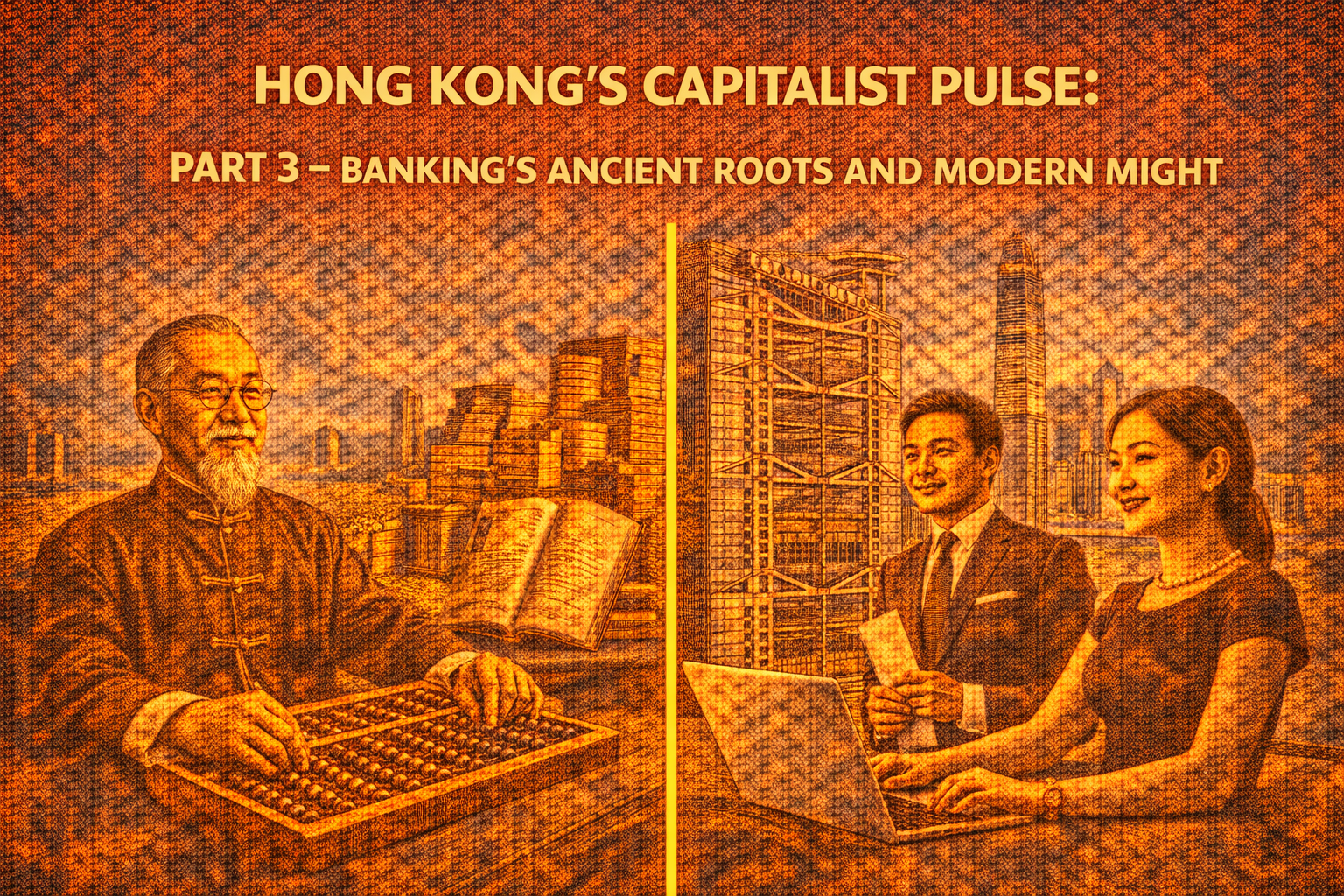
Let’s start with the qianzhuang. These institutions, originating in ancient China during the Ming and Qing dynasties, functioned as informal private banks. They handled currency exchange, loans, and remittances, often relying on personal trust rather than formal regulations. In a pre-industrial era, qianzhuang enabled merchants to navigate vast trade routes, from silk roads to coastal ports, by providing credit without the bureaucracy of state-controlled systems. This model was quintessentially capitalist: profit-driven, risk-assessing, and community-embedded. Fast-forward to Hong Kong’s colonial period under British rule, and we see this tradition morphing into a hybrid. The influx of Western banking—think the establishment of HSBC in 1865—intersected with qianzhuang influences, creating a financial hub that blended Eastern relational lending with Western standardization.
In today’s Hong Kong, this legacy persists in a banking sector that’s a global powerhouse. The city’s status as an international financial center stems from its laissez-faire policies, low taxes, and strategic location bridging East and West. Banks here manage trillions in assets, from offshore wealth management to IPO launches for mainland Chinese firms. Capitalism thrives in this environment through mechanisms like shadow banking—modern echoes of qianzhuang’s informality—where non-bank entities offer loans outside traditional oversight. This isn’t without controversy; it amplifies liquidity but also risks, as seen in periodic financial crises. Yet, objectively, it underscores Hong Kong’s role in global capital flows, where efficiency often trumps caution. The sector employs over 200,000 people and contributes significantly to GDP, illustrating capitalism’s capacity to generate wealth while exposing vulnerabilities to market volatility.
Provocatively, one might question if this banking evolution represents pure capitalism or a regulated variant. Hong Kong’s system, with its Monetary Authority enforcing stability, isn’t anarchic; it’s a calculated balance that maximizes profit while mitigating systemic failure. This neutrality allows banks to serve diverse clients—from tycoons parking fortunes in private accounts to startups seeking venture capital. The qianzhuang spirit lives on in family offices and boutique firms that prioritize guanxi (relationships) over algorithms, a nod to cultural continuity amid globalization.
Now, shifting to creative applications: incorporating Hong Kong’s banking narrative into Hollywood projects could add layers of authenticity, especially when portraying the city’s upper class. Imagine a thriller where a protagonist, heir to a qianzhuang-descended banking dynasty, navigates high-stakes mergers. This fits culturally because Hong Kong’s elite often view banking as a familial legacy, passed down through generations in exclusive circles like the Hong Kong Jockey Club or private yacht gatherings.
Scripts could emphasize discreet wealth management—offshore trusts and art-backed loans—that reflect the upper class’s preference for privacy and long-term asset preservation over flashy displays. For a drama series, draw on real tensions like the 1997 Asian financial crisis, showing how bankers in elite Tsim Sha Tsui offices balanced personal loyalties with capitalist imperatives. This resonates with the upper echelons, where education at places like Oxford or Harvard fosters a global, understated sophistication. Hollywood could provoke thought by contrasting this with Western excess, highlighting how Hong Kong’s banking elite embody restrained ambition—think quiet negotiations in dim-sum boardrooms rather than Wall Street bravado.
Such integrations aren’t mere embellishments; they ground stories in cultural specificity. For instance, a biopic on a fictionalized HSBC founder could explore qianzhuang influences, portraying the upper class’s role in bridging colonial and modern eras. This approach avoids stereotypes, instead showcasing the elite’s multilingual, cosmopolitan lives—summer homes in London, investments in Silicon Valley—all while maintaining the provocative edge of unchecked capitalism’s human costs.
As we wrap this part, Hong Kong’s banking story—from qianzhuang to skyscraper vaults—reveals capitalism’s enduring adaptability. Stay tuned for Part 4, where I’ll examine Hong Kong’s tech scene, from fintech innovations to AI-driven disruptions. And in Part 5, we’ll conclude with the consulting world’s influence on this capitalist tapestry.