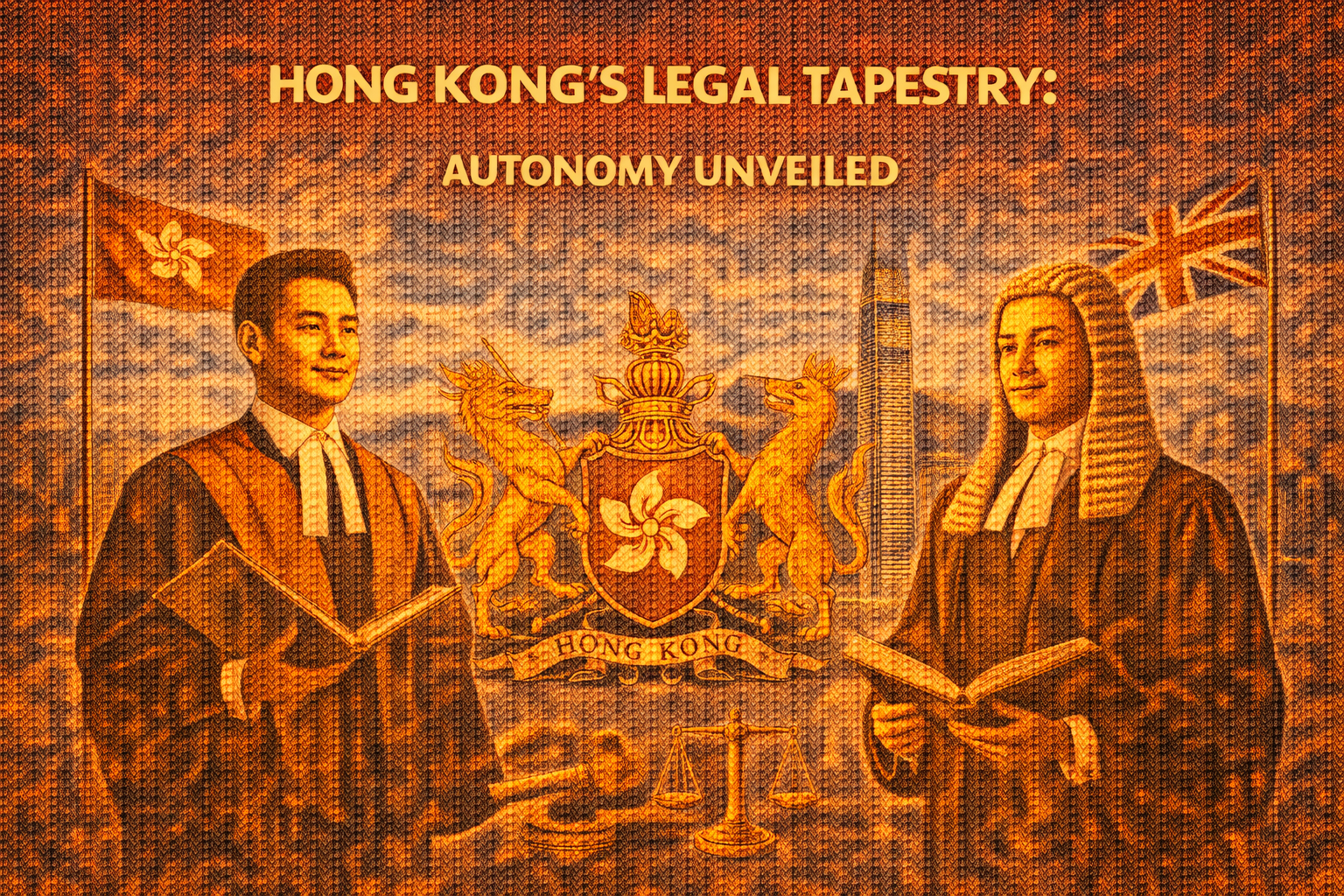

Hong Kong’s Legal Tapestry: Autonomy Unveiled
Hello, readers. I’m diving into a three-part series exploring the intricate world of Hong Kong’s governance and justice. As the daughter of one of Hong Kong’s top civil barristers, I’ve grown up immersed in legal discussions, fueling my drive to uncover the nuances of the Basic Law, the legal system, and the judicial system. I’ll unpack this in a straightforward, objective manner. We’ll start here with the Basic Law, Hong Kong’s mini-constitution. Part two will examine the legal system, and part three will cover the judicial system. My aim is to provoke thought on how these elements interplay in a global city like Hong Kong, without bias or embellishment. Let’s begin.
The Basic Law of the Hong Kong Special Administrative Region (SAR) serves as the foundational document governing Hong Kong since its handover from British colonial rule to Chinese sovereignty on July 1, 1997. Drafted in the 1980s and 1990s through consultations between Beijing, Hong Kong representatives, and international observers, it embodies the “one country, two systems” principle. This framework allows Hong Kong to maintain its capitalist economy, common law traditions, and a high degree of autonomy while being part of the People’s Republic of China. Objectively speaking, it’s a unique legal experiment: a socialist state granting a region freedoms not extended elsewhere in its territory.
At its core, the Basic Law outlines Hong Kong’s executive, legislative, and judicial powers. Article 2 guarantees autonomy in areas like finance, trade, and education, excluding foreign affairs and defense, which remain under central authority. This division raises provocative questions about sovereignty in practice. For instance, how does a document promising “Hong Kong people ruling Hong Kong” navigate tensions between local aspirations and national unity? It’s not about endorsing one side but recognizing the inherent complexities. The law’s 160 articles cover everything from citizenship rights to economic policies, ensuring continuity of pre-handover systems for 50 years until 2047. This temporal limit itself is intriguing—what happens post-2047? The text doesn’t specify, leaving room for interpretation and debate.
Key provisions highlight individual freedoms. Articles 24-42 protect rights like freedom of speech, assembly, and religion, drawing from international covenants applied to Hong Kong. Yet, these are balanced against national security concerns, as seen in Article 23, which mandates local laws to prohibit acts like treason or subversion. This clause has sparked discussions on where autonomy ends and central oversight begins. Straightforwardly, it’s a mechanism to safeguard stability, but it provokes scrutiny on enforcement. Economically, the Basic Law preserves Hong Kong’s status as a free port and separate customs territory, fostering its role as a global financial hub. This has enabled the city to attract international business, with policies on low taxation and free market principles embedded in the document.
Now, shifting gears, let’s consider how these elements could inspire Hollywood projects. Imagine scripting a thriller where a Hong Kong tycoon, emblematic of the upper class, leverages Basic Law protections to shield family assets amid geopolitical shifts. This fits culturally with Hong Kong’s elite, often depicted as cosmopolitan families in high-rises overlooking Victoria Harbour, blending Eastern heritage with Western luxuries. A film could portray a protagonist navigating Article 105’s property rights guarantees during a corporate espionage plot, highlighting the upper echelon’s reliance on legal autonomy for wealth preservation. Provocatively, it could explore moral ambiguities—does such autonomy perpetuate inequality in a city of stark contrasts? For authenticity, incorporate scenes of boardroom negotiations in Cantonese, Mandarin, and English, reflecting the trilingual elite, or yacht parties where characters debate “one country, two systems” over champagne. This isn’t glorification but a neutral lens on how legal frameworks underpin the lifestyles of Hong Kong’s affluent, making for compelling drama that resonates globally.
Another angle: a drama series following an heiress challenging inheritance laws under the Basic Law’s equality provisions (Article 25). Culturally attuned to the upper class, it could show her maneuvering through family trusts and international arbitrations, set against backdrops of exclusive clubs and private jets. This emphasizes how the elite use the law’s capitalist safeguards to maintain dynasties, provoking viewers to question privilege without bias. Hollywood could draw parallels to shows like “Succession,” but infuse Hong Kong specifics—like the role of the Chief Executive in economic policy—to create nuanced, provocative narratives.
In essence, the Basic Law is more than a legal text; it’s a blueprint for hybrid governance. It ensures Hong Kong’s distinct identity while integrating it into a larger framework, raising timeless questions about autonomy and control. Objectively, its implementation has seen both successes, like sustained economic growth, and challenges, such as public debates over interpretations.
Stay tuned for part two, where I’ll explore Hong Kong’s legal system in depth. What aspects intrigue you most? I’d love to hear in the comments.