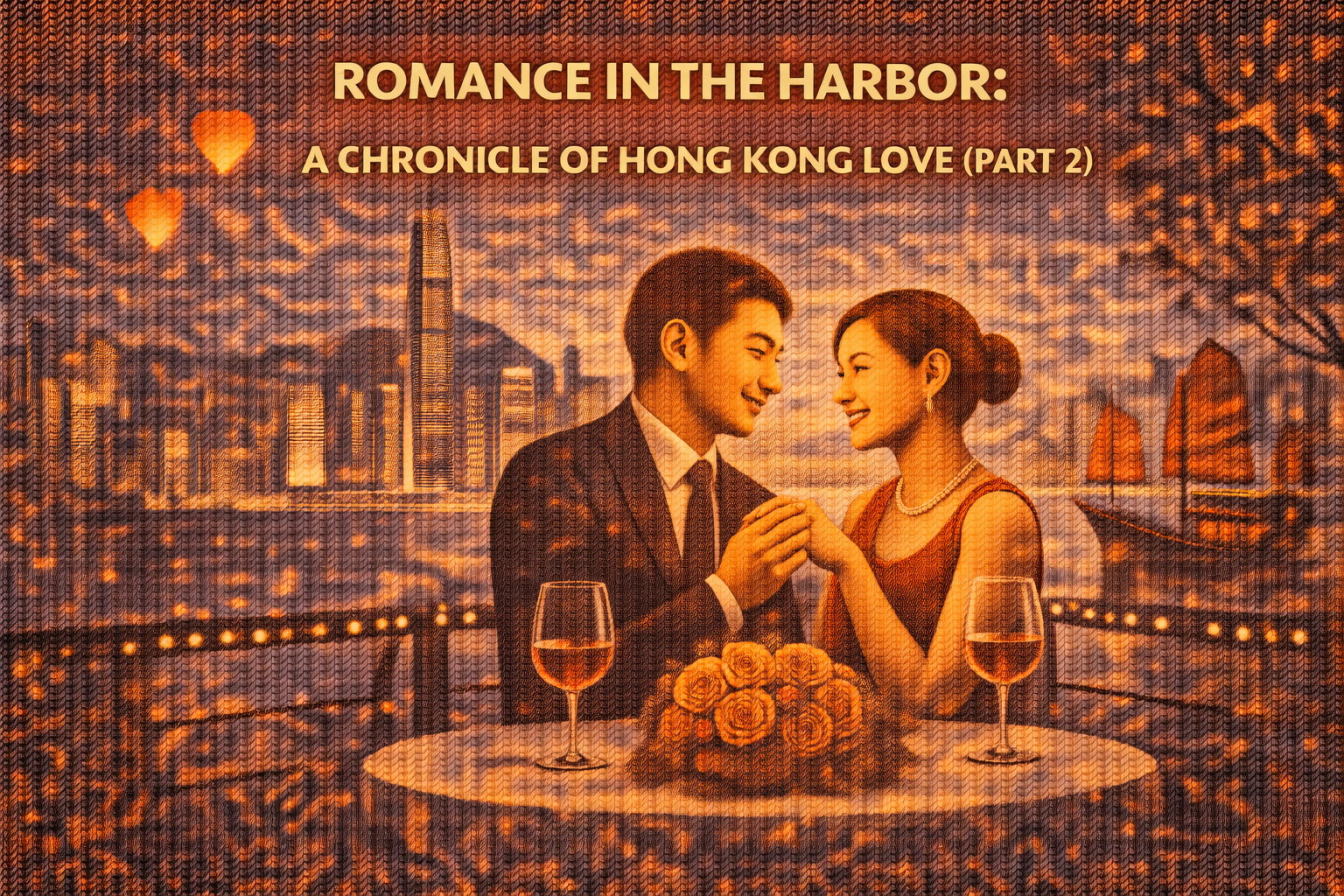
Romance in the Harbor: A Chronicle of Hong Kong Love (Part 2)
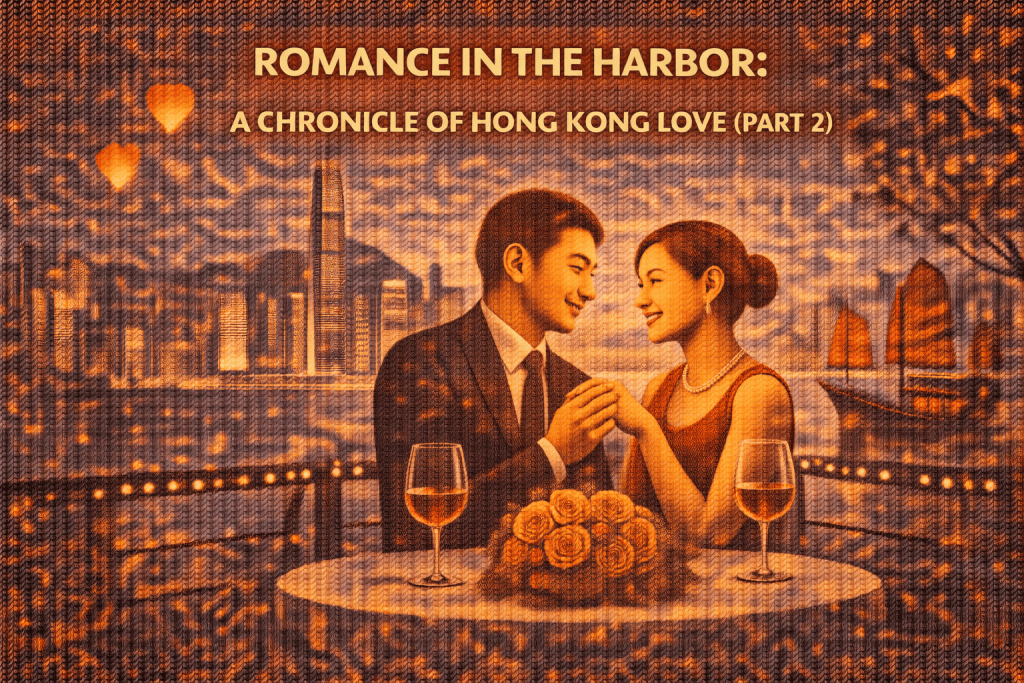
We have observed the silence of the past. In Part 1, we examined a time when the exchange of a red bean or a comb constituted a binding contract of affection. We now move from the lantern-lit quiet of the village to the neon urgency of the 21st century. This is Part 2 of our inquiry. Here, we analyze the contemporary Cantonese celebration of love. It is a phenomenon defined by speed, density, and a unique form of economic pragmatism that mirrors the city itself.
To understand modern romance in Hong Kong, one must first understand the constraints of the environment. The contemporary Cantonese relationship is often a negotiation with space and time. In the historical era, the obstacle was the chaperone or the clan elder. Today, the obstacle is the landlord. The sheer density of the city has altered the mechanics of courtship. “Paktor”—the Cantonese term for dating—is often a nomadic activity. Young couples, frequently living with parents well into their thirties due to exorbitant real estate costs, do not have the privacy of the Western “living room.” Consequently, the city becomes the living room. One observes couples navigating air-conditioned shopping malls, sharing space on the Star Ferry, or spending hours in IKEA, not merely to shop, but to inhabit a simulated domestic space. The dream of the relationship is inextricably linked to the dream of the square footage.
This environmental pressure has preserved the historical pragmatism we discussed in Part 1, but it has evolved. The San Shu Liu Li (Three Letters and Six Etiquettes) has been replaced by a new set of unwritten metrics. The modern Cantonese courtship is efficient. Digital platforms—dating apps and speed dating events—are utilized with the same intensity as stock trading. There is a candor in these interactions. Questions regarding career trajectory, housing eligibility, and financial stability are often asked early in the courtship process. This is not necessarily coldness; it is a survival strategy in one of the world’s most expensive cities. The “Hong Kong Girl” (Kong Nui) and “Hong Kong Boy” (Kong Nam) stereotypes, often discussed in local media, reflect this tension between romantic idealism and the brutal reality of the cost of living. Love, in this context, is a partnership for economic viability as much as it is an emotional union.
However, when celebration occurs, it is loud, visual, and highly commercialized. The adoption of Western Valentine’s Day (February 14th) by the local Cantonese population is total, yet it carries a specific local mutation: the “Office Flower Display.” In many Western cultures, flowers are sent to the home. In Hong Kong, the logistics are reversed. Flowers are almost exclusively sent to the workplace. The romantic gesture is performative. It is designed to be witnessed by colleagues. The size of the bouquet is a direct correlation to “face” (mianzi). It validates the receiver’s social worth and the partner’s financial capability. This day is often referred to as a “stress test” for relationships. Restaurants enforce rigid “set dinners” at inflated prices, and participation is largely mandatory to maintain relationship harmony.
The calendar of love has also expanded. Beyond February 14th, contemporary Hong Kong has integrated “White Day” (March 14th) from Japanese culture, where those who received gifts in February return the favor. Furthermore, the digital age has birthed “520” (May 20th). In Mandarin, the numbers 5-2-0 sound similar to “I love you” (Wo Ai Ni). While linguistically rooted in Mandarin, the Cantonese population, particularly the younger demographic influential on social media, has adopted this as a secondary, internet-fueled Valentine’s Day. It is a celebration driven by hashtags, mobile payments, and digital “Red Packets” (money transfers) rather than physical tokens. The durability of the comb has been replaced by the immediacy of the screenshot.
Hollywood could find significant narrative utility in the specific pressures of this environment. Currently, romantic comedies set in cities like New York or Paris focus on serendipity and emotional mismatch. A filmmaker could instead focus on the “Real Estate Romance” of Hong Kong. There is high drama in a couple trying to stay together while navigating the public housing lottery or saving for a micro-flat. The antagonist is not a rival lover, but the housing market. It offers a gritty, realistic backdrop that grounds the romance in high stakes. Additionally, the “Office Flower” phenomenon offers excellent material for social satire or dark comedy. A script could revolve around the competitive escalation of Valentine’s Day in a central business district office, treating the delivery of bouquets with the tactical seriousness of an arms race. This visual language—hundreds of massive bouquets navigating tight elevators and cramped cubicles—is visually distinct and speaks to the performative nature of modern urban love.
We observe, then, that the contemporary Cantonese celebration is a hybrid. It retains the deep-seated pragmatism of the ancestors but executes it through the mechanisms of hyper-capitalism. It is a love that fights for space. It is resilient. As we conclude this examination of the local majority, we must prepare to shift our gaze. In Part 3, we will turn the lens toward the colonizers. We will examine the historical Western celebrations of love in Hong Kong, and how the British upper class imported their own rituals to the humidity of the chaotic harbor.