Romance in the Harbor: A Chronicle of Hong Kong Love (Part 7)
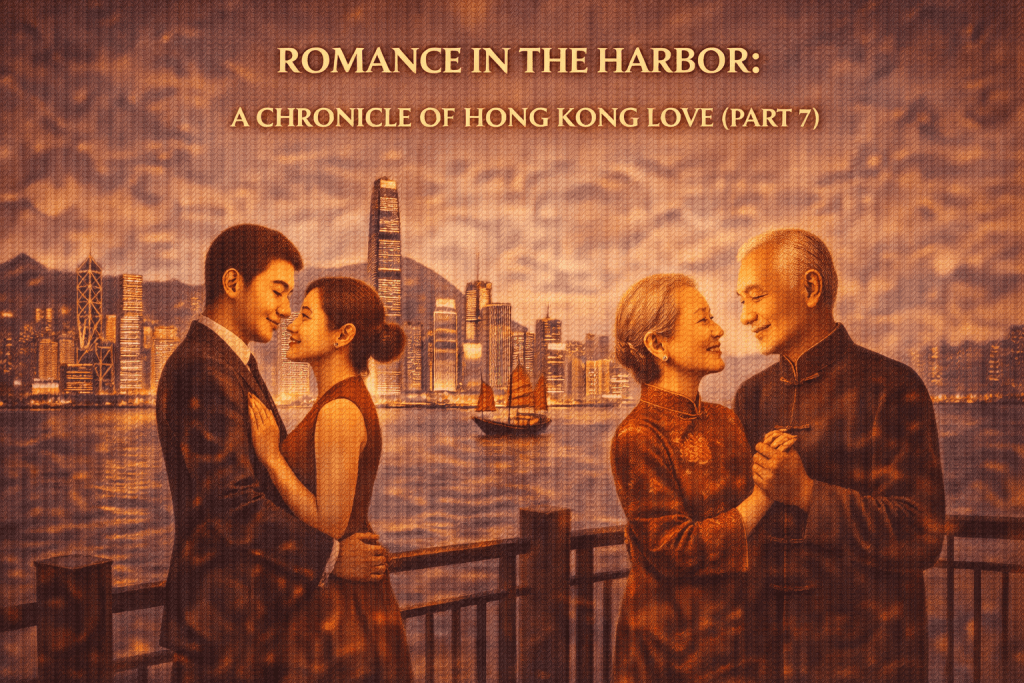
We have previously analyzed the cultural scripts that dictate the behavior of Hong Kong’s elite. Yet, scripts require a stage. In a city defined by its density and verticality, the location of a romantic encounter is as significant as the encounter itself. This is Part 7 of our inquiry. Here, we map the *Geography of Upper-Class Love*. We observe that for the wealthy, romance is an exercise in exclusion, providing unique spatial settings that Hollywood filmmakers could utilize to visualize themes of isolation and status.
To understand the topography of elite dating, one must first understand the “Private Member’s Club.” The *Aberdeen Marina Club (AMC)* serves as a primary hub for established families, while *Soho House* in Sheung Wan caters to the creative elite. A date within these walls signals access to a vetted social circle.
For screenwriters, this environment offers a perfect setting for a “Social Thriller” or Satire. The conflict would not be the romance itself, but the “Membership Committee.” A compelling narrative could follow an outsider courting a member of the elite, where the ultimate antagonist is the bureaucratic exclusion of the club system. The climax of the film would not be a wedding, but the acceptance letter—or the rejection—highlighting how institutions gatekeep relationships in high society.
When the elite venture outside the club system, they gravitate toward “Sanctuaries of Silence.” The hotel dining room is the traditional venue. *The Peninsula* represents “Old Money,” while *The Upper House* represents “New Luxury.” The concept of the “Staycation”—where couples retreat to a hotel in their own city—is a staple of local romance. This provides a structural framework for a “Chamber Drama.” A film could take place entirely within a luxury suite over a weekend. As the couple looks out at the crowded city through soundproof glass, their internal relationship dynamics unravel in the vacuum of the hotel room, contrasting the chaotic city outside with the sterile perfection inside.
We must also consider the verticality of the city. In Hong Kong, social status is correlated with physical altitude. Romantic dining often occurs at the summit—restaurants on *The Peak* or the upper floors of the International Commerce Centre (ICC).
This verticality offers a ready-made visual language for *Sci-Fi or Dystopian* cinema. Hollywood production designers often struggle to visualize class stratification; Hong Kong provides a literal model. A futuristic romance could depict a society where the rich live above the cloud line, never touching the ground, while the poor inhabit the street level. The love story would then become a vertical journey, a descent from the “Ozone” bar to the street markets, physically representing a fall from grace.
Finally, we observe the geography of the weekend escape: the sea. The elite do not merely rent boats; they own luxury cruisers moored in Deep Water Bay. A romantic excursion here involves leaving the land entirely to anchor in the secluded bays of the Sai Kung Geopark.
This setting is ideal for a *”Whodunit” or Mystery*. The “Junk Trip” is effectively a locked-room mystery on water. A group of wealthy elites, isolated on a yacht in the middle of the South China Sea, with the glittering skyline visible but unreachable in the distance. It combines the glamour of the French Riviera with the specific cultural tensions of Hong Kong, providing a fresh backdrop for the classic murder mystery genre.
In summary, the geography of upper-class love is a map of gated communities, high-altitude dining, and private marine vessels. It is a love that thrives in isolation. However, this isolation is not hermetically sealed. The Hong Kong elite are often educated abroad, returning with Western values that clash with Eastern expectations. In Part 8, we will explore the *Cross-Cultural Intersection*. We will examine the romantic lives of the “Third Culture Kids” (TCKs) and the complex dynamics of mixed-heritage couples as they navigate the collision of Western liberalism and traditional Chinese family structures.