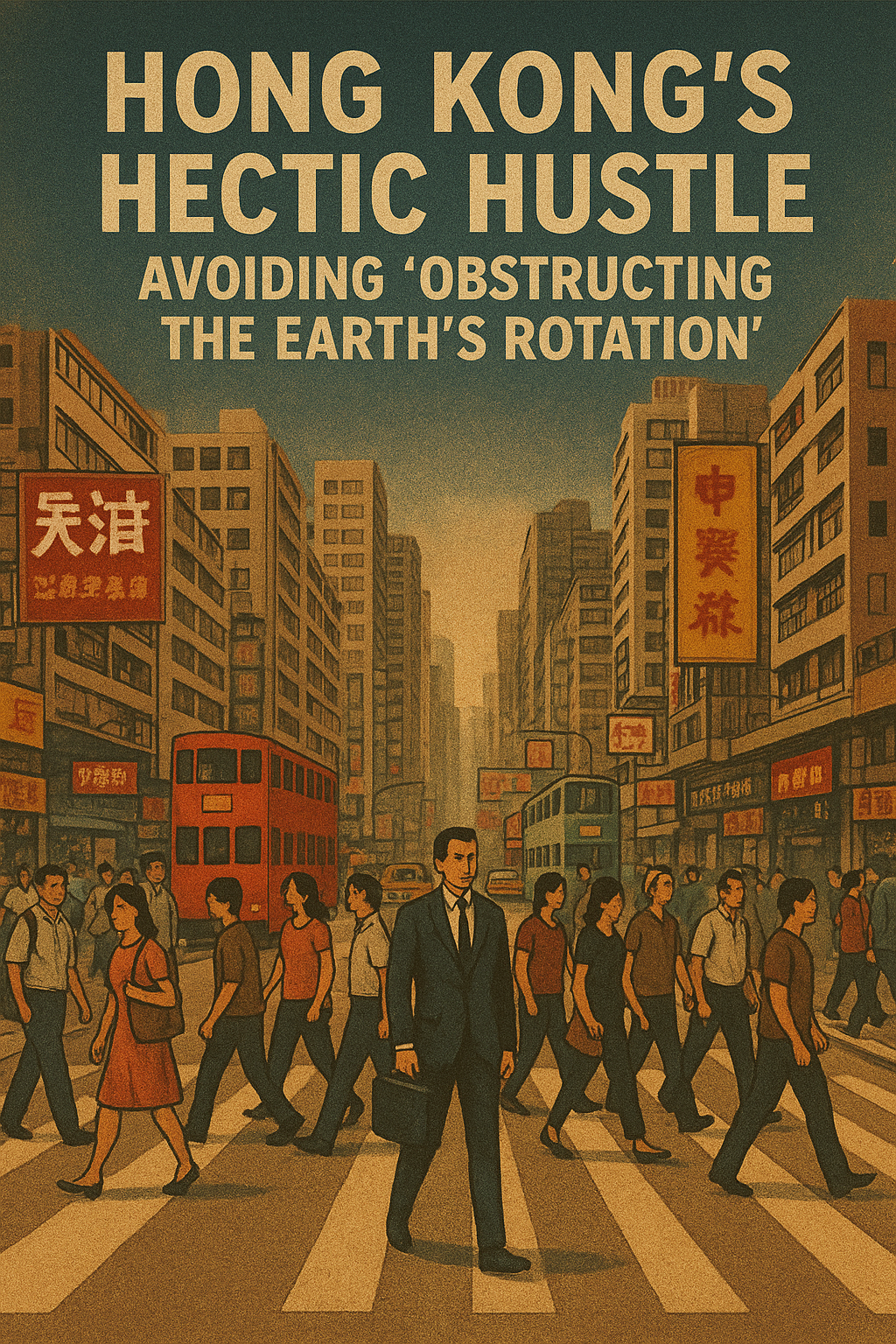

Hong Kong’s Hectic Hustle: Avoiding “Obstructing the Earth’s Rotation”
Hong Kong is renowned for its breakneck pace of life, a whirlwind of activity where efficiency reigns supreme and any delay can feel like a cardinal offense. In Cantonese, this is captured by the vivid phrase “阻住地球轉,” which translates roughly to “obstructing the Earth’s rotation.” It refers to hindering others in their daily routines, whether by blocking a crowded escalator or lingering too long at a crosswalk. This cultural idiom underscores a societal emphasis on momentum, where the average resident navigates a densely packed urban environment with a sense of urgency that can appear impatient to outsiders. While this fast tempo drives productivity and innovation, it also raises questions about its impact on well-being and interpersonal dynamics.
Objectively, Hong Kong’s rhythm is shaped by its geography and economy. With a population of about 7.4 million crammed into just 1,110 square kilometers, the city boasts one of the highest population densities globally, at around 6,800 people per square kilometer. This compactness necessitates swift movement: the Mass Transit Railway (MTR) system, one of the world’s most efficient, handles over 5 million passengers daily with trains arriving every 1-2 minutes during peak hours. Public transport affordability and availability are rated positively by 88% and 90% of expats, respectively, far above global averages. Such infrastructure supports a lifestyle where time is a premium commodity—residents often walk at speeds averaging 72 meters per minute, or about 4.3 kilometers per hour, which aligns with patterns in other Asian metropolises like Singapore and Bangkok. This pace isn’t just anecdotal; studies on urban walking speeds, such as those inspired by psychologist Richard Wiseman’s 2007 global survey, place Asian cities high on the list for rapidity, with Singapore topping rankings at an average of 10.55 seconds to cover 60 feet. Guangzhou, a nearby Chinese city, ranked fourth, suggesting a regional trend toward accelerated locomotion.
Work culture further amplifies this velocity. Hong Kong employees log an average of around 42-44 hours per week, exceeding the OECD average of 1,752 annual hours across member countries. In contrast, Canada’s average hovers at 32-37 hours weekly, depending on whether part-time roles are included, reflecting a more balanced approach influenced by labor laws capping standard weeks at 40 hours with ample overtime regulations. Hong Kong’s longer hours stem from its status as a global financial hub, where sectors like finance and trade demand extended commitments. Surveys indicate that 60% of Hong Kong workers experience work-related stress, surpassing the global figure of 56%. Overall, 87% of residents report stress levels higher than the Asia-Pacific average of 84% and the worldwide 80%, according to health research. Among university students, 21-41% exhibit moderately severe or higher symptoms of depression, anxiety, or stress, while broader population studies show up to 65% facing clinical psychological issues amid urban pressures.
Comparatively, Canada’s pace feels more measured. With vast open spaces and a population density of just 4 people per square kilometer, daily life allows for greater leisure. Quality-of-life indices rank Canada at 171.82 versus Hong Kong’s 133.50, factoring in elements like purchasing power, safety, and health care. Canadians benefit from colder climates and planned urban layouts that encourage a slower rhythm—think extended coffee breaks or unhurried commutes in cities like Toronto, where public transit, while reliable, doesn’t match Hong Kong’s precision. Expats note Hong Kong’s heat and crowds contribute to a “hot climate” vibe of constant motion, unlike Canada’s cooler, more relaxed demeanor. This contrast highlights how environmental and structural factors influence national temperaments: Hong Kong’s efficiency-driven culture can foster impatience, while Canada’s spaciousness promotes tolerance for delays.
Culturally, the impatience tied to “obstructing the Earth’s rotation” arises from a pragmatic focus on collective flow. In bustling spots like cha chaan teng cafes or wet markets, service is brisk to accommodate high volumes, which might come across as curt to newcomers. Cantonese’s tonal, rapid delivery can sound abrasive, but it’s often just efficient communication in noisy environments. This isn’t rudeness per se but adaptation to a city where “every hour is rush hour,” as one observer put it—punctual minibuses and MTR trains condition residents to expect and demand speed, leading to frustration when others disrupt the rhythm. Online discussions, such as those on Reddit, echo this: Hong Kongers prioritize not obstructing others, viewing it as a social courtesy in a high-density setting.
Personally, I recognize echoes of this in myself. Despite a background in philosophy and academia, which might suggest a contemplative bent, I’m often impatient and impulsive—rushing through tasks or conversations without pause. This realization has prompted me to cultivate mindfulness and intentionality in my thoughts, speech, and actions. By doing so, I aim to improve my karma, fostering positive outcomes through deliberate choices rather than reactive haste. It’s a work in progress, balancing Hong Kong’s energizing tempo with inner calm.
In essence, Hong Kong’s hectic pace is a double-edged sword: it fuels economic vitality and urban efficiency but can strain patience and health. Facts show higher stress and longer hours here than in places like Canada, yet this doesn’t make one superior—each suits different lifestyles. Whether embracing the rush or seeking moderation, the key is awareness: avoid “obstructing the Earth’s rotation” not just for others, but for your own equilibrium in this spinning world.