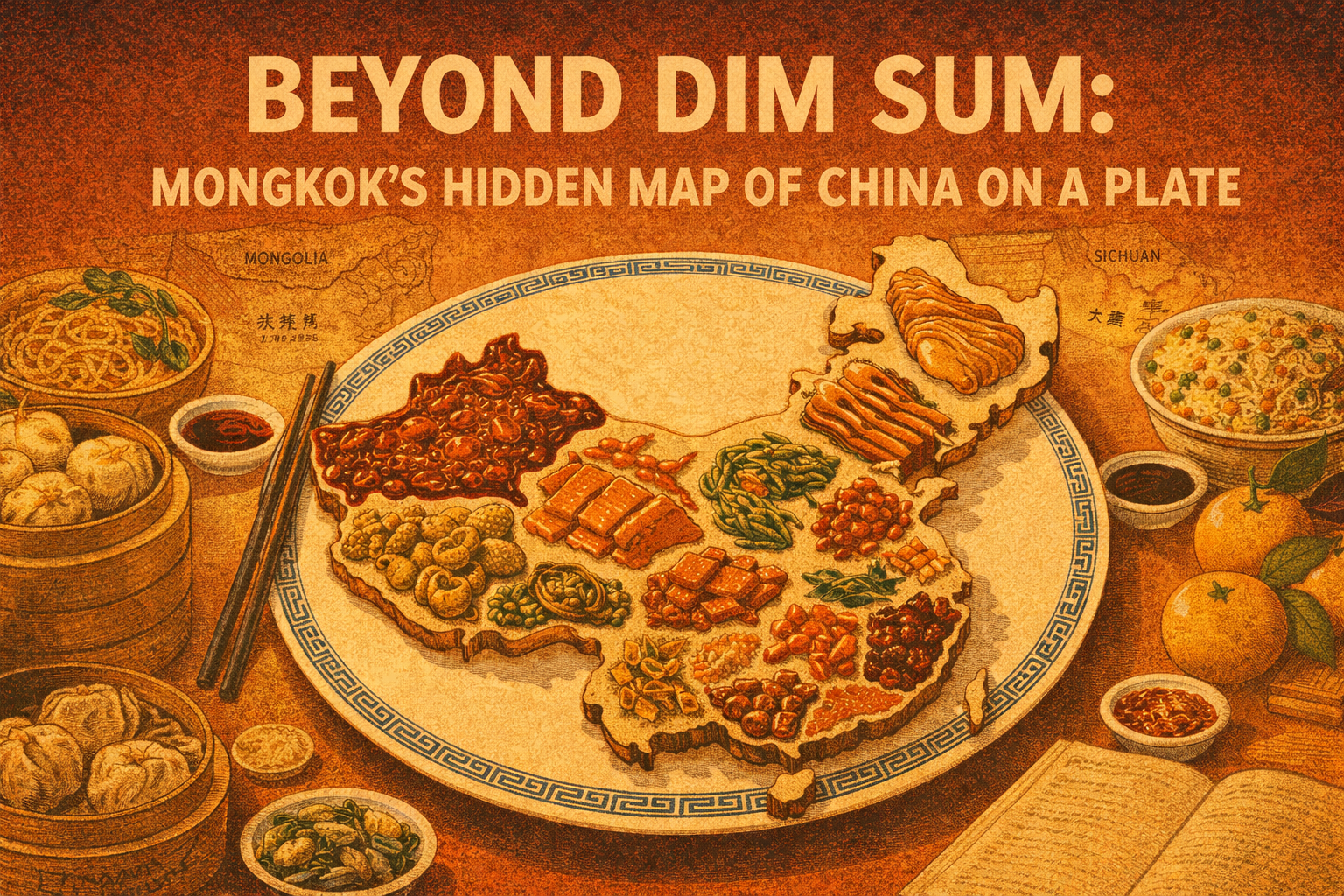

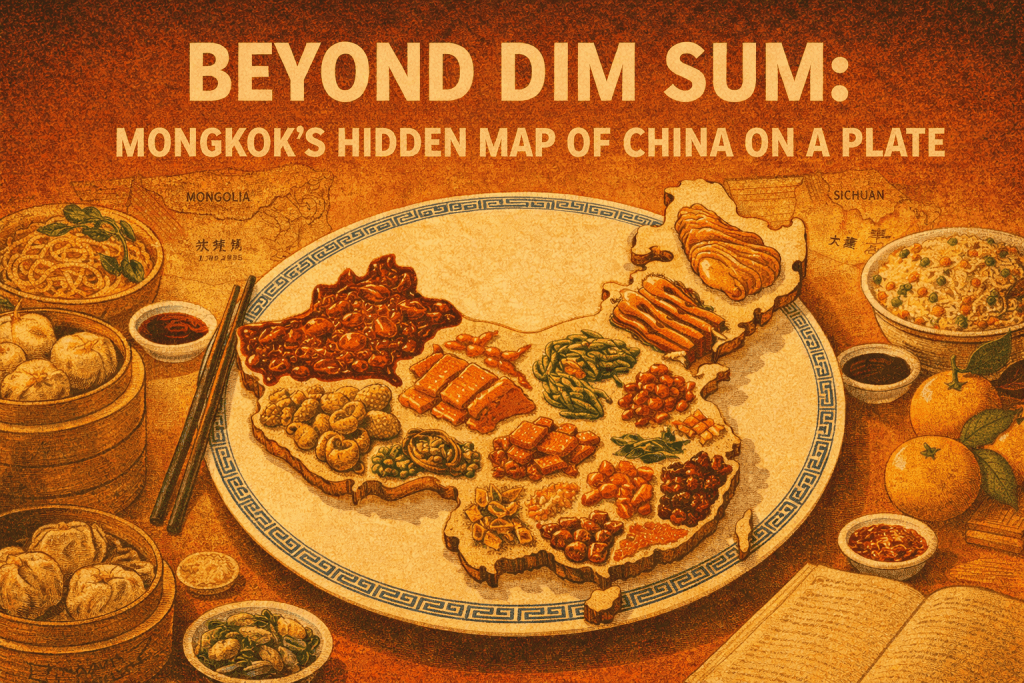
Beyond Dim Sum: Mongkok’s Hidden Map of China on a Plate
As I navigate my emerging role as a Hollywood cultural consultant specializing in Hong Kong culture, I find myself drawn to the unfiltered realities of Mongkok’s culinary landscape. This district, with its dense urban fabric and constant flux, hosts a range of eateries that deliver cuisines from mainland China’s varied regions—far beyond the familiar Cantonese staples. These spots offer direct insights into migration patterns, ingredient sourcing, and flavor profiles that reflect historical trade routes and ethnic adaptations. In my fieldwork, I prioritize firsthand observation to ensure accuracy in advising on scripts and sets, avoiding oversimplifications that plague Western portrayals of Asian food cultures.
One standout is 五指間蘭州牛肉麵 (Ng5 zi2 gaan1 laan4 zau1 ngau4 juk6 min6 – Between Five Fingers Lanzhou Beef Noodles), located at 190-192 Soy Street South in Mongkok. This establishment specializes in hand-pulled noodles from Gansu province’s Lanzhou area, featuring clear beef broth simmered with radish, cilantro, and chili oil. The noodles come in varying thicknesses—fine like hair or broad like belts—paired with halal-certified beef slices, emphasizing the Muslim Hui influence in northwestern Chinese cooking. Portions are generous, with prices around HK$50-70, and the open kitchen allows visibility into the pulling technique, a skill requiring years to master.
Nearby, 雲貴川小鬍子 (Wan4 gwai2 cyun4 siu2 wu4 zi2 – Yunnan Guizhou Sichuan Little Moustache) at 103-109 Soy Street South focuses on southwestern flavors from Yunnan, Guizhou, and Sichuan provinces. Signature rice noodles (mi xian) arrive in sour-spicy broths with toppings like pickled vegetables, minced pork, and fermented beans. The numbing heat from Sichuan peppercorns contrasts with Yunnan’s herbal notes, such as in crossing-the-bridge noodles where raw ingredients cook in hot stock at the table. This fusion highlights how border regions blend indigenous Miao and Yi elements with Han Chinese methods, with meals costing HK$40-60.
For northwestern authenticity, Twins Liangpi Limited (Seong1 zi2 loeng4 pei4 jau5 haan6 gung1 si1 – Twins Cold Skin Limited) on Hak Po Street serves Shaanxi-style cold noodles. Liangpi, made from wheat starch sheets, gets dressed in vinegar-chili sauce with cucumber, gluten, and sesame. Despite occasional Sichuan spice infusions, the core remains Shaanxi’s street food tradition—simple, tangy, and textural. This Michelin Bib Gourmand spot, priced at HK$30-50, underscores resourcefulness in arid inland provinces, where gluten extraction maximizes wheat usage.
Shifting east, Ah Chun Shandong Dumpling (Aa3 ceon1 saan1 dung1 gaau2 zi2 – Ah Chun Shandong Dumplings) near Prince Edward MTR on Lai Chi Kok Road represents Shandong’s coastal influences. Boiled or pan-fried dumplings feature fillings like pork with chives or lamb with fennel, wrapped in chewy skins. Accompaniments include garlic-heavy soups and onion pancakes, reflecting the province’s emphasis on bold, umami-driven seafood and grains. At HK$40-70 per dish, it maintains a no-frills ambiance, aligning with Shandong’s agrarian roots.
Hunan cuisine appears at 辣湘湘小炒湖南菜 (Laat6 soeng1 soeng1 siu2 caau2 wu4 naam4 coi3 – Spicy Hunan Stir-Fry Hunan Cuisine) on Fa Yuen Street. This venue delivers stir-fries from central China’s Hunan, known for smoked meats and fermented chilies. Dishes like cured pork with green beans or spicy fish head use aggressive heat without Sichuan’s numbness, drawing from Xiang River valley agriculture. Prices hover at HK$50-80, and the wok-heated intensity mirrors Hunan’s humid climate adaptations.
Sichuan’s mala profile dominates at 811 Sichuan Cuisine (Baat3 jat1 jat1 cyun4 coi3 – 811 Sichuan Dishes) on Nelson Street. Classics include mapo tofu with fermented broad beans and poached beef in chili oil, balancing numbing peppercorns and doubanjiang paste. This reflects Sichuan Basin’s fertile, spice-reliant farming, with meals at HK$60-90. Finally, Ming Hing Shanxi Sliced Noodles (Ming4 hing1 saan1 sai1 dou1 cit3 min6 – Ming Hing Shaanxi Sliced Noodles) on Yim Po Fong Street offers Shaanxi’s knife-cut noodles—irregular ribbons in tomato-egg or lamb soups. The technique, shaving dough directly into boiling water, yields chewy strands evoking northern China’s wheat belts, priced at HK$40-60.
These findings directly inform my consulting work. Hollywood often reduces Hong Kong to neon-lit chaos or generic “Chinese food,” ignoring how Mongkok’s eateries embody diaspora stories—migrants from Gansu or Hunan adapting recipes amid urban constraints. This diversity counters monolithic views, providing factual depth for authentic representations. For instance, I advise on set designs incorporating open kitchens to show labor-intensive techniques, ensuring cultural neutrality without exoticism.
Inspired by these, I pitch story ideas: A thriller where a Lanzhou noodle chef in Mongkok uncovers smuggling via ingredient shipments, drawing on Gansu’s Silk Road history—provoking questions on global trade ethics. Or a drama following a Yunnan rice noodle vendor navigating family rivalries from Guizhou roots, using food as a metaphor for cultural fusion in HK’s melting pot. Another: A comedy about Shaanxi dumpling makers competing with Sichuan spice shops, highlighting regional tensions in a shared alley—straightforwardly exploring identity without bias. These concepts, grounded in observed realities, aim to elevate HK narratives in film, challenging audiences factually.