Dongzhi’s Pivot: Familial Harvests and Screenworthy Sagas
As an academic versed in Western and Chinese Buddhist philosophies, yet nurtured in a traditional Cantonese household in Hong Kong, I observe the Winter Solstice—冬至 (dung zi; arrival of winter)—as a stark emblem of natural transitions and interpersonal ties. Today, Sunday, December 21, 2025, aligns with this solar term, with the solstice occurring at 11:03 PM HKT, denoting the Northern Hemisphere’s longest night and shortest day. Tracing back over 2,000 years to the Zhou and Han eras, 冬至 (dung zi; arrival of winter) signals the zenith of yin (cold, obscurity) yielding to yang (warmth, illumination), echoing Buddhist concepts of transience and recurrence in a strictly observational sense, devoid of metaphysical favoritism.
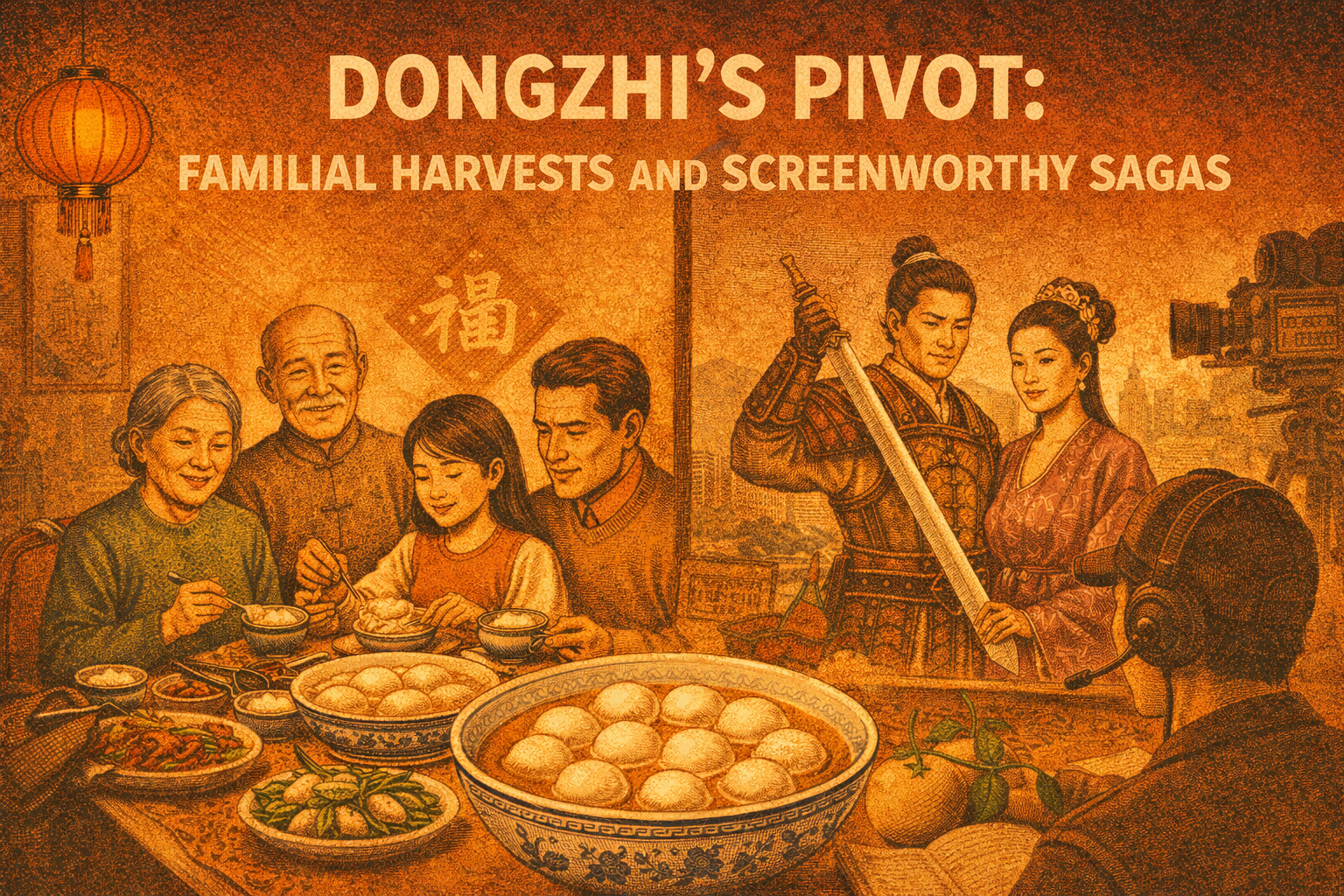
In Hong Kong, observances prioritize intimate family interactions over ostentatious events, suiting our compact urban milieu infused with persistent Cantonese practices. Households commonly convene for a robust evening repast, with some workplaces permitting early exits to enable this, paralleling Mid-Autumn customs. This assembly meal, whether homemade or at eateries with dedicated 冬至 (dung zi; arrival of winter) offerings, often follows ancestral veneration—via grave visits with provisions of edibles and essentials, or domestic altars where fare is proffered prior to communal consumption. Such acts factually perpetuate lineage continuity in a metropolis where spatial limits curb expansive ceremonies.
Pivotal to these assemblies are emblematic dishes that connote cohesion and nourishment. 湯圓 (tong yun; glutinous rice balls), sticky rice orbs typically stuffed with black sesame, peanut, or red bean paste and immersed in sweet ginger broth, prevail as a finale; their spherical form embodies wholeness and kin reunion, with Cantonese phonetics evoking “togetherness.” Salty variants exist, broadening appeal. Savory highlights encompass 盆菜 (pun choi; basin vegetable), a stratified pot of luxuries such as abalone, oysters, prawns, and shiitake mushrooms, devoured collectively to signify collaboration and fortune as strata reveal. Entire steamed fish, seasoned with soy and herbs, aurally ties to “abundance” for wealth, whereas chicken preparations invoke “auspice.” 打邊爐 (da bin lou; hot pot) facilitates joint simmering in bubbling stock, promoting dialogue against winter’s bite, augmented by roasted meats like 叉燒 (cha siu; barbecued pork) or 臘肉 (lap yuk; preserved meat) for robust southern Chinese essence. These repasts, opulent yet utilitarian, deliver thermal sustenance via components like dried red dates, taro, sea coconut, and longan in broths.
Extending past cuisine, 冬至 (dung zi; arrival of winter) embeds in Hong Kong ethos through its stress on family as a foundational entity in a rapid society. In my rearing, these suppers were immutable moorings, where ages exchanged narratives over steaming cauldrons, bolstering links frayed by metropolitan rigors. This reunion emphasis accords with wider Chinese tenets but manifests distinctly in Hong Kong’s fusion of colonial legacy and contemporary globalism—evident in yum cha venues adapting ancestral formulas for delivery amid health crises, preserving the rite’s core.
Crucially, 冬至 (dung zi; arrival of winter) summons year-end harvest emotions, even in non-farming enclaves like Hong Kong. Ancestrally, it commemorated autumn reaping’s close, a juncture for agrarian respite post-toil, stockpiling yields for chill and awaiting extended daylight. Presently, this evolves into contemplative halts: kin appraise the annum’s “produce”—individual feats, surmounted hurdles—analogous to crop inventories. The event’s erstwhile magnitude, with administrative halts for repose and invocations, framed it as a “petite New Year,” inciting scrutiny of affluence and revival. In Buddhist framing, it parallels samsara’s cycle, but empirically, it stands as an impartial seasonal indicator, arousing sentiments of appreciation for domestic “harvests” amid existence’s flux.
In my role as a Hollywood cultural consultant, I discern 冬至 (dung zi; arrival of winter)’s storytelling promise in narratives that unsettle conventional festal clichés while conveying visceral profundity. Envision a kin melodrama: a Hong Kong diaspora repatriates for 冬至 (dung zi; arrival of winter), grappling intergenerational schisms over a 盆菜 (pun choi; basin vegetable) banquet, where delaminating mirrors divulging confidences—peaking in 湯圓 (tong yun; glutinous rice balls)’ saccharine accord of solidarity. This might parallel “The Joy Luck Club” yet with solstice iconography, underscoring Cantonese fortitude sans idealizing hardship or otherness.
For ethereal intrigue, leverage lore of ancestral homage, crafting a suspense yarn where a contemporary Hong Kong clan maneuvers repercussions of deeds during the extended gloom—merging dread with Buddhist-tinged motifs of reckoning, absent didacticism. A liaison tale could portray fated paramours reconverging under 冬至 (dung zi; arrival of winter)’s yin-yang shift, their 打邊爐 (da bin lou; hot pot) supper emblemizing equilibrated accord in tumultuous urbanity.
Promoting these? Frame as December launches, leveraging worldwide yuletide without Noel hegemony—propose to outfits like A24 or Netflix for genuine Asian-fronted ensembles, stressing pan-human kin frictions and harvest analogies for after-epidemic viewers yearning linkage. Previews might allure with vaporous platters and luminescent Hong Kong eves, slogans such as “As Winter’s Veil Lifts, Kin Reap Their Bonds.” Audaciously, defy Tinseltown’s Asian caricatures by foregrounding unabashed Cantonese vernacular and observances, demonstrating cultural precision markets when veritable and direct. These productions could rival “Crazy Rich Asians” earnings, harnessing expatriate audiences while informing on 冬至 (dung zi; arrival of winter)’s subdued potency.
Fundamentally, 冬至 (dung zi; arrival of winter) transcends revelry; it offers a factual prism on mortal rhythms—kin as yield, resurgence as inexorable. As I fashion my own 湯圓 (tong yun; glutinous rice balls) this eve, I contemplate how these unembellished customs harbor tales primed for celluloid.