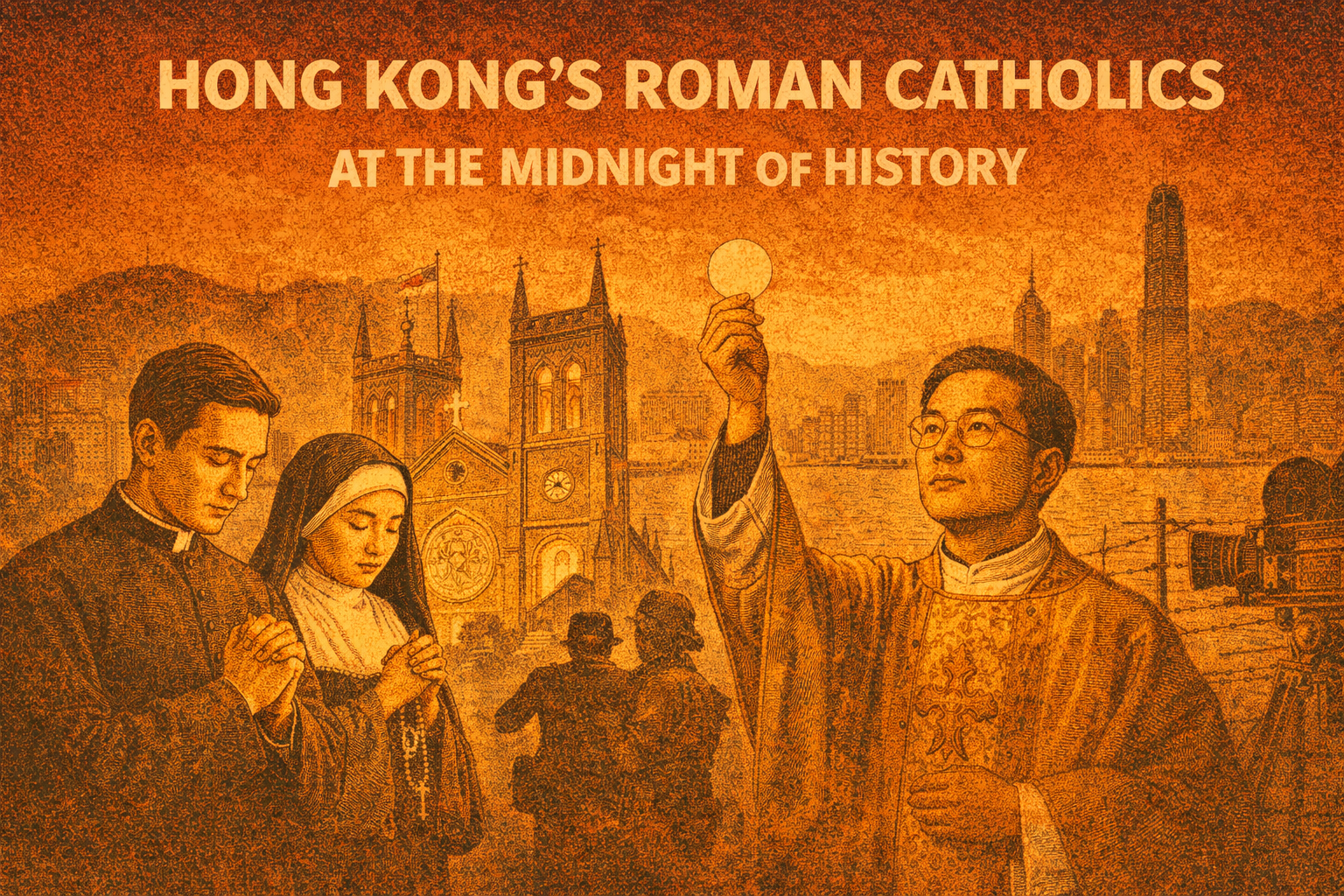
Hong Kong’s Roman Catholics at the Midnight of History
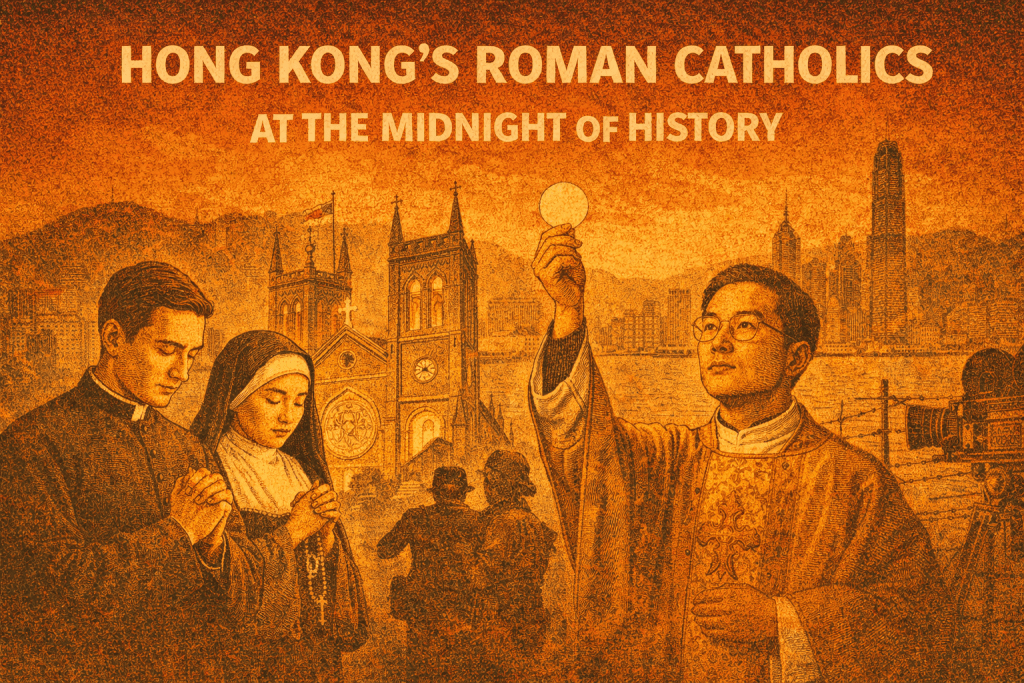
As the clock ticks toward midnight here in Hong Kong on December 24, 2025 HKT—Christmas Eve—I’m reflecting on the enduring presence of the Roman Catholic community in this city. Tomorrow, December 25, marks Christmas Day, a public holiday where churches like the Cathedral of the Immaculate Conception (聖母無原罪主教座堂, Sing3 mou5 mou4 jyun4 zeoi1 zyu2 gaau3 zok6 tong4, Cathedral of the Immaculate Conception) will host midnight Masses, blending ancient rituals with the neon glow of our skyline. As a fledgling Hollywood cultural consultant specializing in Hong Kong culture, I’ve spent my early career unpacking the layers of this place for screenwriters and directors. In my blog, Echoes of Empire, I explore how history shapes stories. Today, I analyze the Roman Catholic community’s trajectory from Hong Kong’s establishment as a British Crown Colony in 1842 to the present, five years after the 2020 National Security Law (NSL). This neutral examination highlights its institutional growth, social contributions, and evolving challenges, while suggesting cinematic narratives it inspires.
Hong Kong became a British Crown Colony following the 1842 Treaty of Nanking, ceding the island to Britain after the First Opium War. Roman Catholicism arrived concurrently, with the Holy See designating Hong Kong an apostolic prefecture in 1841, separate from the Diocese of Macau (澳門教區, Ou3 mun4 gaau3 keoi1, Diocese of Macau). Swiss priest Theodore Joset established the first parish in 1842, and by 1843, a modest church stood at the junction of Pottinger Street (砵甸乍街, But6 din1 zaa3 gaai1, Pottinger Street) and Wellington Street (威靈頓街, Wai1 ling4 deon6 gaai1, Wellington Street). Missionaries from societies like the Paris Foreign Missions and the Pontifical Institute for Foreign Missions focused on evangelization amid a transient population of traders, laborers, and refugees. By 1874, the prefecture elevated to a vicariate apostolic, reflecting steady expansion. Churches proliferated, including the Gothic-style Cathedral of the Immaculate Conception, completed in 1888 on Caine Road (堅道, Gin1 dou6, Caine Road), which remains the diocese’s seat.
Throughout the colonial era, the Catholic Church embedded itself in society through education and welfare, filling voids left by a profit-oriented British administration. It opened the first school for Chinese boys in 1843 and expanded to elite institutions like Wah Yan College (華仁書院, Waa4 jan4 syu1 jyun2, Wah Yan College) and Sacred Heart Canossian College (嘉諾撒聖心書院, Gaa1 nok6 saai1 sing3 sam1 syu1 jyun2, Sacred Heart Canossian College). These schools nurtured generations, including future leaders, and by the mid-20th century, Catholics operated nearly half of Hong Kong’s primary and secondary education. Social services followed: hospitals, orphanages, and clinics addressed needs during turbulent periods, such as the Sino-Japanese War (1937–1945) and the Chinese Civil War. The Japanese occupation from 1941 to 1945 interned foreign clergy, but local Chinese priests sustained operations, demonstrating resilience. In 1946, Hong Kong became a full diocese, with Italian bishop Enrico Valtorta installed in 1948, followed by the first Chinese bishop, Francis Hsu, in 1969.
The post-1949 era, marked by the People’s Republic of China’s founding, brought massive refugee influxes from the mainland, swelling the Catholic population. The Church responded with emergency aid, housing, and vocational training through organizations like Caritas (明愛, Ming4 oi3, Caritas), which by the 1970s managed 60% of social welfare services and 20% of hospitals. Ecumenical efforts with Protestants emerged in media and welfare, though formal ties remained limited. By the 1984 Sino-British Joint Declaration, paving the way for the 1997 handover, the diocese had grown to over 50 parishes, serving a community of around 250,000—about 5% of the population, including many Filipino migrant workers. Publications like Kung Kao Po (公教報, Gung1 gaau3 bou3, Catholic Newspaper), established in 1928, and the English-language Sunday Examiner documented this growth, while the Catholic Institute for Religion and Society hosted workshops on faith in modern life.
The 1997 handover to China under the “one country, two systems” framework guaranteed religious freedom in the Basic Law (基本法, Gei1 bun2 faat3, Basic Law). Initially, the Church continued its operations, with figures like Cardinal Joseph Zen Ze-kiun (陳日君樞機, Can4 jat6 gwan1 su1 gei1, Cardinal Joseph Zen) advocating for democracy and human rights. Adult baptisms averaged 2,000 annually, offsetting emigration. However, tensions arose as Beijing tightened control. The 2020 NSL, enacted amid pro-democracy protests, criminalized secession, subversion, terrorism, and foreign collusion, prompting concerns over its broad application. The diocese initially opposed the law, citing threats to rights. By 2024, reports indicated deteriorating religious freedom: the Church reportedly suppressed information on mainland persecution to avoid repercussions, and the law’s anti-espionage clauses potentially impacted religious organizations with overseas ties. Despite assurances from the diocese that the seal of confession remains protected, critics noted risks to clergy, exemplified by arrests of activists with Catholic affiliations. As of 2025, the community persists with 51 parishes, including recent expansions like St. Joseph’s Church in Fanling (粉嶺聖若瑟堂, Fan2 ling5 sing3 joek6 sat1 tong4, St. Joseph’s Church in Fanling), but operates under heightened scrutiny, balancing pastoral duties with compliance.
This history, objective and unvarnished, reveals a community navigating empire, war, and sovereignty shifts—provocative in its quiet defiance of transient powers. As a Hollywood consultant, I see untapped narratives here. Imagine a period drama tracing a missionary’s arrival in 1842, clashing with opium trade realities, echoing themes in films like The Mission. Or a thriller set post-NSL, following a priest safeguarding refugees amid surveillance, inspired by real tensions and akin to Spotlight’s investigative edge. Personal sagas could spotlight elite Catholics like former Chief Executive Carrie Lam (林鄭月娥, Lam4 zeng6 jyut6 ngo4, Carrie Lam), exploring faith’s role in governance—or stories of Filipino domestics finding solace in Sunday Masses at Victoria Park (維多利亞公園, Wai4 do1 lei6 aa3 gung1 jyun4, Victoria Park). These tales, drawn from Hong Kong’s Catholic fabric, could humanize the city’s complexities for global audiences, blending provocation with cultural depth. As Christmas dawns tomorrow, this legacy endures beneath the Lion Rock (獅子山, Si1 zi2 saan1, Lion Rock).