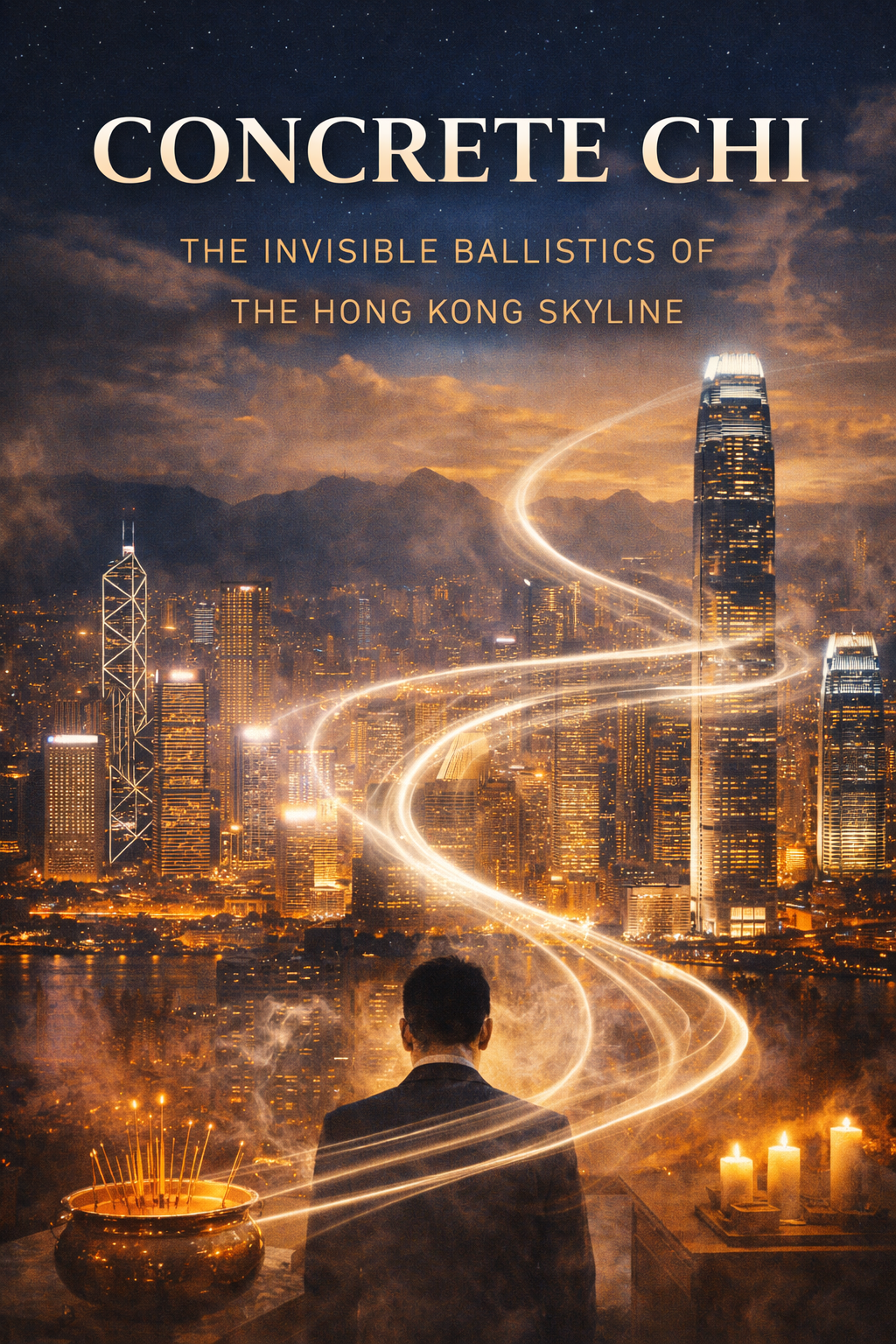

Concrete Chi: The Invisible Ballistics of the Hong Kong Skyline
Standing on the Tsim Sha Tsui promenade and looking across the harbor, one sees what is arguably the most vertical city on Earth. To the uninitiated eye, the Hong Kong skyline is a testament to engineering density, high finance, and the scarcity of land. However, to view this steel-and-glass panorama merely as a result of economic zoning laws is to miss the fundamental narrative of the city’s urban planning. Through a sociological lens, the skyline is not just a cluster of corporate headquarters; it is a metaphysical battlefield. In my ongoing analysis of how tradition informs modernity in Hong Kong, I have turned my attention to the concept of “Architectural Sociology,” specifically the phenomenon known locally as the “Feng Shui Wars.” Here, the orientation of a window or the angle of a roof is not an aesthetic choice, but a tactical maneuver in a silent, spiritual conflict.
The most prominent protagonist in this narrative is undoubtedly the Bank of China Tower. Designed by I.M. Pei, the structure is an architectural marvel of geometric prisms. However, upon its completion, it was viewed by the local populace not as a triumph of modernism, but as a source of aggressive negative energy, or Sha Qi. The building’s sharp, triangular edges resemble a cleaver or a knife. In the lexicon of Feng Shui, these angles slice through the benevolent energy of the surrounding area. Sociologically, this creates a tangible impact; during its construction, the perceived “cutting” of the skyline was blamed for various misfortunes, including the sudden death of the British Governor at the time within the Government House, which sits directly in the tower’s “line of fire.” This demonstrates that in Hong Kong, a building’s metaphysical reputation is as significant as its structural integrity.
The response to this aggression illustrates the unique dialogue between corporate strategy and folk belief. The HSBC Main Building, designed by Norman Foster, sits near the Bank of China Tower. In response to the “knife” pointing at their headquarters, HSBC did not file a zoning complaint; they deployed metaphysical artillery. The maintenance cranes mounted on the roof of the HSBC building are shaped like cannons. While functionally used for window washing, they are positioned to aim directly at the Bank of China Tower. It is a defensive posture, a way to deflect the Sha Qi back toward its source. This standoff—a knife against a cannon—is a permanent, physical manifestation of a spiritual belief system, frozen in steel and concrete for the entire city to witness.
The narrative complexity deepens with the introduction of the Cheung Kong Center, the headquarters of Li Ka-shing’s empire. Situated directly between the aggressive Bank of China Tower and the defensive HSBC building, the architects faced the challenge of placing a skyscraper in the middle of a crossfire. The solution was a masterclass in neutrality. The building is a perfect, boxy rectangle with a reflective glass exterior. The design intent was to create a “shield” that allows the negative energy to flow around the structure without adhering to it. It avoids the sharp angles of the aggressor and the open weaponry of the defender. This reflects a very specific Hong Kong business ethos: the pragmatic middle path that seeks to accumulate wealth while avoiding conflict.
For the creative industries, particularly Hollywood, this architectural landscape offers a largely untapped resource for visual storytelling. Western cinema often depicts Asian mysticism through ancient temples or rural villages. However, there is a far more compelling thriller to be written about the boardroom meetings where these architectural decisions are made. A screenwriter could craft a narrative where the tension is not derived from gunfights, but from the drafting of blueprints. Imagine a plot centered on a young architect who inadvertently designs a structure that disrupts the Qi of a powerful tycoon, triggering a corporate war fought through geometry and light. The “warfare” is invisible to the naked eye but devastating to the stock price. The visual language of such a film would not need to rely on special effects, but on the menacing shadows cast by a prism or the reflection of a cannon in a glass curtain wall.
Furthermore, this adherence to Feng Shui principles acts as a form of social cohesion among the elite. It creates a shared language of risk. Just as I observed with the “Metaphysical Hedge” of the temple rituals, the design of a skyscraper is an attempt to impose order on a chaotic universe. By adhering to these principles, developers signal to the market that they are responsible stewards of capital. A building with “bad Feng Shui” is difficult to lease; therefore, the superstition becomes a hard economic reality. The belief creates the value.
As we look at the skyline, we must recognize that we are not seeing a secular arrangement of glass. We are witnessing a frozen conversation about power, luck, and defense. The winds—or Zephyrs—that blow through the canyons of Central are believed to carry fortune, and the buildings are the nets designed to catch it. To understand Hong Kong, one must understand that its architecture is functionally dualistic: it is built to withstand typhoons, but it is designed to withstand bad luck.