The Dual Altar: Synthesizing the Spiritual Capital of Hong Kong’s Elite
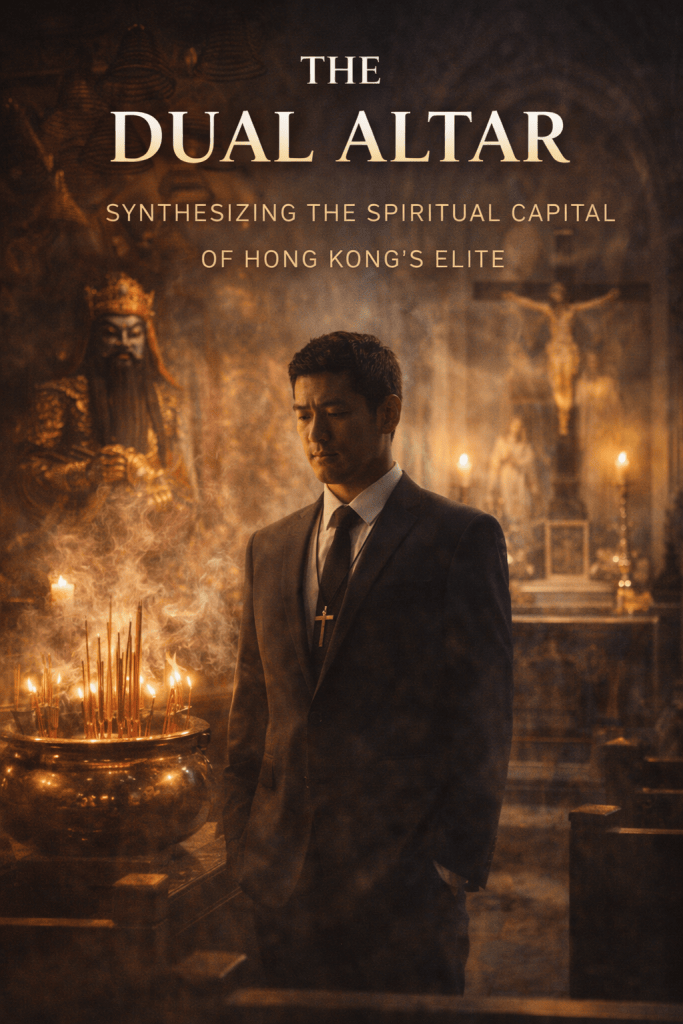
Having spent the past few days dissecting the spiritual behaviors of Hong Kong’s upper echelon—first through the lens of Chinese folk religion and subsequently through the prism of the Catholic establishment—I find it necessary to now draw these two distinct threads together. To view Hong Kong merely as a secular hub of global finance is a sociological error; it is, in reality, a city fueled by a complex dual-voltage spiritual battery. By placing the practitioner of the “Metaphysical Hedge” side-by-side with the “Ascetic Executive,” a fascinating dichotomy emerges. While both groups utilize their faith to navigate the volatility of high-stakes capitalism, their methodologies represent opposite ends of the theological spectrum: one is transactional and additive, while the other is penitential and subtractive.
In my analysis, the primary distinction lies in the direction of the spiritual energy. The practitioner of Chinese folk religion—the tycoon who consults Guandi or Che Kung—operates on an external vector. The objective is to influence the environment. By spinning the pinwheel or appeasing the Tai Sui, the individual seeks to manipulate cosmic variables to their favor. It is a bureaucratic approach to the divine, mirroring the transactional nature of a contract: offerings are made, and protection is expected in return. Conversely, the Catholic elite operate on an internal vector, particularly during the Lenten season. The refusal of luxury or the imposition of the fast is not an attempt to change the external market, but to discipline the internal self. If the folk religionist seeks to control their luck, the Catholic seeks to control their desires.
This juxtaposition offers a sophisticated palette for Hollywood screenwriters and directors, far surpassing the monolithic depictions of Asian culture often seen in Western cinema. The true drama of Hong Kong society is not found in a singular exotic ritual, but in the collision of these two worldviews within the same boardroom. Imagine a scene in a corporate thriller where a merger is being negotiated. On one side of the table sits a chairman who has selected the meeting date based on the Tong Sing (Chinese almanac) to ensure auspicious alignment. On the other side sits a barrister who refuses the celebratory champagne because it is a Friday in Lent. The tension here is not just commercial; it is metaphysical. It visualizes a conflict between a worldview that seeks to bend fate to its will and a worldview that seeks to submit the will to a higher discipline.
Furthermore, my observation of the social landscape reveals that these two categories are not mutually exclusive. This creates the most compelling character archetype of all: the syncretic pragmatist. It is not uncommon to find Hong Kong families who attend High Mass on Sunday morning and visit the Wong Tai Sin temple on Sunday afternoon. In Western narrative structures, this might be viewed as a contradiction or a crisis of faith. However, in the context of Hong Kong’s utilitarian culture, it is viewed as the ultimate diversification strategy. Just as a wise investor creates a portfolio with a mix of bonds and equities to mitigate financial risk, the pragmatic elite cultivate a spiritual portfolio to mitigate metaphysical risk.
For a filmmaker, this syncretism offers a rich character study. A protagonist who wears a crucifix around their neck but carries a jade amulet in their pocket represents the quintessential Hong Kong identity. This character treats the spiritual realm with the same fluidity as they treat currency exchange, switching between the Latin liturgy and the Taoist incantation depending on which “market” they need to access. This challenges the Western notion of religious exclusivity and presents a more nuanced reality of how power operates in the East.
The architecture of the city itself reflects this duality. The sleek, glass curtain walls of the financial district reflect both the incense-choked temples nestled in their shadows and the colonial-era cathedrals standing on the slopes above. Both institutions serve as power centers. The temple provides the assurance of luck, a necessary commodity in a market driven by chance. The cathedral provides the assurance of moral order, a necessary commodity in a legal system derived from British common law. The elite navigate both, drawing “spiritual capital” from each to reinforce their earthly status.
In conclusion, the study of Hong Kong’s upper class is incomplete without acknowledging this spiritual infrastructure. Whether through the “Metaphysical Hedge” of the folk religion rituals or the “Ascetic Discipline” of the Catholic fast, the elite are constantly engaged in a dialogue with the unseen. For the storyteller, the lesson is clear: in Hong Kong, the accumulation of wealth is rarely a purely secular pursuit. It is a drama played out on a stage where the smell of money is always intermingled with the scent of incense and the smoke of the altar.