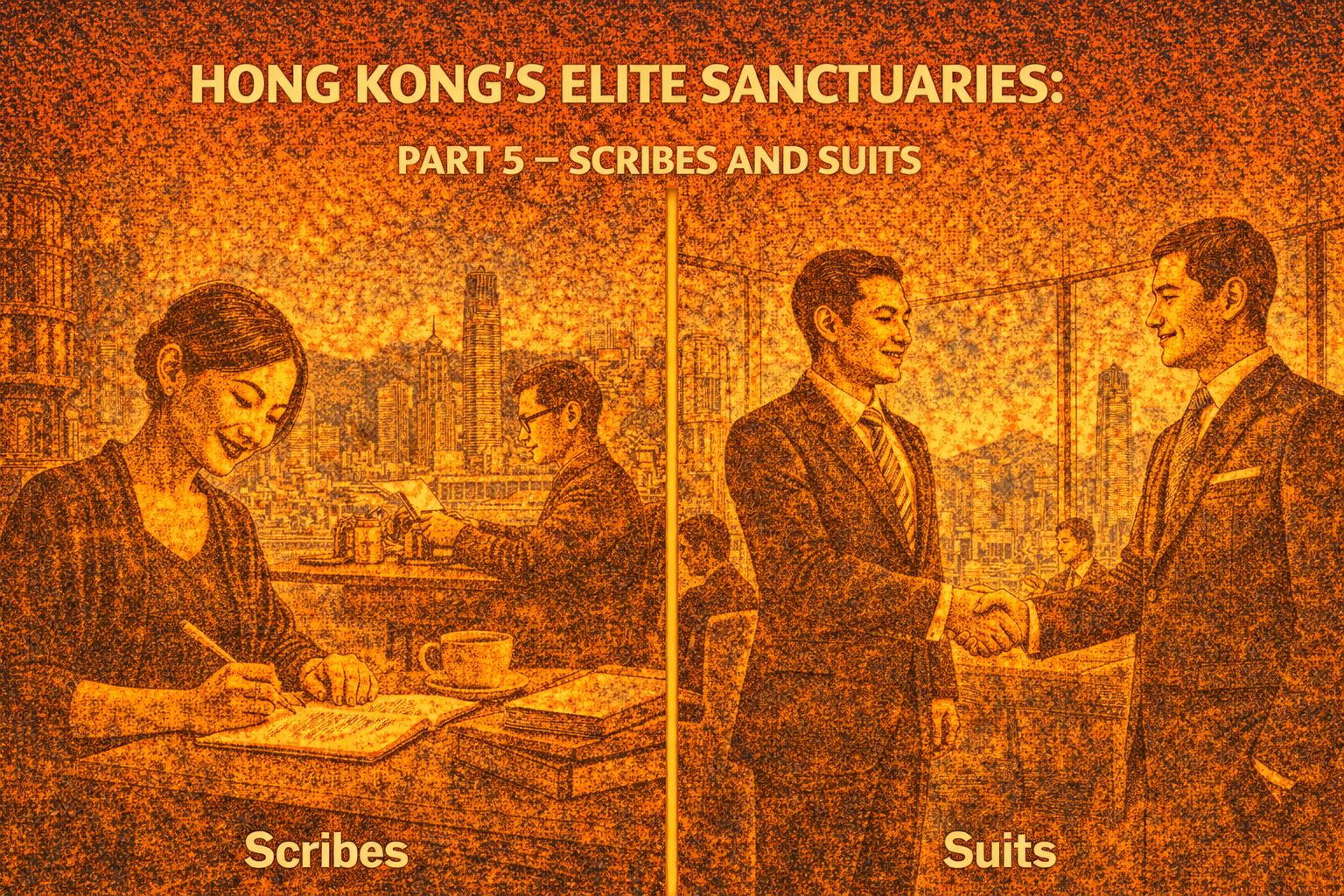
Hong Kong’s Elite Sanctuaries: Part 5 – Scribes and Suits
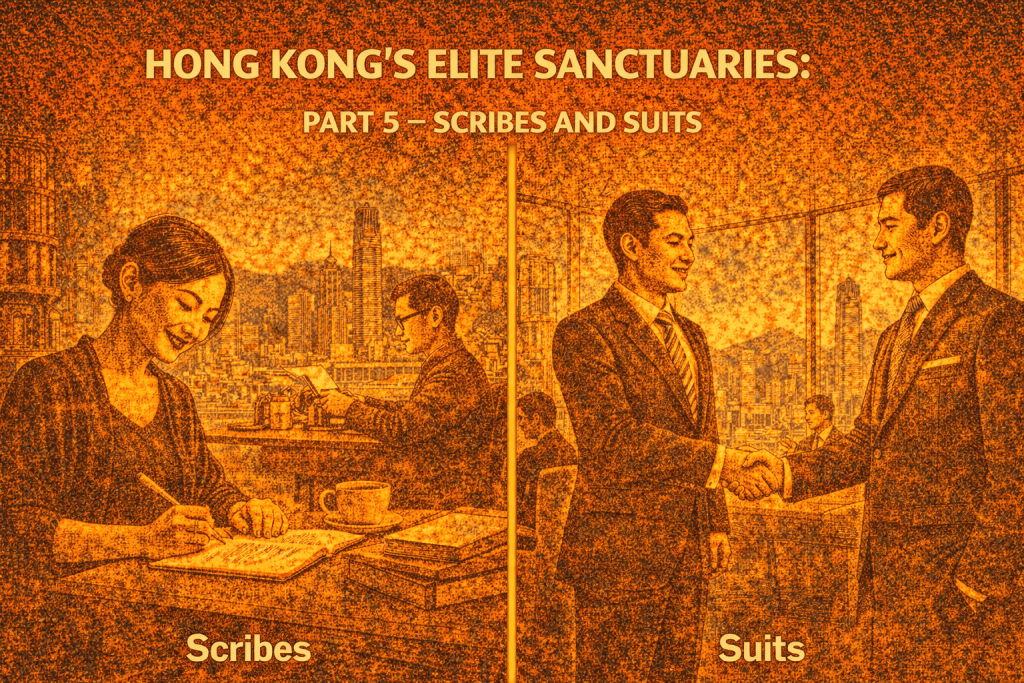
As I continue this series exploring Hong Kong’s private clubs—those bastions of privilege that shape the city’s social fabric—I’ve delved into venerable institutions like the Hong Kong Club and the Jockey Club in earlier installments. Now, in this fifth chapter, I turn to two establishments that embody the intersection of global influence and local power: the Foreign Correspondents’ Club (FCC) and the Hong Kong Bankers Club. These venues aren’t just retreats; they’re nodes in networks of information and capital, reflecting Hong Kong’s role as Asia’s crossroads. Drawing from historical records and my own experiences, I’ll examine their origins, functions, and potential as cinematic backdrops, all while highlighting their embeddedness in the upper strata of Hong Kong society.
The FCC stands as a testament to journalism’s enduring grit amid geopolitical upheaval. Established in 1943 amid the chaos of wartime Chongqing, it served as a refuge for reporters covering China’s resistance against Japanese occupation. As civil war raged, the club migrated with the story—first to Nanjing, then Shanghai—before settling in Hong Kong in 1949, just as Mao’s forces claimed the mainland. This relocation wasn’t mere happenstance; Hong Kong’s status as a British colony offered a stable base for international media, free from the mainland’s tightening grip. By the 1960s, during the Vietnam War, the FCC became a pivotal hub, providing rest and resources for correspondents shuttling between battlefields and briefings. Today, housed in the historic Old Dairy Farm Depot in Central since 1982, it hosts over 2,400 members, including journalists, diplomats, and business figures. It functions as a neutral forum for debates, with speakers ranging from politicians to activists, and staunchly advocates for press freedom across Asia. In a city where information flows like currency, the FCC underscores journalism’s elite status—members aren’t just observers; they’re shapers of narratives that influence global perceptions.
Shifting to the financial realm, the Hong Kong Bankers Club emerged in 1977, founded by ten expatriate bankers seeking a dedicated space amid Hong Kong’s booming economy. Initially named the Hong Kong Overseas Bankers Club, it rebranded in 1996 to reflect a broader membership, now encompassing local and international professionals from banking, law, and finance. This evolution mirrors Hong Kong’s transformation into a world-class financial center, where East meets West in high-stakes deals. The club, now spanning 22,000 square feet in the Nexxus Building in Central, offers panoramic views of Victoria Harbour, fine dining, and versatile event spaces. Managed by the Peninsula Hotels’ consultancy arm, it’s a sanctuary for networking—think discreet lunches sealing mergers or evenings unwinding after market closes. I’ve dined there multiple times with my parents and their circle, savoring the understated elegance: crystal clinking over discussions of yields and regulations, the air thick with the confidence of those who move markets. It’s not ostentatious, but its exclusivity reinforces the financial elite’s insularity, a microcosm of Hong Kong’s wealth concentration.
Both clubs fit seamlessly into Hong Kong’s upper class, where membership signals not just affluence but access to power corridors. The FCC’s journalist-diplomat blend evokes an intellectual aristocracy, privy to secrets that ripple through policy and media. The Bankers Club, meanwhile, caters to the monetary mandarins, whose decisions fuel the city’s GDP. This cultural positioning makes them ripe for Hollywood’s lens, where Hong Kong often serves as a backdrop for intrigue and ambition. Filmmakers could draw inspiration without romanticizing; instead, portray these spaces as they are—arenas where global forces collide.
For the FCC, imagine a thriller akin to “All the President’s Men” but set against Asia’s flashpoints. A protagonist, perhaps a seasoned correspondent, uncovers a corporate scandal involving Beijing’s influence in Hong Kong. The club’s Main Bar becomes a pivotal set: dimly lit, walls adorned with press clippings, where whispered exchanges reveal leaks over whiskey. Hollywood could emphasize its upper-class cachet by contrasting the club’s colonial-era charm with the gritty realities outside—members in tailored suits debating ethics while protests rage below. This setup provokes questions about journalism’s complicity in elite narratives: Are these scribes watchdogs or gatekeepers? A scene might show a high-society gala disrupted by a whistleblower, highlighting how the FCC’s neutrality masks the class divides in Hong Kong’s media landscape.
The Bankers Club lends itself to finance-driven dramas like “The Big Short,” reimagined in Asia’s money hub. Picture a plot revolving around a hedge fund meltdown, with the club as the epicenter of backroom deals. Directors could film in its sleek lounges, capturing executives plotting over dim sum, Victoria Harbour’s lights symbolizing fleeting fortunes. To underscore its cultural fit, portray it as the ultimate upper-class enclave: entry requires not just wealth but connections, mirroring Hong Kong’s oligarchic tendencies. A provocative twist might involve a young banker challenging old-guard corruption, exposing how such clubs perpetuate inequality. Hollywood could use this to comment on global finance’s excesses—without bias, simply letting the opulence speak for itself.
In weaving these clubs into films, creators tap into Hong Kong’s duality: a glittering facade over underlying tensions. As someone who’s navigated these spaces, I see them as more than venues; they’re cultural artifacts. Yet, their exclusivity raises straightforward queries: In a city of stark divides, do they unite or isolate? This series concludes next with Soho House and Eko, rounding out Hong Kong’s club mosaic. Until then, consider how these institutions quietly steer the city’s story.