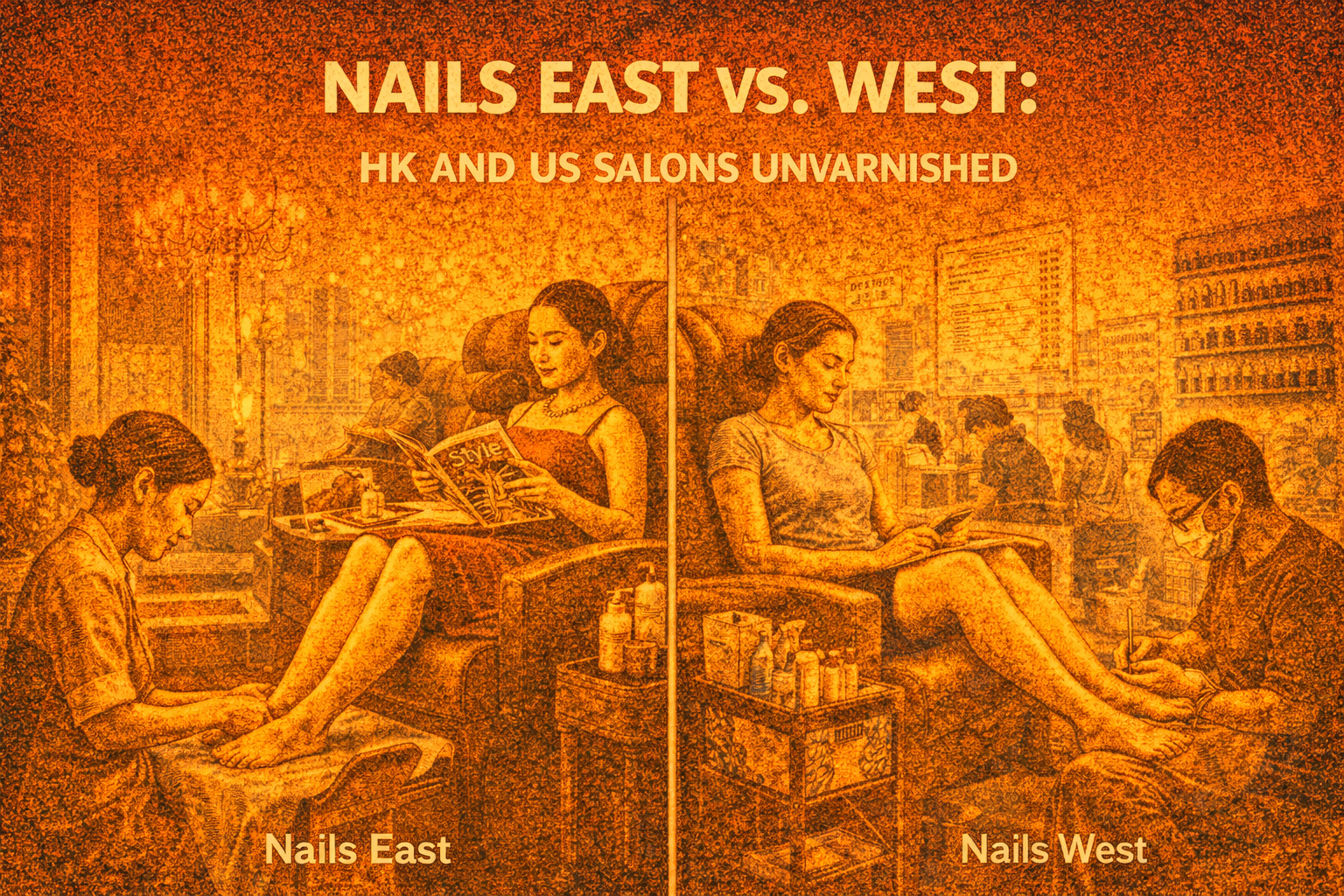

Nails East vs. West: HK and US Salons Unvarnished
As someone who has split time between Hong Kong and the United States, I’ve come to view nail salons as microcosms of broader cultural and economic dynamics. For years, I’ve frequented 創健坊 in Happy Valley, drawn primarily to my go-to manicurist and pedicurist, Linda. She delivers meticulous work—precise shaping, thorough cuticle care, and durable gel applications that last weeks without chipping. A full mani-pedi there runs HK$700, or about $91 USD at current exchange rates. Tipping isn’t customary in Hong Kong, but I typically add HK$100 ($13 USD) out of appreciation, bringing the total to HK$800 ($104 USD). Linda even makes house calls for an extra fee, a convenience that fits seamlessly into Hong Kong’s fast-paced urban life. This personal routine has prompted me to dissect the nail salon landscapes in both places, revealing stark contrasts in pricing, service norms, and cultural underpinnings.
In Hong Kong, nail salons blend efficiency with a touch of luxury, often tucked into high-rises or shopping malls amid the city’s dense verticality. Services range from basic polishes to intricate nail art influenced by Japanese and Korean trends, such as minimalist designs or chrome finishes. Average costs for a standard manicure hover between HK$160 and HK$390 ($20-$50 USD), while pedicures fall in the HK$300 to HK$490 range ($38-$63 USD). Combos like my usual at 創健坊 push toward the higher end, especially with gel or spa add-ons, but entry-level options can dip as low as HK$70 for a quick manicure. Hygiene standards are rigorous, with many salons adhering to hospital-grade sterilization, reflecting Hong Kong’s post-SARS emphasis on public health. Tipping remains optional and understated—perhaps HK$10-20 for basic services or up to 10% at upscale spots. This lack of obligation stems from a service culture where wages are structured to stand alone, without reliance on gratuities. Salons often cater to a professional clientele seeking quick, reliable maintenance rather than indulgent escapes. Unique offerings, like Shanghainese pedicures involving razor-sharp tools for callus removal, add a traditional edge not commonly found elsewhere. Overall, the scene prioritizes precision and speed, aligning with Hong Kong’s no-nonsense ethos.
Shifting to the United States, nail salons proliferate in strip malls and urban neighborhoods, often dominated by Vietnamese-American entrepreneurs who democratized the industry in the 1970s and 1980s. This influx made services more accessible, turning manicures from luxuries into routine self-care. A basic manicure averages $20-$40 USD, with pedicures at $25-$50 USD, and combos frequently bundled for $40-$80 before tips. Gel enhancements bump prices to $35-$65 for manis and $40-$75 for pedis, varying by region—cheaper in the Midwest, pricier in coastal cities like New York or Los Angeles. Tipping is non-negotiable, typically 15-20% of the pre-tax total, or even 25% for exceptional work, adding $10-$20 to a standard visit. This expectation arises from a wage model where base pay is low, and tips form a core income stream, fostering a tipping culture that can feel coercive compared to other countries. Services emphasize relaxation, with spa pedicures including massages and aromatherapy, though quality varies widely—some salons cut corners on sanitation, leading to occasional health concerns. Trends lean toward bold, Instagram-ready designs like acrylic extensions or ombre effects, reflecting America’s diverse, expressive beauty standards.
Comparing the two, Hong Kong salons often deliver superior value for money. My HK$700 session at 創健坊 equates to a premium US experience costing $80-$120 including tip, yet without the pressure to overpay for average service. HK’s optional tipping empowers clients, avoiding the US’s implicit social tax that can inflate bills by 20%. Culturally, HK favors subtlety and functionality—nails as polished extensions of professional attire—while US salons embrace flamboyance, with elaborate art that might seem excessive in Hong Kong’s conservative circles. Hygiene edges toward HK’s favor due to stringent regulations, whereas US variability stems from a fragmented industry. However, US accessibility shines: walk-ins are easier, and budget options abound, thanks to immigrant-driven innovation that lowered barriers. House calls like Linda’s are rarer stateside, reserved for high-end clients, underscoring HK’s service-oriented flexibility.
Yet, neither is inherently superior; context matters. In Hong Kong’s humid, crowded environment, durable gels combat daily wear, while US salons’ spa vibes offer respite from sprawling commutes. Provocatively, one might argue US tipping perpetuates inequality by shifting wage burdens to consumers, whereas HK’s model promotes transparency—but both systems reflect societal norms on labor and luxury. From my vantage, blending the best—HK’s efficiency with US creativity—would idealize the experience. Ultimately, whether in Happy Valley or a Brooklyn bodega-adjacent spot, nail care reveals how global cities pamper amid pressures, one coat at a time.
Drawing from these conclusions, Hollywood could mine rich narrative veins here. Imagine a dramedy series following a Hong Kong expat opening a salon in Los Angeles, clashing over tipping norms—her transparent pricing alienates tip-dependent staff, sparking union tensions and cultural satire on American inequality. Or a thriller where a US nail tech uncovers corporate espionage via house calls in HK’s high-rises, blending precision hygiene with high-stakes intrigue, highlighting East-West efficiency gaps. A romantic comedy might pivot on a flamboyant US designer collaborating with a subtle HK artisan, their creative fusion birthing viral trends but exposing personal divides in expression versus restraint. These stories could provoke audiences on globalization’s frictions, turning salons into stages for broader economic and cultural reckonings.