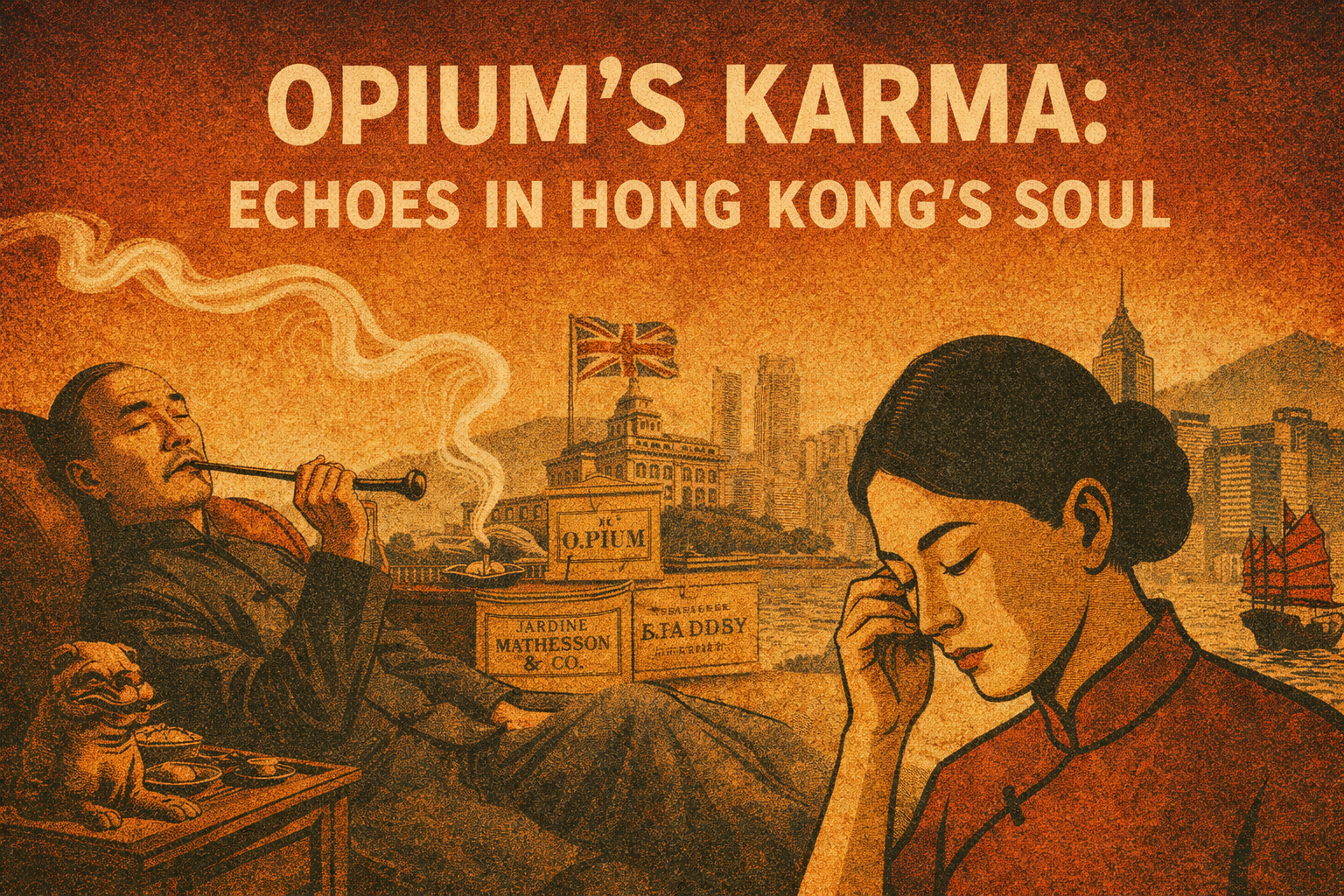
Opium’s Karma: Echoes in Hong Kong’s Soul
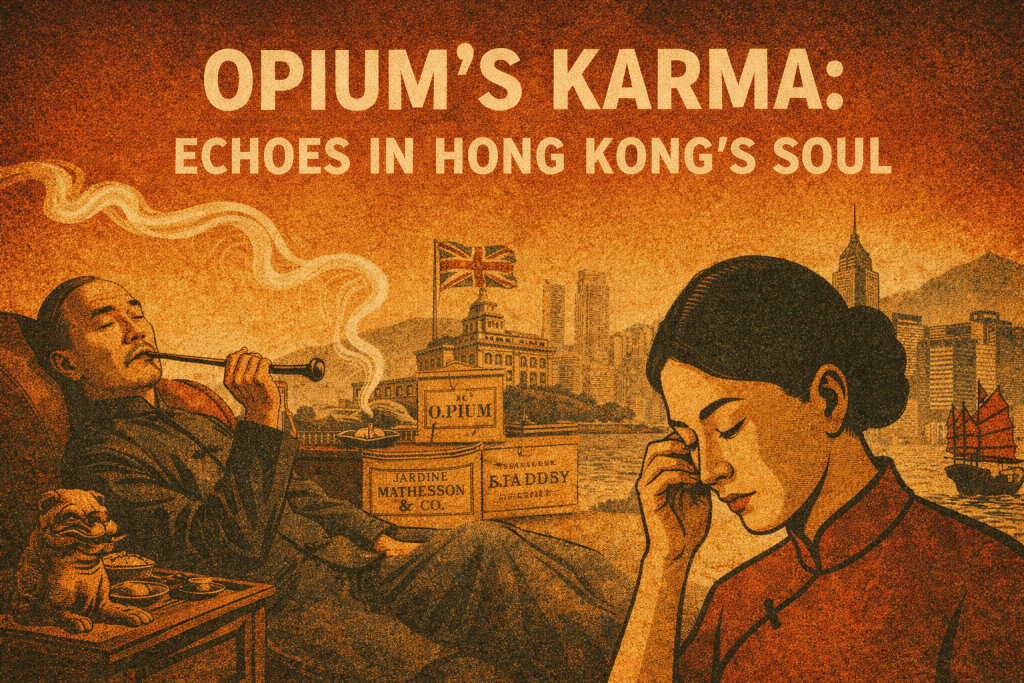
As a scholar and aspiring Hollywood cultural consultant and producer with an academic background in Western and Chinese Buddhist philosophy, I’ve long pondered how historical forces shape human suffering and impermanence. The two Opium Wars, alongside figures like Lord William Jardine and Sir Robert Hotung, left indelible cultural legacies on Hong Kong—the Fragrant Harbour—that resonate with Buddhist concepts of 苦 (fu2, suffering) and 無常 (mou4 soeng4, impermanence). These events transformed a modest fishing village into a bustling metropolis, blending Eastern resilience with Western ambition. Yet, they also sowed seeds of exploitation, reminding us, as in the 法句經 (faat3 geoi3 ging1, Dhammapada), that actions bear fruit like a wheel following the ox. Drawing from my studies, I see these legacies not as fixed destinies but as interdependent phenomena, urging mindfulness in navigating power’s illusions.
The First Opium War (1839–1842) stemmed from Britain’s opium trade imbalance with Qing China, leading to military intervention after Commissioner Lin Zexu’s destruction of opium stocks. The resulting Treaty of Nanjing ceded Hong Kong Island to Britain perpetually, opened treaty ports, and imposed indemnities, marking the start of colonial rule. The Second Opium War (1856–1860), involving Britain and France, ended with the Convention of Beijing, legalizing opium, ceding Kowloon, and expanding extraterritorial rights. These conflicts initiated China’s “century of humiliation,” weakening the Qing dynasty and fostering modernization drives.
Culturally, the wars embedded a hybrid identity in Hong Kong. British institutions—law, education, and architecture—overlaid Chinese traditions, creating a society of fusion and tension. Opium imports surged, exacerbating addiction while fueling economic growth in trade and finance. This duality mirrors Chinese Buddhist views of 輪迴 (leon4 wui4, samsara), where worldly pursuits entangle us in cycles of desire and pain. In Hong Kong, it bred a pragmatic, entrepreneurial ethos, yet also lingering resentment toward imperialism, influencing post-handover identity under “one country, two systems.” From a Western Buddhist perspective, akin to Jon Kabat-Zinn’s mindfulness teachings, this history invites reflection on how colonial legacies perpetuate division, urging compassionate awareness to transcend them.
Lord William Jardine epitomized the aggressive commerce driving these wars. A Scottish merchant, he co-founded Jardine Matheson in 1832, dominating opium smuggling along China’s coast. By the 1830s, his firm handled vast quantities, prompting Qing crackdowns. Jardine lobbied British officials, including Foreign Secretary Palmerston, supplying strategies for war and treaty terms that secured Hong Kong’s cession. His Manila-based operations gave Jardine Matheson a near-monopoly in opium distribution.
Jardine’s legacy in Hong Kong is provocative: his firm evolved into a powerhouse in shipping, banking, and real estate, symbolizing colonial capitalism’s triumph. However, it also represents ethical shadows, draining China’s economy and fueling widespread suffering—echoing Buddhist 業 (jip6, karma), where greed’s actions ripple across generations. In my philosophical lens, Jardine embodies the Western pursuit of material gain, contrasting Chinese 大乘 (daai6 sing4, Mahayana) ideals of 菩薩 (pou4 saat3, bodhisattva) compassion, where one alleviates others’ 苦 (fu2, suffering) rather than exacerbates it.
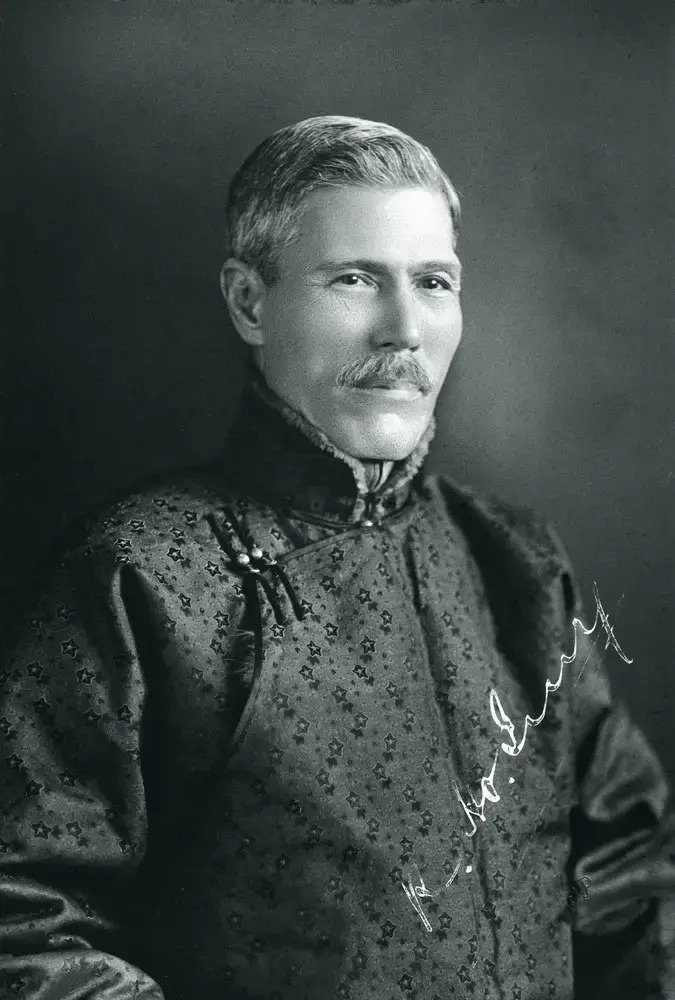
Sir Robert Hotung, born in 1862 to a Eurasian family, navigated this colonial landscape with shrewd adaptability. Starting as a customs clerk, he rose to become Jardine Matheson’s chief comprador in 1894, overseeing trade and investments like sugar refining. Amassing wealth through property and shares, he was dubbed Hong Kong’s richest man. Philanthropically, Hotung funded hospitals, schools, and clubs, including Tung Wah Hospital and the Chinese Recreation Club, while protesting discriminatory laws in 1895. Knighted in 1915, he bridged cultures, supporting Sun Yat-sen and establishing Buddhist institutions like Tung Lin Kok Yuen.
Hotung’s enduring impact, via his family foundation, highlights Eurasian integration and welfare advocacy. His life reflects Chinese Buddhist equanimity amid 無常 (mou4 soeng4, impermanence), turning hybrid identity into a force for good—much like Western Buddhist integrations of Stoic resilience with mindfulness.
These elements intertwine: The wars created colonial Hong Kong, Jardine built its economic pillars through opium, and Hotung softened its edges with philanthropy. Together, they forged a culture of resilience amid conflict, provoking questions about progress’s cost.
In my career as a Hollywood cultural consultant with deep ties to the Fragrant Harbour, I apply this history infused with Buddhist insights. I advise on authentic portrayals, ensuring scripts capture bicultural nuances without romanticizing exploitation. My background helps frame narratives around 苦 (fu2, suffering) and 無常 (mou4 soeng4, impermanence), enriching films on Asian diasporas or colonial eras. For instance, I consult on depicting opium’s human toll, drawing parallels to modern addictions through mindful storytelling.
Inspired stories could provoke: A drama following a Jardine-esque trader, exploring 業 (jip6, karma)’s retribution as empires crumble, blending action with philosophical introspection. Or a Hotung biopic, delving into his dual heritage and advocacy, questioning attachment to wealth via Buddhist detachment. War tales might center a family’s intergenerational 苦 (fu2, suffering), humanizing China’s humiliation for global viewers. These narratives challenge: Does prosperity justify suffering? Fact-driven yet bold, they bridge East-West philosophies, illuminating history’s transient scars.
Through my lens, Hong Kong’s legacies teach that all phenomena arise and pass—urging us to cultivate wisdom in their wake.