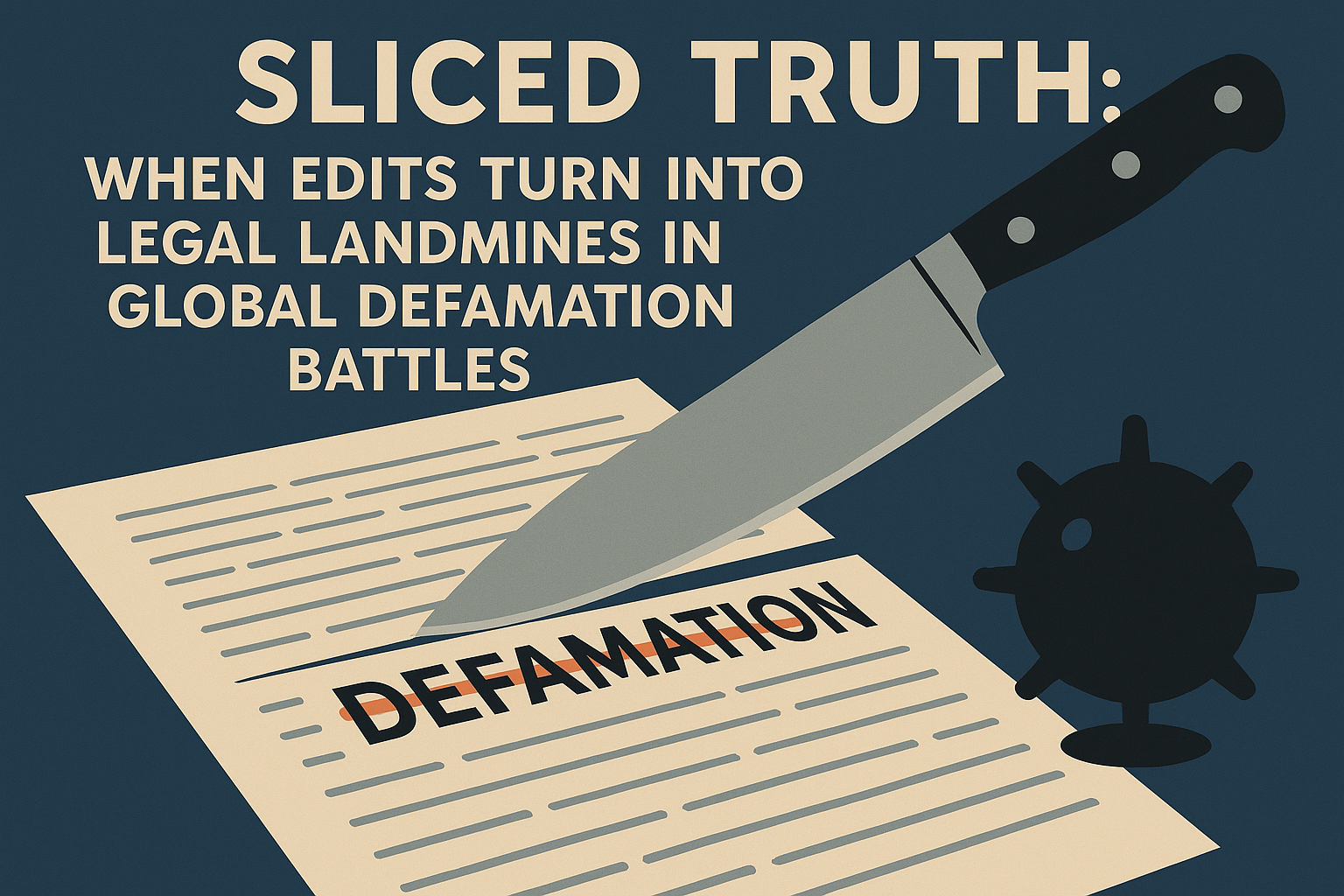
Sliced Truth: When Edits Turn into Legal Landmines in Global Defamation Battles
In the neon-lit underbelly of Tokyo’s Akihabara district, where anime conventions draw fans from across the globe, reputations can shatter faster than a dropped figurine. Imagine “Aki-chan,” a rising cosplay influencer with 500,000 followers, live-streaming her latest event. She’s mid-sentence, praising a sponsor’s booth as “the heart of otaku culture—pure, unfiltered joy,” when a rival YouTuber, “ShadowSlice,” uploads a “reaction” video. With surgical precision, ShadowSlice edits Aki-chan’s clip, splicing in footage from a chaotic crowd surge to make it sound like she incited the frenzy: “Pure, unfiltered joy… let’s rush the stage!” The video explodes, racking up millions of views. Sponsors drop Aki-chan, fans harass her online, and her brand deal vanishes. Was it fair game in the creator economy, or a deliberate defamation ripe for the courts? This fictional tale echoes real-world clashes, from Donald Trump’s showdown with the BBC to YouTuber Chris Broad’s viral editing feud, spotlighting how laws in Hong Kong, the US, and Japan draw lines between critique and character assassination.
Defamation isn’t just hurt feelings—it’s a legal minefield where false statements erode trust and livelihoods. Globally, it hinges on proving a published falsehood that harms reputation. But jurisdictions vary wildly, balancing free speech against personal dignity. Hong Kong, a common-law hub, treats defamation as libel (written/permanent) or slander (spoken/transient), actionable under the Defamation Ordinance (Cap. 21). A statement qualifies if it lowers the subject’s standing in “right-thinking” eyes, presuming falsity unless the defendant proves truth. Publication requires a third party, even a whisper in a Kowloon tea house. Defenses include fair comment on public matters or unintentional defamation via apology offers. No “actual malice” hurdle for private figures, but courts award damages for emotional distress, often HK$100,000–500,000 for mid-tier cases. In Aki-chan’s hypothetical, if ShadowSlice posted from Hong Kong, she’d sue for libel, demanding retraction and costs—provocative, as HK law favors plaintiffs, potentially chilling edgy content.
Across the Pacific, US states like Florida, California, and New York offer fragmented shields, influenced by the First Amendment’s speech protections. Florida, Trump’s chosen battleground against the BBC, demands a false, published statement causing harm, with fault at least negligent. Per se categories—like accusing crime or professional incompetence—presume damage, easing proof. Trump’s suit alleges the BBC’s Panorama edit falsely portrayed his January 6 speech as a violence call, splicing “walk down to the Capitol” with “fight like hell” to imply incitement. Aired in 2024, it sparked resignations and a $1 billion threat under Florida law, where media must retract promptly or face punitive damages. The BBC apologized but balked at payout, citing contextual opinion on public concern. Florida’s two-year statute limits suits, but its plaintiff-friendly tilt—eschewing presumed damages against media—makes it a defamation hotspot. For Aki-chan, if the edit hit Florida servers, she’d navigate negligence proof, but Trump’s playbook shows how public figures must evidence malice: knowing falsity or reckless disregard.
California flips the script with its robust anti-SLAPP statute, a bulwark against “Strategic Lawsuits Against Public Participation.” Here, defamation requires a false fact statement published to third parties, harming reputation, with private plaintiffs showing negligence and publics proving malice per New York Times v. Sullivan. But if the speech touches public issues—like Aki-chan’s “otaku riot” clip—defendants can move to strike, shifting burden to plaintiffs for prima facie evidence. Success nets fees; failure invites “SLAPPback” suits. Per se libels (e.g., business sabotage) skip damage proof, but California’s one-year limit and speech safeguards often dismiss cases early. Provocatively, it deters baseless claims, yet critics argue it shields bad actors in viral scandals.
New York, media’s mecca, demands precision: false, identified statements published to non-privileged third parties, defamatory on their face. Per se includes crime accusations or trade smears, presuming harm; otherwise, special damages must be pled with particularity under CPLR 3016. Public figures face the malice bar, but private ones need only fault. Defenses abound: truth, opinion, or privilege (absolute for courts, qualified for fair reports). One-year filing window applies, with social media counting as publication if viewed locally. In Aki-chan’s saga, a New York-based editor might invoke “fair comment” on convention chaos, but if malice shows—say, fabricated audio—damages could hit $1 million plus. NY’s defendant bias, honed by tabloid wars, underscores how edits can boomerang.
Japan, culturally averse to confrontation yet litigious online, criminalizes defamation under Penal Code Article 230-1: public fact allegations harming honor, punishable by up to three years’ imprisonment or ¥500,000 fine—even if true, unless public-interest proven. Civilly, Civil Code Article 709 yields tort damages for emotional harm (meiyo kanjo) or social standing (shakai meiyo), averaging ¥500,000–1 million, plus apologies under Article 723. No discovery eases burdens, but courts probe evidence strictly; online posts qualify if downloaded domestically. Insult (Article 231) adds lighter penalties for non-factual belittlement. For Aki-chan, Japan’s victim-friendly code might force ShadowSlice’s channel takedown, but its truth defense protects whistleblowers—straightforward, yet it chills discourse in harmony-obsessed society.
These laws collide in our Aki-chan tale: ShadowSlice, a Japanese expat in California, edits from a Florida VPN, uploads to a Hong Kong server, and promotes in New York. Jurisdiction? A nightmare. Trump’s BBC clash, filed in Florida despite UK origins, shows cross-border reach via availability. Inspired by that and Chris Broad’s controversy—where Metatron dissected deliberate cuts in a video portraying “Oriental Pearl” as a chaotic figure, exposing misleading juxtapositions that fueled xenophobic backlash—these cases provoke: In a spliced world, does intent matter more than impact? Broad’s edit, like the BBC’s, blurred lines, eroding trust without outright lies.
Editing isn’t malice per se, but when it fabricates narrative, laws bite. Platforms like YouTube amplify risks, demanding creators tread carefully. For victims, swift cease-and-desists or suits restore equity; for creators, transparency builds armor. As global media blurs borders, Aki-chan’s plight warns: One cut can scar forever. In this digital dojo, wield your blade wisely—or face the counterstrike.