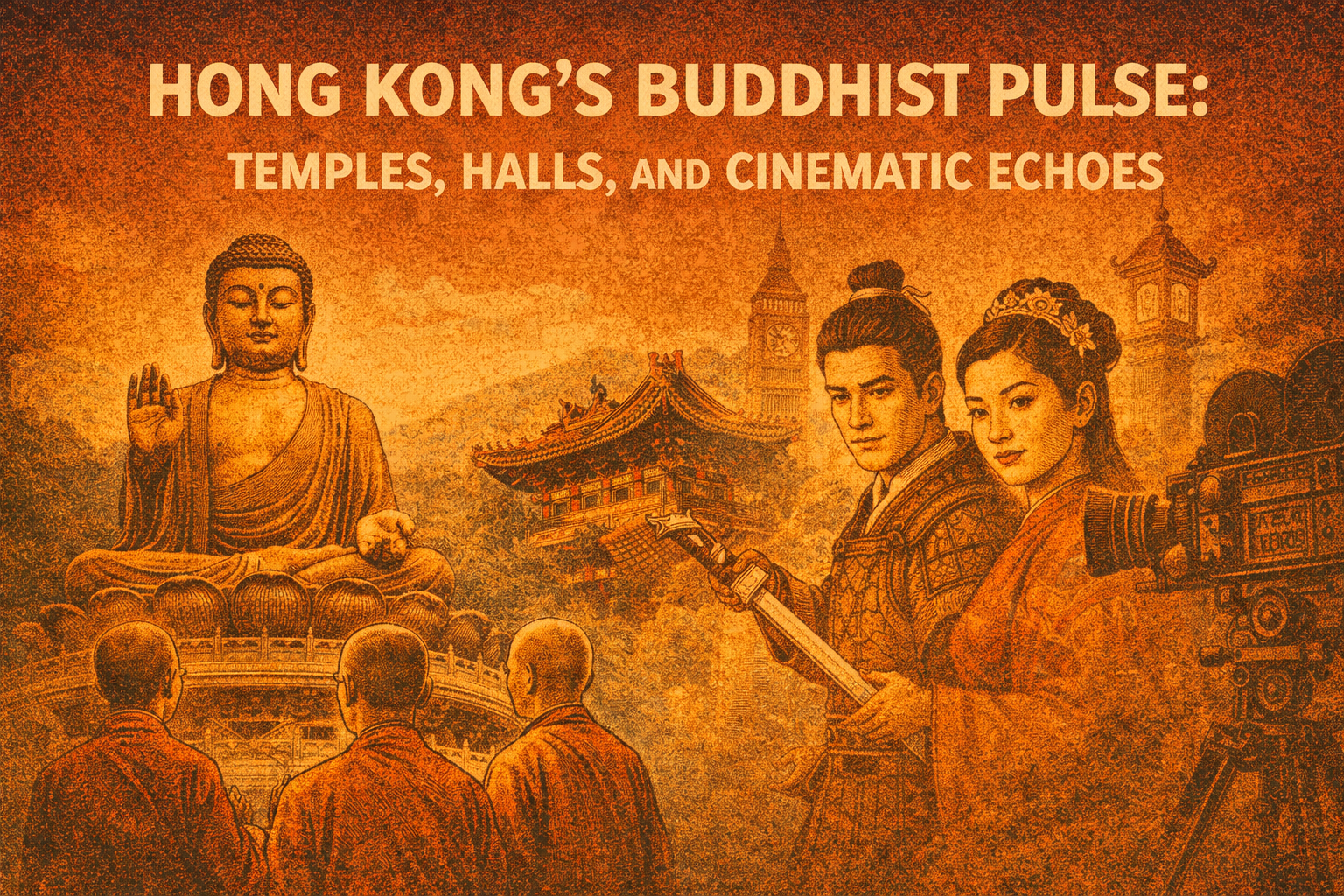
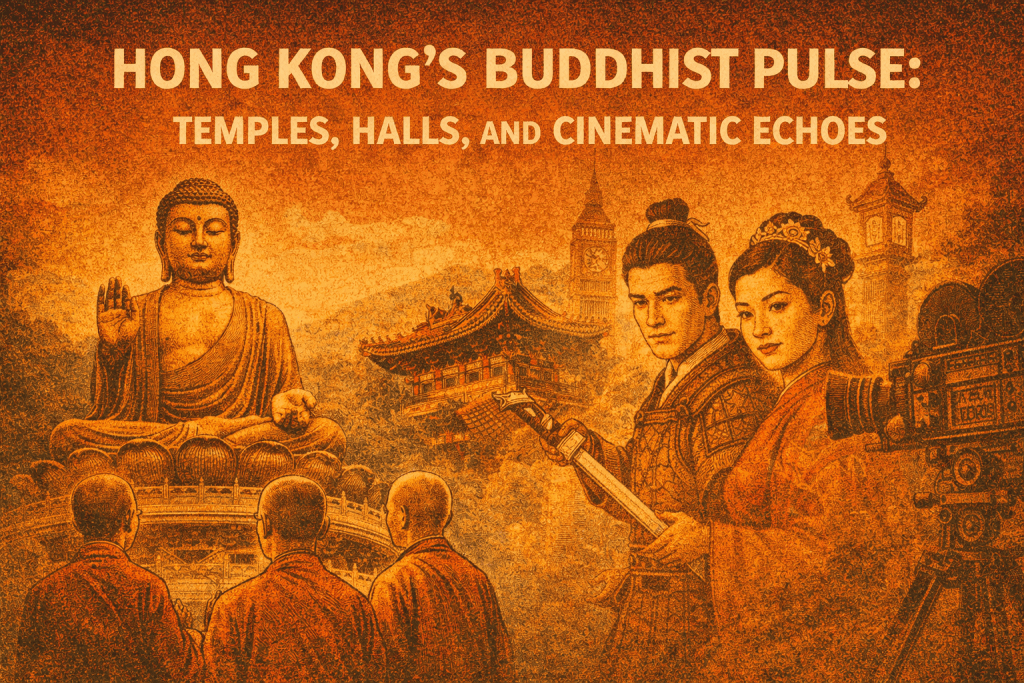
Hong Kong’s Buddhist Pulse: Temples, Halls, and Cinematic Echoes
As a scholar trained in Chinese Buddhist philosophy, particularly the Tiantai School (天台宗, tin1 toi4 zung1, Heavenly Terrace Sect), I navigate the intricate doctrines of the One Vehicle and the integration of all phenomena into a single mind. Yet, my personal practice anchors in a Chan Buddhist Hall (禪佛堂, sim4 fat6 tong4, Zen Buddha Hall) here in Hong Kong, where silent meditation cuts through the city’s relentless hum. This dual perspective—academic rigor fused with lived devotion—shapes my emerging role as a Hollywood cultural consultant specializing in Hong Kong culture. In this post, I dissect Hong Kong’s Chinese Buddhist landscape: its temples, rituals, and the elusive count of Buddha Halls (佛堂, fat6 tong4). I then pivot to narrative potentials, proposing stories that could captivate global audiences without romanticizing or distorting the tradition.
Hong Kong’s Chinese Buddhist culture emerges from a syncretic blend of Mahayana strains—Chan (禪宗, sim4 zung1, Zen Sect), Pure Land (淨土宗, zing6 tou2 zung1, Pure Land Sect), and echoes of Tiantai—infused with local Cantonese folk elements. Introduced during the Tang Dynasty via mainland migrants, it flourished under British colonial indifference, evolving into a resilient urban spirituality. Today, amid skyscrapers and neon, Buddhism offers refuge, emphasizing impermanence (無常, mou4 soeng4, no permanence) in a city of flux.
Key temples exemplify this. The Po Lin Monastery (寶蓮禪寺, bou2 lin4 zim1 zi2, Precious Lotus Zen Temple) on Lantau Island stands as a Chan stronghold. Founded in 1906, it houses the Tian Tan Buddha (天壇大佛, tin1 taan4 daai6 fat6, Heavenly Altar Great Buddha), a 34-meter bronze statue completed in 1993. Visitors climb 268 steps to its base, symbolizing ascent toward enlightenment. Rituals here include daily chanting of sutras (誦經, zung2 ging1, reciting scriptures), such as the Heart Sutra (心經, sam1 ging1, Heart Scripture), and vegetarian meals (素食, sou3 sik6, plain food) aligning with precepts against killing. On Buddha’s Birthday (佛誕, fat6 daan3, Buddha’s Birth), practitioners perform the bathing ritual (浴佛, yuk6 fat6, bathing the Buddha), pouring scented water over infant Buddha statues to purify karma.
In Sha Tin, the Ten Thousand Buddhas Monastery (萬佛寺, maan6 fat6 zi2, Ten Thousand Buddhas Temple), built from 1949 to 1957, features over 12,800 gilded Buddha statues lining a 430-step path. Its founder, Yuet Kai (月溪, jyut6 kai1, Moon Stream), a lay practitioner, mummified his body post-mortem, now displayed in gold. This site underscores Pure Land influences, with devotees reciting Amitabha’s name (念佛, nim6 fat6, chanting Buddha) for rebirth in the Western Paradise. Incense offerings (上香, soeng5 hoeng1, offering incense) dominate, creating aromatic clouds that ward off negative energies.
The Chi Lin Nunnery (志蓮淨苑, zi3 lin4 zing6 jyun2, Aspiration Lotus Pure Garden), established in 1934 and rebuilt in 2000 in Tang Dynasty style without nails, represents architectural purity. It promotes Tiantai meditation practices, like contemplating the threefold truth (三諦, saam1 dai3, three truths). Adjacent Nan Lian Garden (南蓮園池, naam4 lin4 jyun4 ci4, South Lotus Garden Pond) hosts tea ceremonies (茶道, caa4 dou6, tea way), blending mindfulness with Cantonese dim sum culture. Rituals include prostrations (頂禮, ding2 lai5, bowing in respect) before altars and group dharma talks (法會, faat3 wui2, dharma assembly).
Other sites, like Tsz Shan Monastery (慈山寺, ci4 saan1 zi2, Compassion Mountain Temple) in Tai Po, opened in 2015, focus on Guanyin (觀音, gun1 jam1, Contemplating Sounds) devotion, with massive statues encouraging compassion vows (發願, faat3 jyun6, making vows). Hong Kong’s Buddhism often merges with Taoism and Confucianism, as seen in mixed temples, but core practices remain: meditation (打坐, daa2 zo6, sitting in meditation), precept observance (持戒, ci4 gaai3, holding precepts), and merit-making through donations (布施, bou3 si1, giving).
Quantifying Buddha Halls (佛堂, fat6 tong4)—spaces dedicated to Buddha worship, from grand temples to home altars—proves challenging. Official estimates suggest over 600 temples in Hong Kong, many containing multiple halls. The Hong Kong Buddhist Association, founded in 1945, oversees numerous affiliated institutions, but precise counts of smaller 佛堂 vary. Some sources indicate thousands of registered and informal halls, reflecting Buddhism’s grassroots penetration into households and communities. This ubiquity underscores the tradition’s adaptability, not confined to monastic elites but embedded in daily life.
Transitioning to my Hollywood consultancy, I leverage this expertise to infuse authenticity into scripts. Hong Kong’s Buddhist culture inspires provocative narratives that probe human frailty without bias. Imagine a thriller where a Tiantai philosopher-turned-detective unravels a corporate scandal using the doctrine of mutual interpenetration (圓融, jyun4 jung4, perfect fusion), exposing how greed (貪, taam1, avarice) poisons society—echoing real HK financial pressures. Or a drama following a Chan practitioner in a crowded 佛堂, confronting urban alienation through koan riddles (公案, gung1 on3, public cases), challenging Western tropes of Buddhism as mere mindfulness apps.
More daringly, a horror story could draw from Hungry Ghost Festival rituals (盂蘭盆會, jyu4 laan4 pun4 wui2, Ullambana Assembly), where offerings to spirits (超度, ciu1 dou6, ferrying across) blur life and afterlife, set against Po Lin’s misty peaks. This highlights syncretism: Buddhist compassion meeting Cantonese ancestor veneration, provoking questions on cultural appropriation. For romance, envision lovers separated by reincarnation beliefs, reuniting at Chi Lin during a dharma assembly, exploring attachment (執著, zap1 zoek6, clinging) in a fast-paced city.
These tales could humanize Hong Kong beyond action flicks, portraying Buddhists as complex agents navigating modernity. As consultant, I’d ensure accurate depictions—like proper Cantonese chants or temple layouts—avoiding exoticism. In 800 words, this barely scratches the surface, but it invites deeper engagement with a culture that’s both ancient and urgently alive.