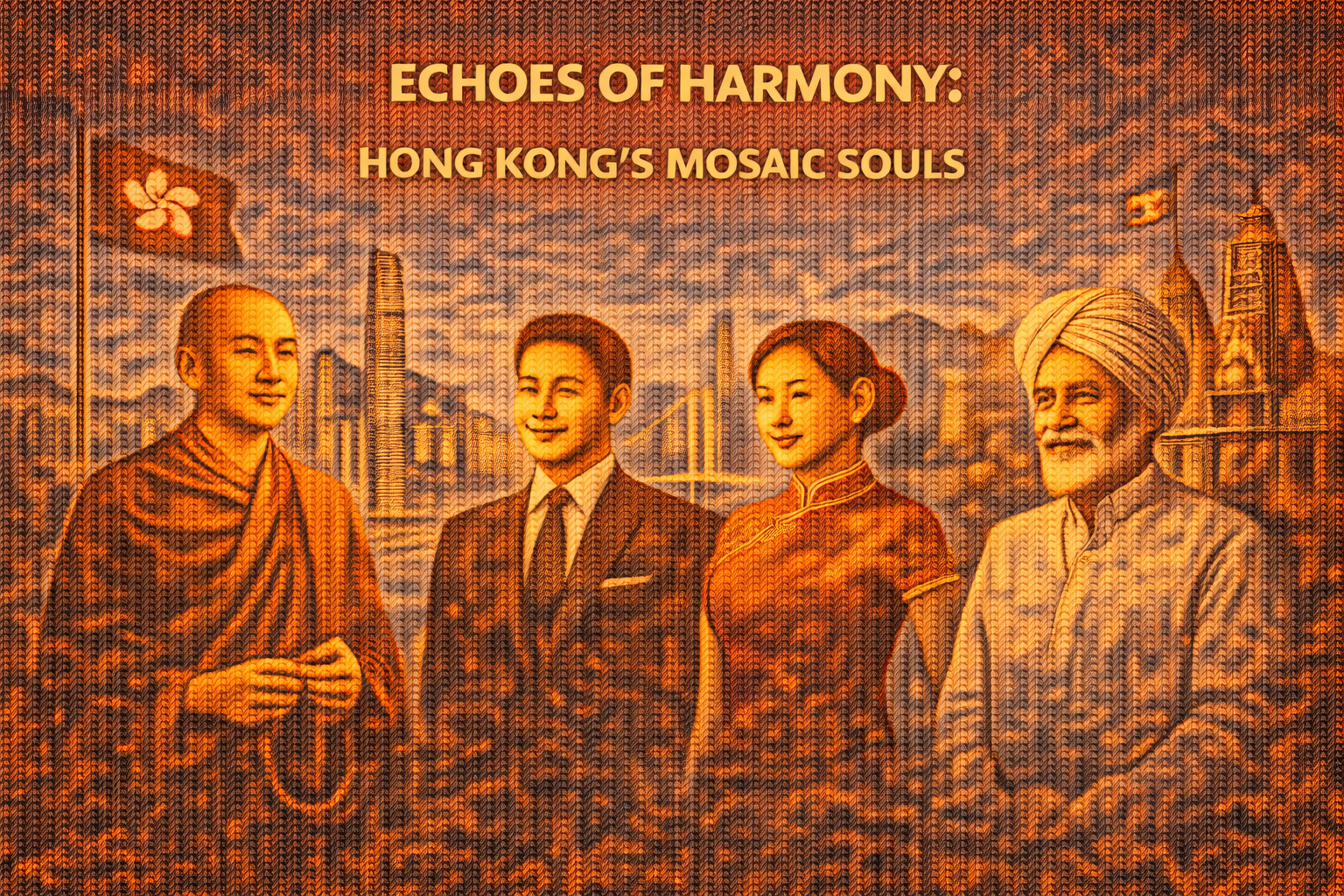
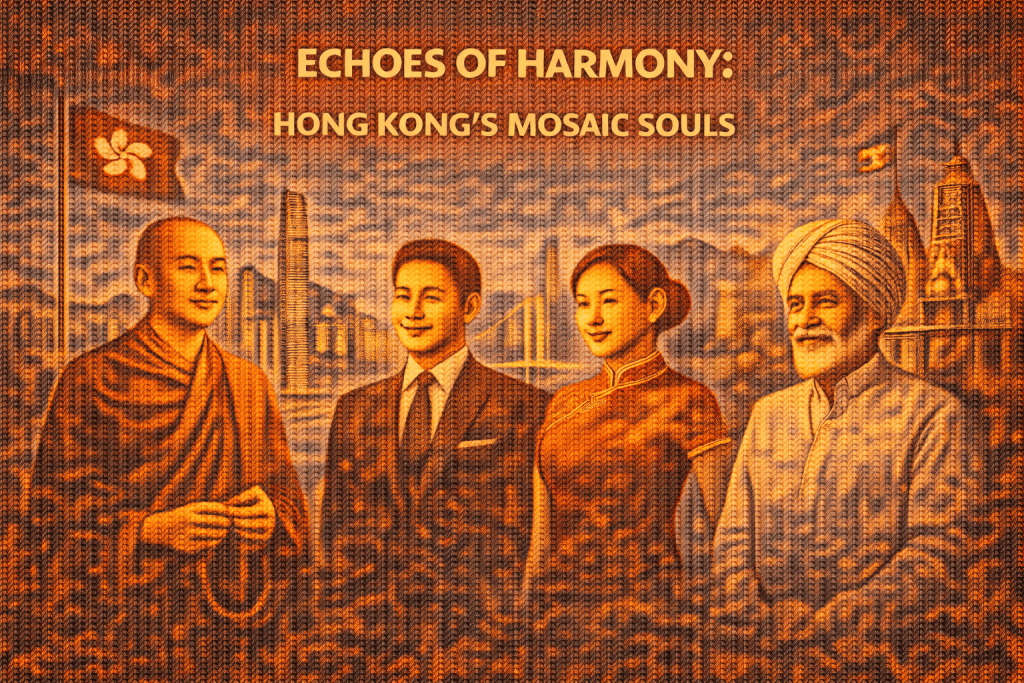
Echoes of Harmony: Hong Kong’s Mosaic Souls
Hey everyone, welcome back to this five-part series on Hong Kong society. I’m continuing our journey with a calm, reflective vibe—think of it as a gentle wave washing over the shore, drawing from Tiantai Buddhist philosophy where all phenomena interpenetrate in a vast, harmonious web. Paired with that introspective, narrative pull of a soulful melody, we’ll explore without judgment or slant, just clear-eyed observations that might stir deeper questions. This is Part 2: Post-Handover Shifts – Demographics in the SAR Era. Building on Part 1’s look at colonial non-Han families, here we examine racial and religious demographics since the July 1, 1997, Handover, zeroing in on five top Hong Kong families—evolving from or akin to those legacies—and their role in shaping culture, particularly among the upper class. We’ll touch on broader trends from census data and public reports, then suggest Hollywood integrations that fit the elite’s cultural nuance. Onward to Part 3 next, covering the National Security Law period.
Since the Handover, Hong Kong’s demographics have shifted subtly yet significantly, reflecting Tiantai’s principle of mutual containment—where old influences contain the new, and vice versa. Official figures from the Hong Kong Census and Statistics Department show the population at around 7.5 million by 2023, with ethnic Chinese (mostly Han) comprising over 91%, down slightly from 95% in 1996 due to immigration and expatriate influxes. Non-Chinese groups, including South Asians, Filipinos, Indonesians, and Westerners, make up the rest, with religious diversity spanning Buddhism (21%), Christianity (12%), Islam (4%), Hinduism (under 1%), and others, alongside a large non-religious segment. This mosaic has evolved under “one country, two systems,” blending mainland ties with global openness, though economic pressures and policies have influenced upper-class dynamics.
Focusing on five top families—selected from prominent post-Handover influencers with diverse roots, continuing Part 1’s thread—their stories illustrate how they’ve molded elite culture. These aren’t ranked; they’re exemplars from business annals and societal records.
First, the Kadoorie family, maintaining their Iraqi Jewish heritage, have expanded CLP Holdings into renewable energy, aligning with global sustainability. Post-1997, they’ve supported interfaith dialogues through philanthropy, like funding youth programs that blend Jewish ethics with local Buddhism. In upper-class circles, this fosters a Tiantai-like harmony, where diverse faiths intermingle at charity galas, shaping a cosmopolitan elite that values quiet resilience over ostentation.
The Hotung descendants, with Eurasian ties, have diversified into finance and real estate, with figures like Eric Hotung advocating for cultural preservation. Since the Handover, their mixed heritage has promoted inclusivity, sponsoring arts festivals that highlight hybrid identities. Among the upper class, this has softened racial divides, encouraging intermarriages and clubs where Tiantai’s non-duality shines—East and West as one, influencing a more fluid social hierarchy.
The Harilela family, upholding Sindhi Hindu traditions, grew their hospitality empire amid tourism booms, establishing the first Hindu temple in Happy Valley. Their post-Handover philanthropy includes disaster relief, infusing elite networks with communal dharma. This shapes upper-class culture by integrating spiritual retreats into business retreats, echoing Tiantai’s interconnected flux—prosperity as shared karma, evident in exclusive events blending yoga with high finance.
The Ruttonjee lineage, Parsi Zoroastrians, continued healthcare legacies through the Ruttonjee Hospital expansions, adapting to SAR health policies. Their emphasis on ethical innovation has influenced upper-class philanthropy, funding multicultural wellness centers. Objectively, this promotes a tolerant religious landscape, where Zoroastrian principles of balance align with Tiantai harmony, seen in elite circles prioritizing holistic well-being over pure profit.
Shifting to a Han-influenced but globally connected family, the Li family—led by Li Ka-shing of Cantonese roots—dominates through CK Hutchison, with post-Handover ventures in tech and ports. While not non-Han, their Protestant-tinged philanthropy (via Li Ka Shing Foundation) supports diverse education, bridging demographics. In the upper class, this molds a pragmatic culture, where Tiantai’s mutual possession manifests as cross-cultural investments, like funding Islamic finance hubs.
These families have collectively shaped post-Handover society by steering economic power toward inclusivity. Upper-class culture, per social studies from think tanks like the Hong Kong Institute for the Humanities and Social Sciences, reflects this: racial diversity in boardrooms has risen 20% since 1997, with religious pluralism evident in mixed-faith weddings and foundations. Provocatively, this challenges narratives of homogenization under Beijing’s influence—straightforward data shows sustained multiculturalism, though expatriate outflows post-2019 hint at tensions. Neutrally, their influence maintains Hong Kong as a global hub, where demographics evolve without erasure.
For Hollywood, envision a thriller like “John Wick” meets “Folklore”-era introspection: Keanu Reeves as a Kadoorie scion navigating corporate espionage, using Tiantai meditation to resolve conflicts, fitting the upper class’s understated power. Or a Swift-inspired rom-com about a Hotung heir’s identity quest, highlighting elite galas where diverse heritages clash and harmonize—authentic to Hong Kong’s mosaic, provoking views on unity without preachiness.
That’s Part 2. Reflect on these interwoven paths as we head to Part 3 on the NSL era.