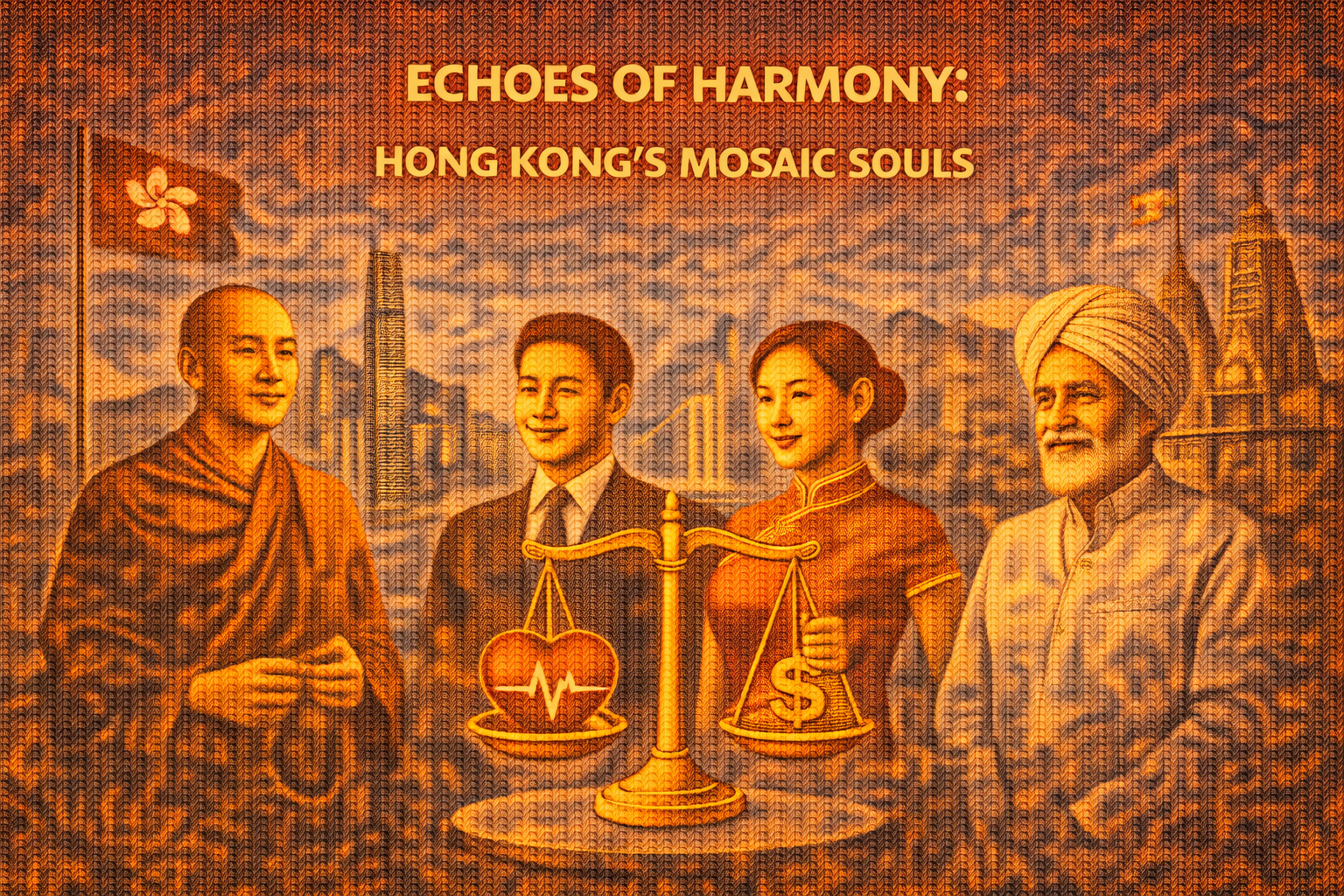
Echoes of Harmony: Hong Kong’s Mosaic Souls
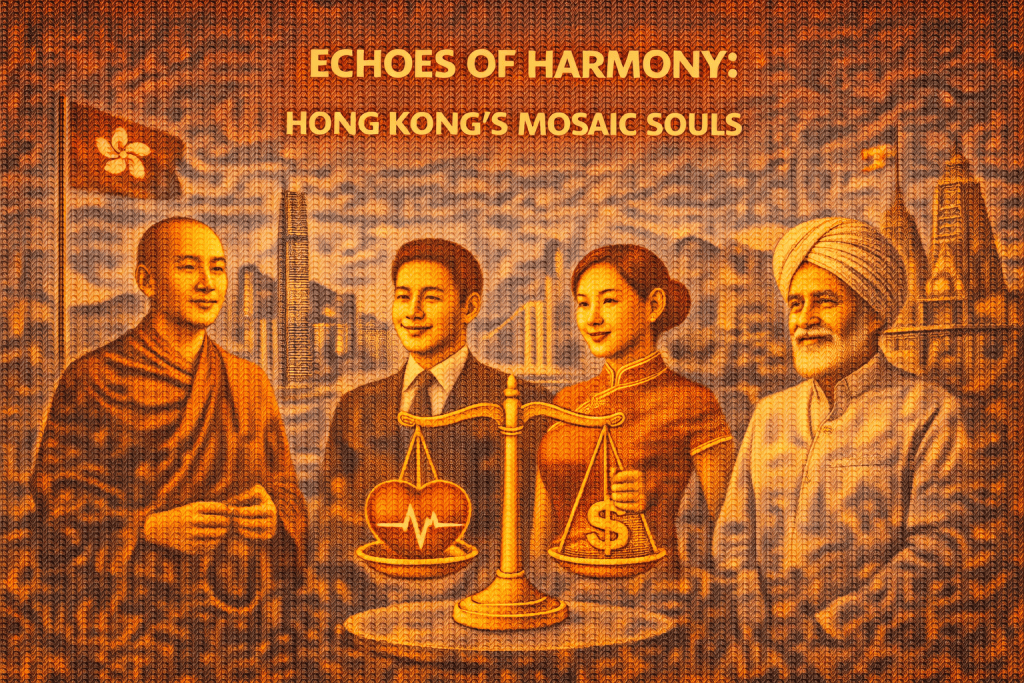
Hey there, I’m diving into this five-part series on Hong Kong society, exploring its racial and religious demographics through a lens that’s equal parts reflective and resonant. Think of it as a quiet conversation over tea, blending the serene wisdom of Tiantai Buddhism—where all things interconnect in harmonious flux—with the heartfelt storytelling of a late-night ballad. We’ll navigate the city’s evolving identity without bias, just straightforward observations that provoke thought. This is Part 1: The Colonial Tapestry – Non-Han Legacies in British Hong Kong. Future parts will cover post-Handover shifts (Part 2), the National Security Law era (Part 3), immigration laws (Part 4), and a concluding synthesis (Part 5). Let’s begin with the roots.
In the era of the British Crown Colony, Hong Kong wasn’t just a trading post; it was a crossroads of worlds, where diverse families wove themselves into the fabric of power. Tiantai philosophy reminds us that no single thread dominates the weave—everything interpenetrates, creating a balanced whole. So, let’s trace the histories of five prominent non-Han Chinese families who rose during this time, not as conquerors, but as integral parts of the colony’s elite. These aren’t exhaustive lists; they’re snapshots of influence, drawn from historical accounts and public records that highlight their roles in commerce, philanthropy, and society.
First, the Kadoorie family, of Iraqi Jewish descent, arrived in the late 19th century. Elly Kadoorie started with modest ventures in banking and rubber, but his sons built an empire through the Hongkong and Shanghai Hotels group and CLP Holdings, powering the city’s literal and figurative growth. Their story echoes Tiantai’s notion of mutual possession—wealth wasn’t hoarded but channeled into education and welfare, like the Kadoorie Agricultural Aid Association, which supported rural communities. In Hong Kong’s upper class, they embodied a quiet philanthropy that bridged East and West, fostering stability amid colonial flux.
Next, the Hotung family, with Eurasian roots tracing back to Sir Robert Hotung, born in 1862 to a Dutch-Jewish father and Chinese mother. As a comprador for Jardine Matheson, he amassed fortunes in shipping and real estate, becoming the first Chinese resident allowed in the Peak district. His influence shaped interracial dynamics, advocating for Eurasian rights and funding schools. This reflects Tiantai’s middle way—neither fully colonial nor indigenous, but a harmonious blend that elevated mixed-heritage voices in elite circles, challenging racial hierarchies without confrontation.
The Harilela family, from Sindhi Hindu origins, migrated in the early 20th century. Hari Harilela turned tailoring into a global empire, with the Harilela Group’s hotels and investments spanning continents. Their devout Hinduism infused business with ethical dealings, supporting temples and charities. In upper-class Hong Kong, they introduced a spiritual dimension to commerce, where prosperity served communal harmony, much like Tiantai’s emphasis on non-duality—profit and piety as one.
Then, the Ruttonjee family, Parsi Zoroastrians from India, established roots through Jehangir Ruttonjee’s ventures in trading and later the Ruttonjee Sanatorium for tuberculosis care. Their philanthropy, rooted in Zoroastrian values of good thoughts, words, and deeds, built hospitals and supported the underprivileged. This shaped elite society by promoting health as a shared good, aligning with Tiantai’s interconnected reality—individual success uplifting the collective.
Finally, the Keswick family, of Scottish Presbyterian heritage, controlled Jardine Matheson since the 19th century. Through opium trade origins evolving into diversified conglomerates, they influenced policy and economy. Their Protestant work ethic drove relentless innovation, yet they adapted to local customs, sponsoring arts and education. In the upper echelons, they represented enduring colonial ties, but with a Tiantai-like adaptation—evolving without erasure.
These families didn’t just accumulate wealth; they sculpted Hong Kong’s upper class into a multicultural vanguard. Pre-Handover, non-Han elites comprised about 10-15% of the top strata, per historical business registries, blending British governance with Asian resilience. They shaped society through exclusive clubs like the Hong Kong Jockey Club, where racial barriers softened over time, and through intermarriages that blurred lines. Religiously, this era saw a mosaic: Judaism, Hinduism, Zoroastrianism, Christianity, and Islam coexisting with Buddhism and Taoism, fostering a tolerant elite culture. Tiantai’s harmony is evident here—diversity as strength, not division.
Provocatively, this history challenges monolithic views of Hong Kong as purely Chinese. Objectively, these families’ legacies persist in boardrooms and foundations, influencing policy subtly. Yet, it’s straightforward: their rise was enabled by colonial structures, but their impact democratized opportunity, albeit unevenly.
Now, imagine weaving this into Hollywood projects. A film like a modern “Crazy Rich Asians” sequel could spotlight these families’ descendants in high-society intrigues, emphasizing cultural fits—lavish Peak galas where Tiantai-inspired mindfulness retreats mix with Swift-like confessional narratives of identity. Or a biopic series: Keanu Reeves as a Kadoorie heir, channeling Buddhist calm amid corporate storms, highlighting how such stories resonate with Hong Kong’s upper class, where heritage fuels quiet power plays. This isn’t exoticism; it’s authentic portrayal of interconnected lives, provoking audiences to see harmony in diversity.
Stay tuned for Part 2, where we’ll explore post-1997 shifts. Until then, reflect on how past threads weave our present.