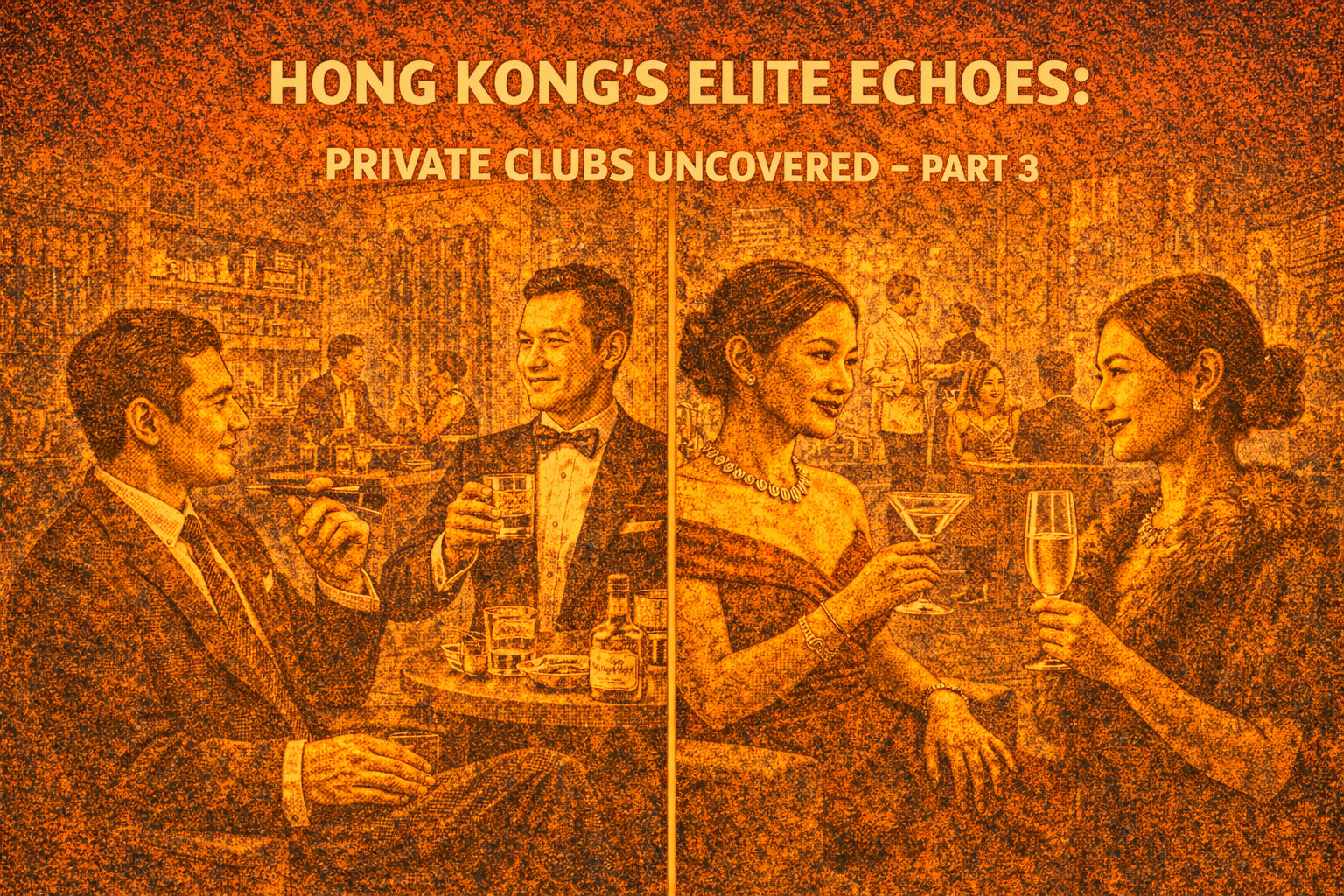

Hong Kong’s Elite Echoes: Private Clubs Uncovered – Part 3
As I delve deeper into Hong Kong’s labyrinth of private clubs in this series, I turn my attention to two institutions that embody the city’s layered colonial past and enduring social hierarchies. The Victoria Recreation Club and Club Lusitano stand as testaments to how sporting pursuits and ethnic affiliations have long served as gateways to exclusivity. Founded in the mid-19th century, these clubs highlight the intersections of recreation, community, and class in a city built on trade and imperialism. In this third installment, I examine their histories, roles, and cultural significance, all while maintaining a clear-eyed view of their place in Hong Kong’s upper echelons.
The Victoria Recreation Club (VRC) claims the distinction of being Hong Kong’s oldest private sporting and recreation club, with roots tracing back to 1849 when it was established as the Victoria Regatta Club along the shoreline of Hong Kong Harbour—now the site of City Hall. Its origins extend even further, to operations in Canton (modern-day Guangzhou) since 1832, making it a pioneer in organized leisure amid the Opium War era’s turmoil. Initially focused on regattas and yachting, the club evolved to encompass a broader array of athletic endeavors, particularly rowing and swimming, which were integral to the colonial elite’s lifestyle. These activities not only fostered physical prowess but also reinforced social bonds among expatriates and local notables navigating British rule.
Over the decades, the VRC has weathered significant challenges, including wars, typhoons, and urban redevelopment. It transitioned from a predominantly Portuguese membership base—reflecting the influx of Macanese and Portuguese migrants seeking opportunities in the burgeoning port—to a more diverse yet still selective community. Today, the club operates two clubhouses that underscore its commitment to natural splendor and seclusion. The Deep Water Bay Club House, a sturdy natural stone edifice on the south side of Island Road between Shouson Hill and Repulse Bay, provides direct waterfront access for aquatic sports. Meanwhile, the Emerald Bay Club House perches at the peak of the Sai Kung Peninsula, offering sweeping views across Sharp Island in Port Shelter, ideal for those seeking respite from the urban grind. Affiliated with bodies like the Sports Federation & Olympic Committee of Hong Kong and the Hong Kong Amateur Swimming Association, the VRC positions itself as the “father” of local sporting clubs, with over 170 years of history. Membership remains invitation-only, emphasizing family-oriented recreation and a shared appreciation for Hong Kong’s coastal heritage. This longevity provokes reflection: in a city of relentless progress, the VRC’s survival speaks to the enduring appeal of tradition-bound enclaves that cater to those with the means to escape public spaces.
Shifting focus to Club Lusitano, established on December 17, 1866, it emerges as Hong Kong’s oldest social club dedicated to the local Portuguese community. Born in a Neo-Classical building on Shelley Street in Mid-Levels, the club arose from the migration of Portuguese families from Macau, drawn by economic prospects in colonial Hong Kong. It quickly became a multifaceted hub, featuring a grand salon, theatre, library stocked with 10,000 volumes of Portuguese literature (known as the Bibliotheca Lusitana), billiard room, and even residential quarters. These facilities hosted theatrical performances, gala balls, and official ceremonies, fostering cultural preservation amid assimilation pressures.
The club’s evolution mirrors broader historical currents. In 1920, it relocated to Ice House Street, with the foundation stone laid by the Governors of Hong Kong and Macau, symbolizing its ties to Lusophone networks. Financed through community loans and debentures, it transformed into a men’s club with stringent rules, excelling in billiards—founding the Lusitano Billiards Association in 1912 and dominating interport competitions. Figures like Jose Pedro Braga, a journalist and the first Portuguese member of the Legislative Council in 1937, elevated its prestige. During World War II, leveraging Portugal’s neutrality, Club Lusitano served as a refuge under Japanese occupation, aiding the community and even housing anti-aircraft units until the British surrender. Post-war, it rebuilt amid emigration waves, expanding membership to include women and returning Macanese by the late 20th century. The current 27-storey building, completed in 2002 after designs by architect Gustavo da Roza, occupies the top five floors, including the opulent Salaõ de Luis de Camões ballroom adorned with a map of Portuguese discoveries. With over 500 members today, the club sustains Lusitanian identity through language, cuisine, and events like the annual Lusitano Challenge Cup horse race, dating back to 1863. Awards such as the Ordem do Infante Dom Henrique in 1991 affirm its role in promoting Portuguese culture.
Both clubs, in their quiet persistence, represent Hong Kong’s upper-class strata—spaces where legacy, leisure, and lineage intersect. The VRC’s emphasis on sporting excellence and natural exclusivity appeals to families with generational ties to the city’s elite circles, while Club Lusitano’s cultural focus preserves a niche ethnic heritage within broader affluence. This duality challenges us to consider how such institutions perpetuate social divides, even as they adapt to modern demographics.
For Hollywood filmmakers eyeing Hong Kong’s multifaceted narrative, these settings offer rich potential. Imagine a thriller set in the VRC’s Deep Water Bay clubhouse, where upper-class protagonists convene amid ocean views to plot corporate takeovers or unravel colonial-era secrets—highlighting the club’s role as a sanctuary for the powerful, far removed from the masses. Similarly, Club Lusitano’s historic ballroom could backdrop a drama exploring identity and migration, with elite characters navigating post-handover tensions in candlelit galas, underscoring how these venues symbolize inherited privilege and cultural insulation. By incorporating such locales, directors could authentically depict Hong Kong’s stratified society, where access to these clubs signals not just wealth, but a continuum of imperial influence.
In wrapping this part, these clubs remind me that Hong Kong’s private spheres are as much about exclusion as they are about community. Stay tuned for Part 4, where I’ll explore the Hong Kong Golf Club and Royal Hong Kong Yacht Club— bastions of leisure that further illuminate the city’s elite landscape.